Why vincristine can damage nerves
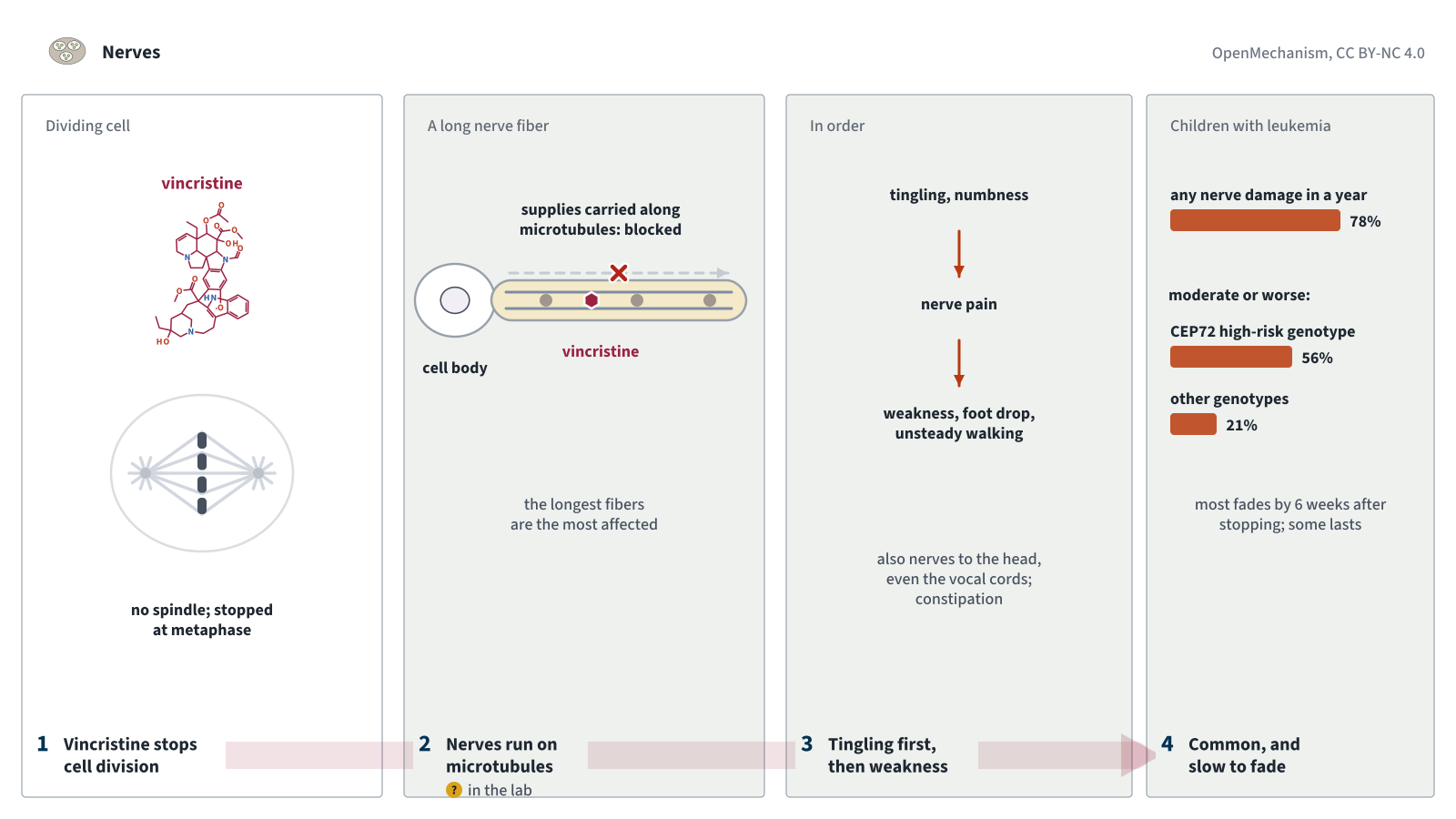
Vincristine stops dividing cancer cells by blocking microtubules. Long nerve fibers rely on microtubules to carry supplies along them, and jamming that transport may be how vincristine harms them: tingling and numbness come first, then pain and weakness, with constipation. Most of it fades within weeks of stopping, but some lasts.
- Kind
- Side effect
- Medicines
- Vincristine
- Sources
- 6
Step 2: in the lab
The LaPointe 2013 study, in squid nerve fibers in the lab, says: Our results suggest that (i) inhibition of microtubule-based fast axonal transport may be a significant contributor to neurotoxicity induced by microtubule-targeting drugs, and (ii) that individual microtubule-targeting drugs affect fast axonal transport through different mechanisms.
Clinical study: A study that followed 128 children with leukemia given vincristine for a year; it measured how often and how badly their nerves were affected, not what failed inside the nerve fibers: Of children who provided a full TNS©-PV score, 85/109 (78%) developed VIPN (TNS©-PV ≥4). … VIPN did not resolve in months 8-12 despite decreasing dose density.
Lavoie Smith EM et al., J Peripher Nerv Syst 2015 (PMID 25977177)
This study was picked with a literature search and is not yet checked by our reviewer.
For teachers: download this drawing.
Step by step
Vincristine stops cell division. Vincristine, used for acute leukemia and, with other medicines, for lymphomas, rhabdomyosarcoma, neuroblastoma and Wilms tumor, stops dividing cells at metaphase by blocking the of the dividing cell's spindle; how it works is still being studied.1
What the source says
“Vincristine Sulfate Injection is indicated in acute leukemia.”
Source 1“Vincristine Sulfate Injection has also been shown to be useful in combination with other oncolytic agents in Hodgkin's disease, non–Hodgkin's malignant lymphomas, rhabdomyosarcoma, neuroblastoma, and Wilms' tumor.”
Source 1“The mechanisms of action of vincristine sulfate remain under investigation.”
Source 1“The mechanism of action of vincristine sulfate has been related to the inhibition of microtubule formation in mitotic spindle, resulting in an arrest of dividing cells at the metaphase stage.”
Source 1Nerves run on microtubules. Nerve fibers move supplies over long distances between the cell body and the nerve endings along microtubules, and the longest fibers are the most affected. In squid nerve fibers in the lab, vincristine was among the strongest blockers of this transport, and in rats it thinned out the microtubules of nerve fibers; the authors suggest the transport failure may be a significant cause.2,3,4
What the source says
“The mechanisms underlying the neuronal damage are unknown, but may include disruption of fast axonal transport, an essential microtubule-based process that moves cellular components over long distances between neuronal cell bodies and nerve terminals.”
Source 2“Clinically, chemotherapy-induced peripheral neuropathy presents as deficits in sensory, motor, and autonomic function which develop in a glove and stocking distribution due to preferential effects on longer axons.”
Source 3“In vesicle motility assays, we found that all four drugs inhibited anterograde (conventional kinesin-dependent) fast axonal transport, with the potency being vincristine=ixabepilone>paclitaxel=eribulin.”
Source 2“There was a significant decrease in axonal microtubules, as well as microtubule disorganization, in myelinated fibers from vincristine-treated rats.”
Source 4“Our results suggest that (i) inhibition of microtubule-based fast axonal transport may be a significant contributor to neurotoxicity induced by microtubule-targeting drugs, and (ii) that individual microtubule-targeting drugs affect fast axonal transport through different mechanisms.”
Source 2Tingling first, then weakness. The nerve effects tend to come in order: first loss of feeling and tingling, then nerve pain, later trouble with movement; reflexes can be lost, the foot can drop, and walking and balance can suffer. Nerves to the head can be hit too, even both vocal cords, and constipation occurs.1
What the source says
“Frequently, there is a sequence to the development of neuromuscular side effects.”
Source 1“Initially, only sensory impairment and paresthesia may be encountered.”
Source 1“With continued treatment, neuritic pain and, later, motor difficulties may occur.”
Source 1“Loss of deep–tendon reflexes, foot drop, ataxia, and paralysis have been reported with continued administration.”
Source 1“Cranial nerve manifestations, such as isolated paresis and/or paralysis of muscles controlled by cranial motor nerves including potentially life–threatening bilateral vocal cord paralysis, may occur in the absence of motor impairment elsewhere;”
Source 1“When single, weekly doses of the drug are employed, the adverse reactions of leukopenia, neuritic pain, and constipation occur but are usually of short duration (ie., less than 7 days).”
Source 1Common, and slow to fade. In 109 children with leukemia followed for a year, 78% developed nerve damage, worse in older children, and it had not resolved by months 8 to 12. In children with a high-risk inherited CEP72 genotype, 56% had moderate or worse neuropathy, against 21% in the rest. Most symptoms go by about six weeks after stopping, but some last, and no medicine is known to reverse them.1,5,6
What the source says
“Of children who provided a full TNS©-PV score, 85/109 (78%) developed VIPN (TNS©-PV ≥4).”
Source 5“VIPN did not resolve in months 8-12 despite decreasing dose density.”
Source 5“VIPN was worse in older children.”
Source 5“Among patients with the high-risk CEP72 genotype (TT at rs924607), 28 of 50 (56%; 95% CI, 41.2%-70.0%) developed at least 1 episode of grade 2 to 4 neuropathy, a higher rate than in patients with the CEP72 CC or CT genotypes (58/271 patients [21.4%; 95% CI, 16.9%-26.7%]; P = 2.4×10(-6)).”
Source 6“Although most such symptoms usually disappear by about the sixth week after discontinuance of treatment, some neuromuscular difficulties may persist for prolonged periods in some patients.”
Source 1“There have been no reports of any agent that can reverse the neuromuscular manifestations that may accompany therapy with vincristine sulfate.”
Source 1
See also
Medicine pages: vincristine.
Other side effects (cancer): why bleomycin can scar the lungs, why CAR T cells can cause cytokine release syndrome, why checkpoint inhibitors can inflame healthy organs, why cisplatin can harm hearing, why cisplatin can harm the kidneys, why cyclophosphamide can make the bladder bleed, why doxorubicin can damage the heart, why rituximab can bring hepatitis B back, why trastuzumab can weaken the heart and all 65 side effects.
Conditions: acute lymphoblastic leukemia, Hodgkin lymphoma, B-cell lymphomas and neuroblastoma.
Sources
- 1Vincristine sulfate injection: FDA labelBoxed Warning; Indications and Usage; Clinical Pharmacology; Adverse Reactions. Saved copy
- 2Effects of eribulin, vincristine, paclitaxel and ixabepilone on fast axonal transport and kinesin-1 driven microtubule gliding: implications for chemotherapy-induced peripheral neuropathyLaPointe NE et al. Neurotoxicology 2013 (abstract). Saved copy
- 3Pathophysiology of Chemotherapy-Induced Peripheral NeuropathyStarobova H, Vetter I. Front Mol Neurosci 2017 (abstract). Saved copy
- 4Damage to the cytoskeleton of large diameter sensory neurons and myelinated axons in vincristine-induced painful peripheral neuropathy in the ratTopp KS et al. J Comp Neurol 2000 (abstract). Saved copy
- 5Patterns and severity of vincristine-induced peripheral neuropathy in children with acute lymphoblastic leukemiaLavoie Smith EM et al. J Peripher Nerv Syst 2015 (abstract). Saved copy
- 6Association of an inherited genetic variant with vincristine-related peripheral neuropathy in children with acute lymphoblastic leukemiaDiouf B et al. JAMA 2015 (abstract). Saved copy
Notes and limits
- Vincristine is for the vein only: given into the spinal fluid it is usually fatal.1
- The CEP72 finding comes from a preliminary study.6
Notes that apply to every page are on How to read a page.
Spotted a mistake? Report an error (hello@openmechanism.com). Since launch, every published error we fix is listed on the corrections page.
Cite this page
Tran D. Why vincristine can damage nerves [Internet]. OpenMechanism; 2026 [updated 2026 Oct 21; cited 2026 Oct 21]. Available from: https://openmechanism.com/explained/vincristine-and-nerves