Why bleomycin can scar the lungs
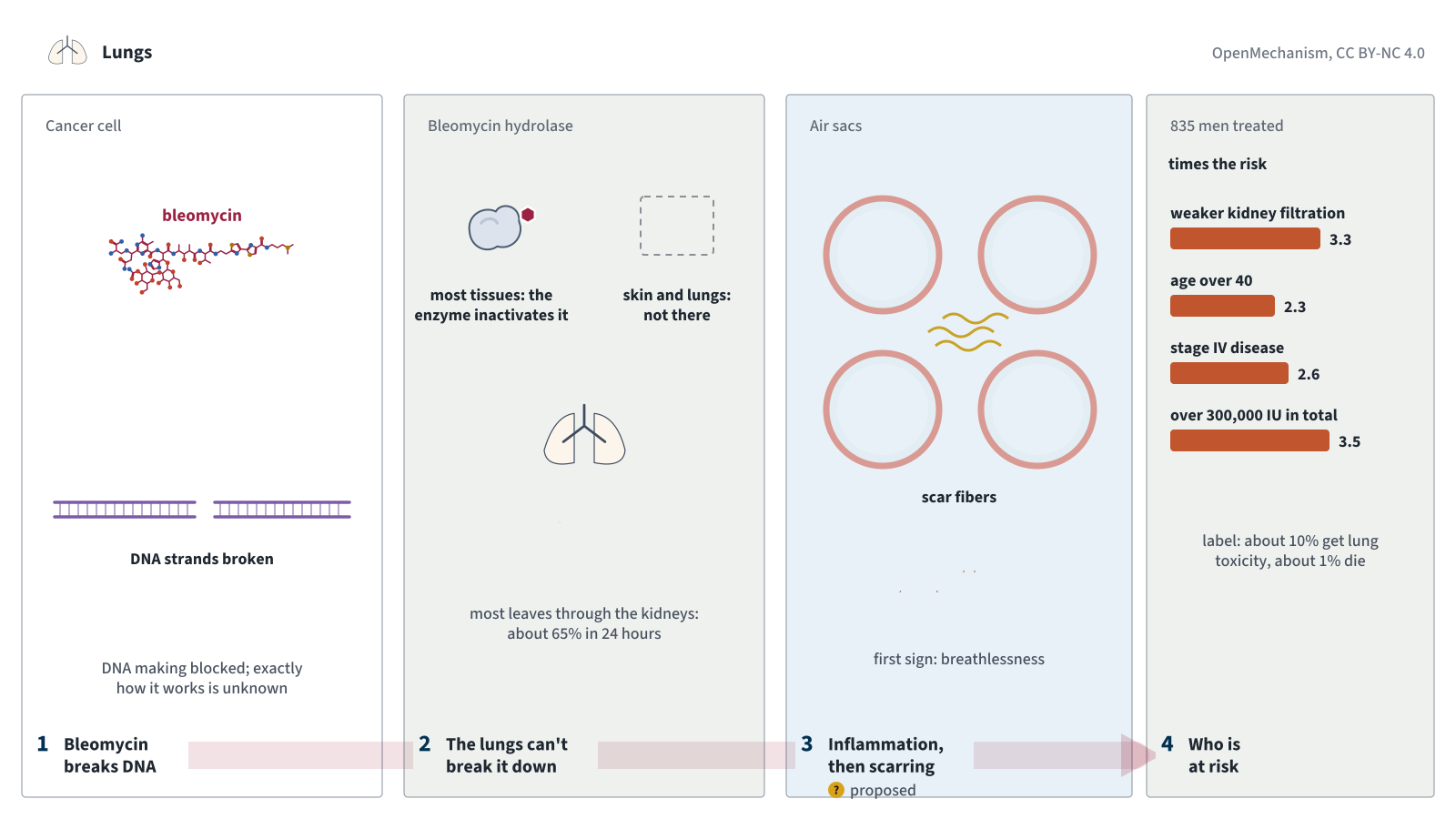
Bleomycin breaks the DNA of cancer cells. Most tissues destroy it with an enzyme, bleomycin hydrolase, but the skin and lungs are the exception, and both are where bleomycin does harm. About 10% of people get lung toxicity, usually pneumonitis that can progress to scarring, and about 1% die; older age, higher doses and weak kidneys raise the risk.
- Kind
- Side effect
- Medicines
- Bleomycin
- Sources
- 3
Step 3: proposed
The Sleijfer 2001 review says: The central event in the development of BIP is endothelial damage of the lung vasculature due to bleomycin-induced cytokines and free radicals.
Source 2: Bleomycin-induced pneumonitis, Sleijfer S. Chest 2001 (abstract)
Clinical study: A study of 835 men treated with bleomycin for germ-cell tumors; it measured who got lung toxicity, and did not test how the lung is damaged: Fifty-seven (6.8%) patients had BPT, ranging from X-ray/CT (computed tomography) changes to dyspnoea. … There were eight deaths (1% of patients treated) directly attributed to BPT.
O'Sullivan JM et al., Ann Oncol 2003 (PMID 12488299)
This study was picked with a literature search and is not yet checked by our reviewer.
For teachers: download this drawing.
Step by step
Bleomycin breaks DNA. Bleomycin, used for squamous cell cancers of the head and neck and other sites, lymphomas and testicular cancer, mainly stops cells making and breaks DNA strands, though exactly how it works is not known.1
What the source says
“Squamous Cell Carcinoma: Head and neck (including mouth, tongue, tonsil, nasopharynx, oropharynx, sinus, palate, lip, buccal mucosa, gingivae, epiglottis, skin, larynx), penis, cervix, and vulva.”
Source 1“Lymphomas: Hodgkin's disease, non-Hodgkin's lymphoma.”
Source 1“Testicular Carcinoma: Embryonal cell, choriocarcinoma, and teratocarcinoma.”
Source 1“Although the exact mechanism of action of bleomycin is unknown, available evidence indicates that the main mode of action is the inhibition of DNA synthesis with some evidence of lesser inhibition of RNA and protein synthesis.”
Source 1“Bleomycin is known to cause single, and to a lesser extent, double-stranded breaks in DNA.”
Source 1The lungs can't break it down. Bleomycin is inactivated by an enzyme, bleomycin hydrolase, found widely in normal tissues except the skin and lungs, the two places bleomycin harms. Most of it leaves through the kidneys, about 65% in the urine within 24 hours.1
What the source says
“Bleomycin is inactivated by a cytosolic cysteine proteinase enzyme, bleomycin hydrolase.”
Source 1“The enzyme is widely distributed in normal tissues with the exception of the skin and lungs, both targets of bleomycin toxicity.”
Source 1“The primary route of elimination is via the kidneys.”
Source 1“About 65% of the administered intravenous dose is excreted in urine within 24 hours.”
Source 1Inflammation, then scarring. In the lungs, and free radicals set off by bleomycin damage the lining of the lung's blood vessels, the central event in a review's account. The result is pneumonitis, which can progress to , scarring of the lung; the first symptom is breathlessness.1,2
What the source says
“The central event in the development of BIP is endothelial damage of the lung vasculature due to bleomycin-induced cytokines and free radicals.”
Source 2“Ultimately, BIP can progress in lung fibrosis.”
Source 2“The most frequent presentation is pneumonitis occasionally progressing to pulmonary fibrosis.”
Source 1“The earliest symptom associated with bleomycin pulmonary toxicity is dyspnea.”
Source 1Who is at risk. Lung toxicity comes in about 10% of people treated and about 1% die of the fibrosis. It is more common over 70 and above 400 units in total, yet unpredictable, seen in young people on low doses. In 835 men treated for testicular cancer, 6.8% had it; weaker kidney filtration, age over 40, advanced disease and higher total doses each raised the risk 2.3 to 3.5 times.1,3
What the source says
“The most serious side effects are pulmonary adverse reactions, occurring in approximately 10% of treated patients.”
Source 1“Approximately 1% of patients treated have died of pulmonary fibrosis.”
Source 1“Pulmonary toxicity is both dose and age related, being more common in patients over 70 years of age and in those receiving over 400 units total dose.”
Source 1“This toxicity, however, is unpredictable and has been seen in young patients receiving low doses.”
Source 1“From our prospectively collected testicular cancer research database, we reviewed 835 patients treated at the Royal Marsden NHS Trust (Sutton, UK) with bleomycin-containing regimens for germ-cell tumours”
Source 3“Fifty-seven (6.8%) patients had BPT, ranging from X-ray/CT (computed tomography) changes to dyspnoea.”
Source 3“On multivariate analysis, the factors independently predicting for increased risk of BPT were GFR <80 ml/min [hazard ratio (HR) 3.3], age >40 years (HR 2.3), stage IV disease at presentation (HR 2.6) and cumulative dose of bleomycin >300,000 IU (HR 3.5).”
Source 3
See also
Medicine pages: bleomycin.
Other side effects (cancer): why CAR T cells can cause cytokine release syndrome, why checkpoint inhibitors can inflame healthy organs, why cisplatin can harm hearing, why cisplatin can harm the kidneys, why cyclophosphamide can make the bladder bleed, why doxorubicin can damage the heart, why rituximab can bring hepatitis B back, why trastuzumab can weaken the heart, why vincristine can damage nerves and all 65 side effects.
Conditions: testicular cancer; Hodgkin lymphoma; head and neck cancer; and cervical cancer.
Sources
- 1Bleomycin for injection: FDA labelBoxed Warning; Indications and Usage; Clinical Pharmacology; Warnings; Precautions; Adverse Reactions. Saved copy
- 2Bleomycin-induced pneumonitisSleijfer S. Chest 2001 (abstract). Saved copy
- 3Predicting the risk of bleomycin lung toxicity in patients with germ-cell tumoursO'Sullivan JM et al. Ann Oncol 2003 (abstract). Saved copy
Notes and limits
- There is no proven treatment, though corticosteroids are widely used; people who survive almost always recover completely.2
- Supplemental oxygen has been suggested as a risk factor too. Some reports suggested a higher risk with G-CSF (filgrastim), but randomized studies have not shown it.1,3
Notes that apply to every page are on How to read a page.
Spotted a mistake? Report an error (hello@openmechanism.com). Since launch, every published error we fix is listed on the corrections page.
Cite this page
Tran D. Why bleomycin can scar the lungs [Internet]. OpenMechanism; 2026 [updated 2026 Oct 21; cited 2026 Oct 21]. Available from: https://openmechanism.com/explained/bleomycin-and-the-lungs