Lovastatin
Lovastatin is converted in the body into its active form, which blocks , an early and rate-limiting step in making cholesterol. It lowers raised cholesterol, possibly through both less and more .
- Acts on
- HMG-CoA reductase
- Where
- Liver cells
- Medicine type
- Small molecule
- Used for
- Heart & circulation
- Drug class
- Statins
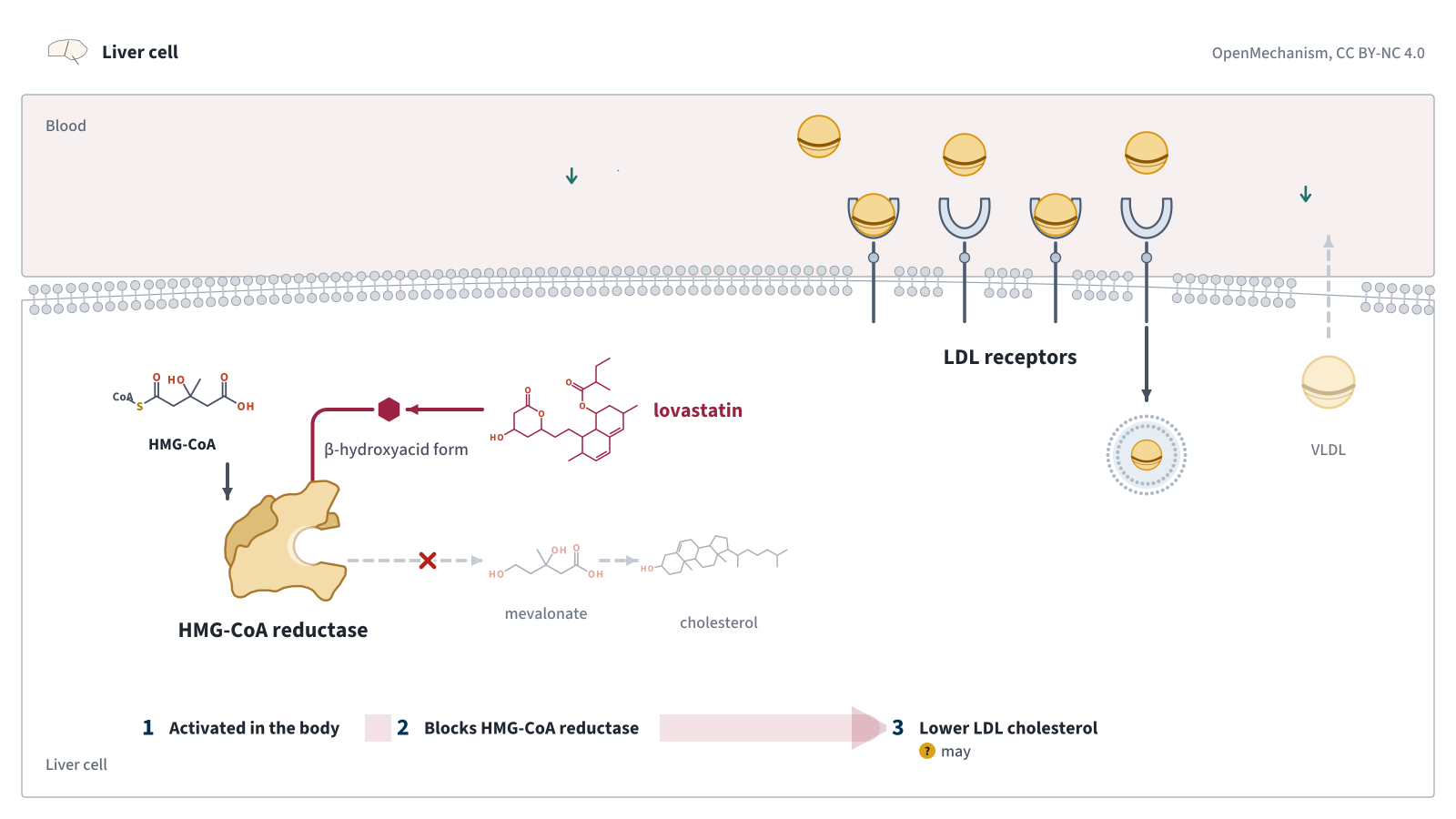
Step 3: may
The lovastatin tablets label says: The mechanism of the LDL-lowering effect of lovastatin may involve both reduction of VLDL-C concentration, and induction of the LDL receptor, leading to reduced production and / or increased catabolism of LDL-C.
Source 1: Lovastatin tablets: FDA label, Clinical Pharmacology; Pharmacokinetics
Clinical study: In a randomized trial against placebo (AFCAPS/TexCAPS) in 6605 people without heart disease, followed for an average of 5.2 years; the trial measured first major coronary events, not how lovastatin lowers LDL: Lovastatin reduces the risk for the first acute major coronary event in men and women with average TC and LDL-C levels and below-average HDL-C levels.
Downs JR et al., JAMA 1998 (PMID 9613910)
This study was picked with a literature search and is not yet checked by our reviewer.
Key terms in this drawing (6)
- CoA
- Coenzyme A. Coenzyme A, the CoA in HMG-CoA, which stands for 3-hydroxy-3-methylglutaryl-coenzyme A.
- HMG-CoA
- 3-hydroxy-3-methylglutaryl coenzyme A. A building block the liver turns into mevalonate on the way to making cholesterol.
- HMG-CoA reductase
- 3-hydroxy-3-methylglutaryl-coenzyme A reductase. The enzyme that turns HMG-CoA into mevalonate, an early step in making cholesterol.
- LDL
- Low-density lipoprotein. Particles that carry cholesterol in the blood ('LDL cholesterol').
- LDL receptor
- Low-density lipoprotein receptor. A receptor on liver cells that takes LDL particles out of the blood.
- VLDL
- Very-low-density lipoprotein. Fat-carrying particles the liver releases into the blood. The lipoprotein that LDL is formed from.
How it works
Activated in the body. Lovastatin, an inactive lactone, is converted (hydrolyzed) after it is taken into its β-hydroxyacid form, a strong blocker of HMG-CoA reductase.1
Blocks HMG-CoA reductase. Lovastatin specifically blocks HMG-CoA reductase, which turns into mevalonate, an early and rate-limiting step in making cholesterol.1
Lower LDL cholesterol. Lovastatin lowers raised LDL cholesterol, and apolipoprotein B falls too. How it lowers LDL may involve both less VLDL, from which LDL is formed, and more LDL receptors: less LDL made and/or more LDL cleared.1
For teachers: download this drawing.
See also
Condition pages: heart attack and high LDL cholesterol.
Other statins: atorvastatin, pravastatin, rosuvastatin and simvastatin.
Explained: why statins can cause muscle problems.
Body system: heart, vessels & cholesterol.
Sources
- 1Lovastatin tablets: FDA labelClinical Pharmacology; Pharmacokinetics
- 2ChEMBL CHEMBL503Target and action classification: HMG-CoA reductase inhibitor
- 3
Also used for the drawing
The HMG-CoA reductase outline is traced from the crystal structure below.
- 4Human HMG-CoA reductase (catalytic portion) with atorvastatinPDB 1HWK; Istvan, E.S., Deisenhofer, J. Science 2001; 292:1160-1164
Spotted a mistake? Report an error (hello@openmechanism.com). Since launch, every published error we fix is listed on the corrections page.
Notes and limits
- A schematic teaching drawing: not to scale, not exact structures, binding poses or a complete pathway, and not a guide to dosing, treatment or how a person will respond.
- The label says the mechanism of the LDL-lowering effect of lovastatin may involve both reduction of VLDL-C concentration and induction of the LDL receptor.
All recorded limits are on the evidence page, and notes that apply to every page are on How to read a page. Version 1.0.0, not yet medically reviewed.
Cite this page
Tran D. Lovastatin [Internet]. OpenMechanism; 2026 [updated 2026 Oct 11; cited 2026 Oct 11]. Available from: https://openmechanism.com/medicines/lovastatin