Atorvastatin
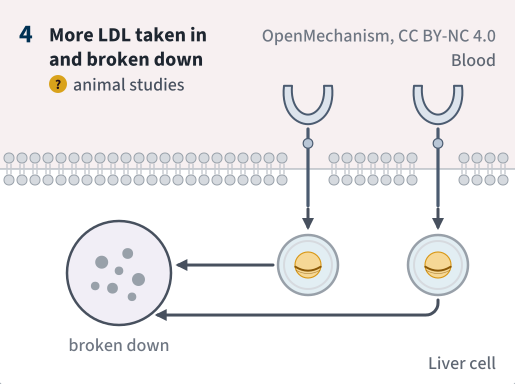
Atorvastatin blocks , an enzyme needed to make cholesterol. In animal studies described in the label, liver cells then carry more , which take up more cholesterol from the blood.
- Acts on
- HMG-CoA reductase
- Where
- Liver cells
- Medicine type
- Small molecule
- Used for
- Heart & circulation
- Drug class
- Statins
Also called Lipitor.
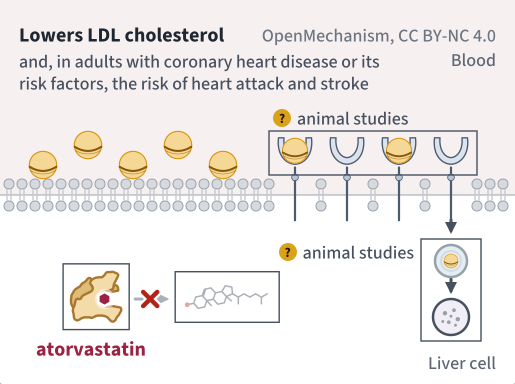
Key terms in this drawing (5)
- CoA
- Coenzyme A. Coenzyme A, the CoA in HMG-CoA, which stands for 3-hydroxy-3-methylglutaryl-coenzyme A.
- HMG-CoA
- 3-hydroxy-3-methylglutaryl coenzyme A. A building block the liver turns into mevalonate on the way to making cholesterol.
- HMG-CoA reductase
- 3-hydroxy-3-methylglutaryl-coenzyme A reductase. The enzyme that turns HMG-CoA into mevalonate, an early step in making cholesterol.
- LDL
- Low-density lipoprotein. Particles that carry cholesterol in the blood ('LDL cholesterol').
- LDL receptor
- Low-density lipoprotein receptor. A receptor on liver cells that takes LDL particles out of the blood.
How it works
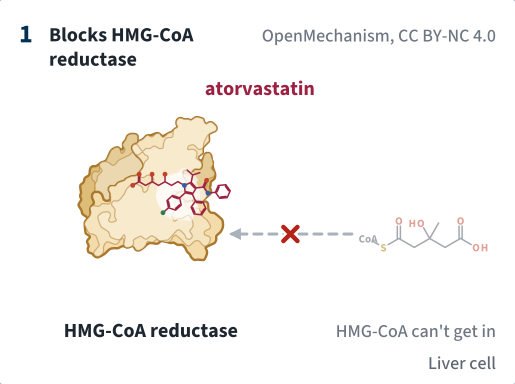
Blocks HMG-CoA reductase. Atorvastatin competitively inhibits HMG-CoA reductase, which converts to mevalonate.1
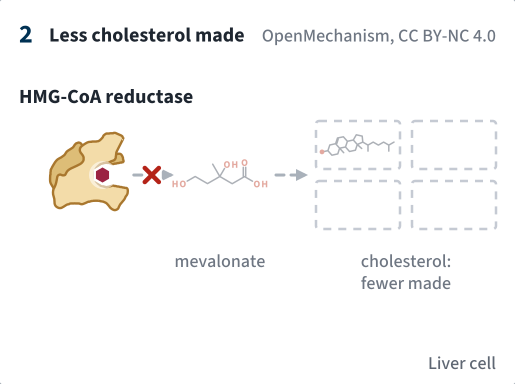
Less cholesterol made. Inhibition decreases the supply of mevalonate, a precursor used to produce cholesterol.1
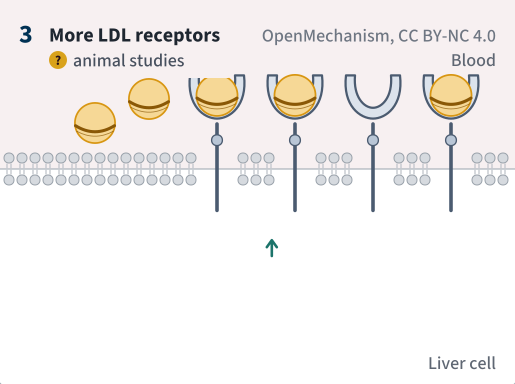
More LDL receptors. The label describes increased hepatic surface LDL receptor numbers in animal models.1
More LDL taken in and broken down. In the animal model described by the label, increased hepatic surface LDL receptor numbers enhance LDL uptake and catabolism.1
For teachers: download this drawing or build a slide deck.
The result and side effects
Alongside diet, atorvastatin is used to lower LDL cholesterol in adults, and in children 10 and older with inherited high cholesterol. It is also used to lower the risk of heart attack and stroke in adults with coronary heart disease or several risk factors for it.1 The numbers below come from the label's own trials, each against placebo.
The result
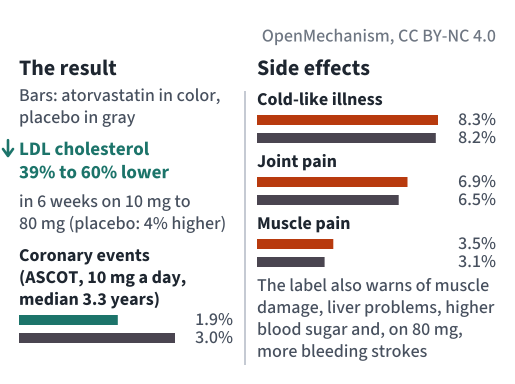
LDL cholesterol 39% to 60% lower. In two placebo-controlled trials in people with high cholesterol (hyperlipidemia), LDL cholesterol was on average 39% lower after 6 weeks on 10 mg and 60% lower on 80 mg; with placebo it was 4% higher.1
Fewer coronary events. In ASCOT, 10,305 adults with high blood pressure, no previous heart attack, total cholesterol of 251 mg/dL or less and at least three other risk factors took 10 mg a day or placebo and were followed for a median of 3.3 years: coronary events (death from coronary heart disease or a non-fatal heart attack) happened to 1.9% with atorvastatin and 3.0% with placebo.1
Side effects
In the label's 17 placebo-controlled trials (8,755 people took atorvastatin and 7,311 placebo), these side effects were reported in at least 2% of people taking atorvastatin and more often than with placebo.1
| Side effect | Atorvastatin, any dose | Placebo |
|---|---|---|
| Cold-like illness (nasopharyngitis) | 8.3% | 8.2% |
| Joint pain (arthralgia) | 6.9% | 6.5% |
| Diarrhea | 6.8% | 6.3% |
| Pain in the arms or legs | 6.0% | 5.9% |
| Urinary tract infection | 5.7% | 5.6% |
| Indigestion (dyspepsia) | 4.7% | 4.3% |
| Nausea | 4.0% | 3.5% |
| Muscle and bone pain (musculoskeletal pain) | 3.8% | 3.6% |
| Muscle spasms | 3.6% | 3.0% |
| Muscle pain (myalgia) | 3.5% | 3.1% |
| Trouble sleeping (insomnia) | 3.0% | 2.9% |
| Sore throat (pharyngolaryngeal pain) | 2.3% | 2.1% |
Trials are run under different conditions, so these rates cannot be compared directly with another medicine's trials and may differ from what happens in practice.1
The label also warns of:
- Muscle damage: myopathy (muscle pain, tenderness or weakness with a raised creatine kinase, CK) and rhabdomyolysis, a breakdown of muscle that has caused acute kidney injury and rare deaths.1
- Rarely, immune-mediated necrotizing myopathy, an autoimmune muscle disease, reported with statins.1
- Raised liver enzymes (serum transaminases), and rare reports of liver failure, fatal and non-fatal, in people taking statins, including atorvastatin.1
- Higher HbA1c and fasting blood sugar, reported with statins, including atorvastatin.1
- More bleeding strokes with 80 mg in people without coronary heart disease who had a stroke or a transient ischemic attack (TIA) in the past 6 months: 2.3% against 1.4% with placebo, in an analysis of the SPARCL trial that was not planned in advance (post hoc). Those who joined the trial after a bleeding stroke appeared to be at higher risk (16% against 4%).1
More detail
How it lowers LDL cholesterol
Absorbed quickly; the gut and liver remove some first. Oral atorvastatin is absorbed rapidly, with presystemic gastrointestinal and/or hepatic clearance.1
Acts mainly in the liver. The liver is the primary site of atorvastatin action.1
Blocks HMG-CoA reductase. Atorvastatin competitively inhibits HMG-CoA reductase (HMGCR), which converts HMG-CoA to mevalonate.1
More LDL receptors (animal studies). In animal models, atorvastatin reduces cholesterol synthesis in the liver and increases surface LDL receptors and LDL uptake and catabolism.1
Lower LDL cholesterol in people. The label documents plasma LDL-C lowering in human hypercholesterolemia.1
What the source says
“LIPITOR is a selective, competitive inhibitor of HMG-CoA reductase, the rate-limiting enzyme that converts 3-hydroxy-3-methylglutaryl-coenzyme A to mevalonate, a precursor of sterols, including cholesterol.”
Source 1
“In animal models, LIPITOR lowers plasma cholesterol and lipoprotein levels by inhibiting HMG-CoA reductase and cholesterol synthesis in the liver and by increasing the number of hepatic LDL receptors on the cell surface to enhance uptake and catabolism of LDL”
Source 1
“The liver is the primary site of action and the principal site of cholesterol synthesis and LDL clearance.”
Source 1
How the body breaks it down and removes it
Some of its breakdown products also block the enzyme. Hydroxylated atorvastatin metabolites retain HMGCR-inhibitory activity.1
Broken down by CYP3A4. contributes to atorvastatin metabolism.1
Leaves mainly in bile. Atorvastatin and metabolites are eliminated primarily through bile.1
What the source says
“In vitro inhibition of HMG-CoA reductase by ortho- and parahydroxylated metabolites is equivalent to that of LIPITOR.”
Source 1
“In vitro studies suggest the importance of LIPITOR metabolism by cytochrome P450 3A4”
Source 1
“LIPITOR and its metabolites are eliminated primarily in bile following hepatic and/or extra-hepatic metabolism”
Source 1
Muscle risk, and medicines that raise its levels
See also
Condition pages: angina, heart attack, high LDL cholesterol and ischemic stroke.
Other statins: lovastatin, pravastatin, rosuvastatin and simvastatin.
Explained: atorvastatin and medicines that block CYP3A4; simvastatin and clarithromycin; and why statins can cause muscle problems.
Body system: heart, vessels & cholesterol.
Sources
- 1Lipitor (atorvastatin calcium): FDA label1 Indications and Usage; 12.1 Mechanism of Action; 12.2 Pharmacodynamics; 12.3 Pharmacokinetics; 5.1 Myopathy and Rhabdomyolysis; 7.1 Drug Interactions; 5 Warnings and Precautions; 6.1 Clinical Trials Experience; 14 Clinical Studies
- 2ChEMBL CHEMBL1487Target and action classification: HMG-CoA reductase inhibitor
- 3Influence of pravastatin, a specific inhibitor of HMG-CoA reductase, on hepatic metabolism of cholesterolReihnér E et al. N Engl J Med 1990 (abstract)
- 4Effects of different doses of atorvastatin on human apolipoprotein B-100, B-48, and A-I metabolismLamon-Fava S et al. J Lipid Res 2007 (abstract)
Also used on this page
The HMG-CoA reductase outline is traced from the crystal structure below.
- 5Human HMG-CoA reductase (catalytic portion) with atorvastatinPDB 1HWK; Istvan, E.S., Deisenhofer, J. Science 2001; 292:1160-1164
Spotted a mistake? Report an error (hello@openmechanism.com). Since launch, every published error we fix is listed on the corrections page.
Notes and limits
- A schematic teaching drawing: not to scale, not exact structures, binding poses or a complete pathway, and not a guide to dosing, treatment or how a person will respond.
- The label explicitly assigns its receptor-upregulation explanation to animal models; human LDL lowering is a separate observation.
All recorded limits are on the evidence page, and notes that apply to every page are on How to read a page. Version 1.1.2, medically reviewed by Daniel Tran, PharmD, on 29 October 2026.
Cite this page
Tran D. Atorvastatin [Internet]. OpenMechanism; 2026 [updated 2026 Oct 29; cited 2026 Oct 29]. Available from: https://openmechanism.com/medicines/atorvastatin