Why checkpoint inhibitors can inflame healthy organs
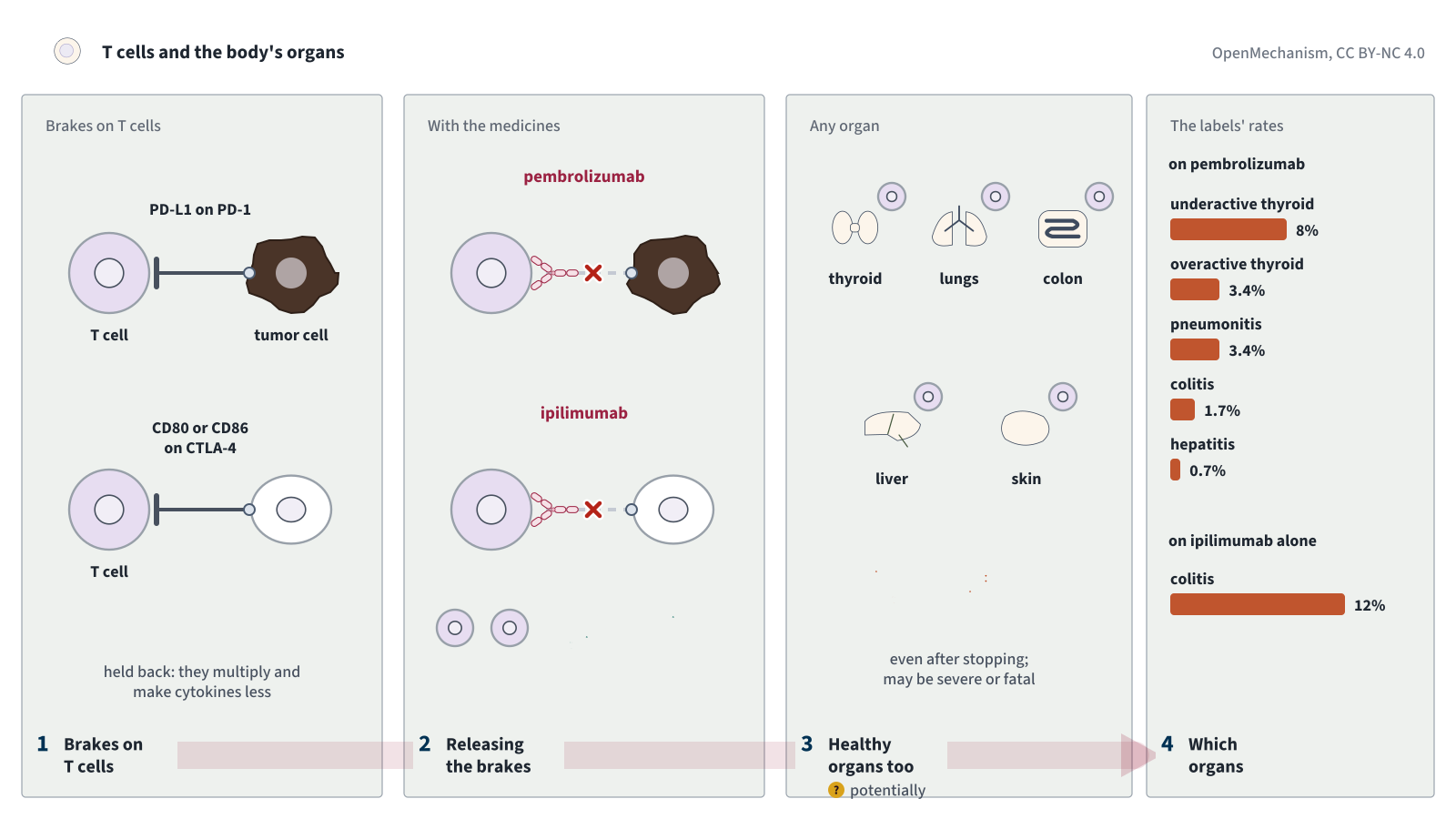
Checkpoint inhibitors such as pembrolizumab and ipilimumab release brakes on T cells, PD-1 and CTLA-4, freeing the immune response against cancer. The same release can set off immune reactions in the body's own organs: the thyroid, lungs, colon, liver and others, sometimes severely, at any time, even after stopping. Severe ones are more common with ipilimumab than with pembrolizumab.
- Kind
- Side effect
- Medicines
- Pembrolizumab, Ipilimumab
- Sources
- 5
Step 3: potentially
The Keytruda label says: KEYTRUDA is a monoclonal antibody that belongs to a class of drugs that bind to either the programmed death-receptor 1 (PD-1) or the PD-ligand 1 (PD-L1), blocking the PD-1/PD-L1 pathway, thereby removing inhibition of the immune response, potentially breaking peripheral tolerance and inducing immune-mediated adverse reactions.
Clinical study: A study of deaths from checkpoint inhibitors, from the WHO's database of adverse reactions, seven academic centers and 112 trials; it measured how often and from what people died, not how tolerance breaks: The spectrum differed widely between regimens: in a total of 193 anti-CTLA-4 deaths, most were usually from colitis (135 [70%]), whereas anti-PD-1/PD-L1-related fatalities were often from pneumonitis (333 [35%]), hepatitis (115 [22%]), and neurotoxic effects (50 [15%]). … A meta-analysis of 112 trials involving 19 217 patients showed toxicity-related fatality rates of 0.36% (anti-PD-1), 0.38% (anti-PD-L1), 1.08% (anti-CTLA-4), and 1.23% (PD-1/PD-L1 plus CTLA-4).
Wang DY et al., JAMA Oncol 2018 (PMID 30242316)
This study was picked with a literature search and is not yet checked by our reviewer.
For teachers: download this drawing.
Step by step
Brakes on T cells. carry brakes. When or binds on a T cell, the cell is held back from multiplying and making , and some tumors make more of these , which can help hold back the T cells' watch on the tumor. CTLA-4 is another brake on T cells.1,2
What the source says
“Binding of the PD-1 ligands, PD-L1 and PD-L2, to the PD-1 receptor found on T cells, inhibits T cell proliferation and cytokine production.”
Source 1“Upregulation of PD-1 ligands occurs in some tumors and signaling through this pathway can contribute to inhibition of active T-cell immune surveillance of tumors.”
Source 1“CTLA-4 is a negative regulator of T-cell activity.”
Source 2Releasing the brakes. Pembrolizumab, an antibody, binds PD-1 so that its ligands cannot, and ipilimumab binds CTLA-4 so that its ligands, and CD86, cannot. With the brakes released, T cells become more active and multiply, against the tumor too.1,2
What the source says
“Pembrolizumab is a monoclonal antibody that binds to the PD-1 receptor and blocks its interaction with PD-L1 and PD-L2, releasing PD-1 pathway-mediated inhibition of the immune response, including the anti-tumor immune response.”
Source 1“Ipilimumab is a monoclonal antibody that binds to CTLA-4 and blocks the interaction of CTLA-4 with its ligands, CD80/CD86.”
Source 2“Blockade of CTLA-4 has been shown to augment T-cell activation and proliferation, including the activation and proliferation of tumor infiltrating T-effector cells.”
Source 2Healthy organs too. Removing these brakes may also break peripheral tolerance and set off immune-mediated reactions. They can come in any organ or tissue, in more than one at once, at any time after starting and even after stopping, and may be severe or fatal.1,2
What the source says
“KEYTRUDA is a monoclonal antibody that belongs to a class of drugs that bind to either the programmed death-receptor 1 (PD-1) or the PD-ligand 1 (PD-L1), blocking the PD-1/PD-L1 pathway, thereby removing inhibition of the immune response, potentially breaking peripheral tolerance and inducing immune-mediated adverse reactions.”
Source 1“YERVOY is a fully human monoclonal antibody that blocks T-cell inhibitory signals induced by the CTLA-4 pathway, thereby removing inhibition of the immune response with the potential for induction of immune-mediated adverse reactions.”
Source 2“Immune-mediated adverse reactions, which may be severe or fatal, can occur in any organ system or tissue and can affect more than one body system simultaneously.”
Source 1“Immune-mediated adverse reactions can occur at any time after starting treatment with a PD-1/PD-L1 blocking antibody.”
Source 1“While immune-mediated adverse reactions usually manifest during treatment with PD-1/PD-L1 blocking antibodies, immune-mediated adverse reactions can also manifest after discontinuation of PD-1/PD-L1 blocking antibodies.”
Source 1Which organs. Among 2,799 people given pembrolizumab in the label's studies, an underactive thyroid came in 8%, an overactive one in 3.4%, pneumonitis in the lungs in 3.4%, colitis in 1.7% and hepatitis in 0.7%; with ipilimumab alone, colitis came in 12%. In melanoma, pembrolizumab caused less high-grade toxicity than ipilimumab, and across 112 trials deaths from toxicity came in 0.36% with PD-1 blockers and 1.08% with CTLA-4 blockers.1,2,3,4
What the source says
“Hypothyroidism occurred in 8% (237/2799) of patients receiving KEYTRUDA”
Source 1“Hyperthyroidism occurred in 3.4% (96/2799) of patients receiving KEYTRUDA”
Source 1“Immune-mediated pneumonitis occurred in 3.4% (94/2799) of patients receiving KEYTRUDA”
Source 1“Immune-mediated colitis occurred in 1.7% (48/2799) of patients receiving KEYTRUDA”
Source 1“Immune-mediated hepatitis occurred in 0.7% (19/2799) of patients receiving KEYTRUDA”
Source 1“Immune-mediated colitis occurred in 12% (62/511) of patients who received YERVOY 3 mg/kg as a single agent”
Source 2“The anti-PD-1 antibody pembrolizumab prolonged progression-free survival and overall survival and had less high-grade toxicity than did ipilimumab in patients with advanced melanoma.”
Source 3“A meta-analysis of 112 trials involving 19 217 patients showed toxicity-related fatality rates of 0.36% (anti-PD-1), 0.38% (anti-PD-L1), 1.08% (anti-CTLA-4), and 1.23% (PD-1/PD-L1 plus CTLA-4).”
Source 4
See also
Medicine pages: pembrolizumab and ipilimumab.
Other side effects (cancer): why bleomycin can scar the lungs, why CAR T cells can cause cytokine release syndrome, why cisplatin can harm hearing, why cisplatin can harm the kidneys, why cyclophosphamide can make the bladder bleed, why doxorubicin can damage the heart, why rituximab can bring hepatitis B back, why trastuzumab can weaken the heart, why vincristine can damage nerves and all 65 side effects.
Conditions: melanoma, non-small cell lung cancer, kidney cancer and hypothyroidism.
Sources
- 1Keytruda (pembrolizumab): FDA label5.1 Severe and Fatal Immune-Mediated Adverse Reactions; 12.1 Mechanism of Action. Saved copy
- 2Yervoy (ipilimumab): FDA label5.1 Severe and Fatal Immune-Mediated Adverse Reactions; 12.1 Mechanism of Action. Saved copy
- 3Pembrolizumab versus Ipilimumab in Advanced MelanomaRobert C et al. N Engl J Med 2015 (abstract). Saved copy
- 4Fatal Toxic Effects Associated With Immune Checkpoint Inhibitors: A Systematic Review and Meta-analysisWang DY et al. JAMA Oncol 2018 (abstract). Saved copy
- 5Immune-related adverse events of checkpoint inhibitorsRamos-Casals M et al. Nat Rev Dis Primers 2020 (abstract). Saved copy
Notes and limits
- These reactions are often low grade, treatable and reversible, but some are severe and lead to permanent disorders; unlike the side effects of older cancer treatments, they typically start late and last long.5
- The causes of death differ by medicine: with CTLA-4 blockers mostly colitis, with PD-1 or PD-L1 blockers often pneumonitis, hepatitis or effects on the nervous system. Myocarditis was the most often fatal, in 52 of 131 reported cases, and a PD-1 or PD-L1 blocker with a CTLA-4 blocker had the highest death rate in the trials, 1.23%.4
Notes that apply to every page are on How to read a page.
Spotted a mistake? Report an error (hello@openmechanism.com). Since launch, every published error we fix is listed on the corrections page.
Cite this page
Tran D. Why checkpoint inhibitors can inflame healthy organs [Internet]. OpenMechanism; 2026 [updated 2026 Oct 21; cited 2026 Oct 21]. Available from: https://openmechanism.com/explained/checkpoint-inhibitors-and-immune-side-effects