Mesna
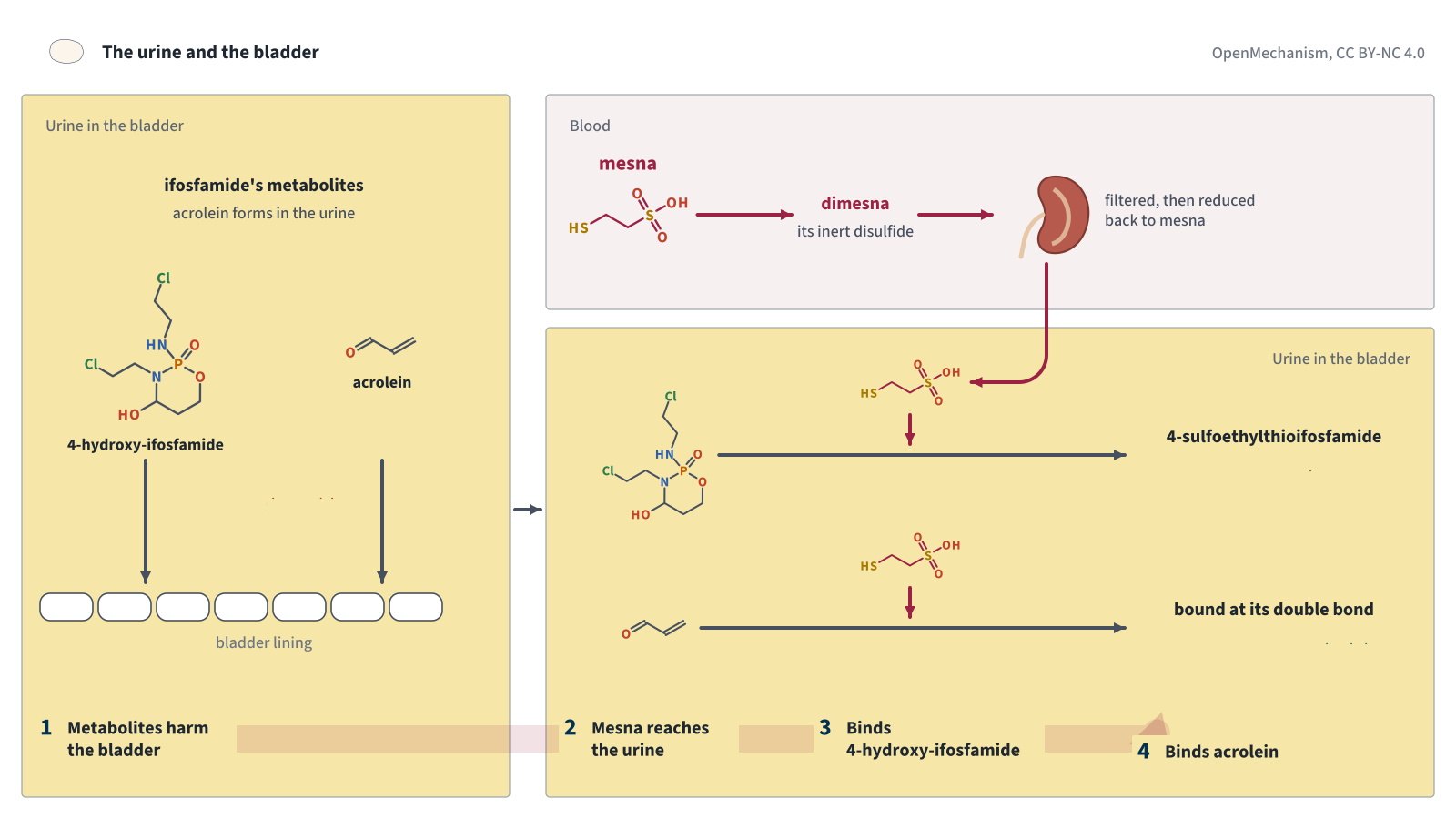
Ifosfamide's urotoxic metabolites, acrolein and 4-hydroxy-ifosfamide, can cause hemorrhagic cystitis. In the body, mesna is oxidized to dimesna, which the kidneys filter and reduce back to mesna, so much of a dose reaches the urine. Mesna binds 4-hydroxy-ifosfamide, forming a product that is not urotoxic, and binds the double bonds of acrolein, inhibiting their effects on the bladder.
- Acts on
- Acrolein and 4-hydroxy-ifosfamide
- Where
- The urinary tract
- Medicine type
- Small molecule
- Used for
- Antidotes & reversal
Also called Mesnex.
How it works
Metabolites harm the bladder. Ifosfamide's urotoxic metabolites, acrolein and 4-hydroxy-ifosfamide, can cause hemorrhagic cystitis. Acrolein forms in the urine from metabolites the kidneys pass into it.1,2,3
Mesna reaches the urine. In the body, mesna is quickly oxidized to its inert disulfide, dimesna. After the kidneys filter it, dimesna is reduced back to mesna; about a third of a dose leaves in the urine as mesna and a third as dimesna.1,3
Binds 4-hydroxy-ifosfamide. The first step in detoxification is mesna binding 4-hydroxy-ifosfamide, forming 4-sulfoethylthioifosfamide, which is not urotoxic.1
Binds acrolein. Mesna also binds the double bonds of acrolein and other urotoxic metabolites, inhibiting their effects on the bladder.1,3
For teachers: download this drawing.
See also
Condition pages: bladder bleeding from chemotherapy (hemorrhagic cystitis).
More medicines for antidotes & reversal: acetylcysteine, atropine, digoxin immune fab, dimercaprol, flumazenil, fomepizole, glucarpidase, hydroxocobalamin and 7 more.
Explained: why cyclophosphamide can make the bladder bleed.
Related drawings: cyclophosphamide (also broken down into acrolein).
Sources
- 1Mesnex (mesna): FDA label1 Indications and Usage; 12.1 Mechanism of Action; 12.3 Pharmacokinetics
- 2Acrolein, the causative factor of urotoxic side-effects of cyclophosphamide, ifosfamide, trofosfamide and sufosfamideBrock N et al., Arzneimittelforschung 1979 (abstract)
- 3Detoxification of urotoxic oxazaphosphorines by sulfhydryl compoundsBrock N et al., J Cancer Res Clin Oncol 1981 (abstract)
- 4ChEMBL CHEMBL1098319Target and action classification: Unknown
Spotted a mistake? Report an error (hello@openmechanism.com). Since launch, every published error we fix is listed on the corrections page.
Notes and limits
- A schematic teaching drawing: not to scale, not exact structures, binding poses or a complete pathway, and not a guide to dosing, treatment or how a person will respond.
- Not for blood in the urine from other causes, such as a low platelet count (the label).
All recorded limits are on the evidence page, and notes that apply to every page are on How to read a page. Version 1.0.0, not yet medically reviewed.
Cite this page
Tran D. Mesna [Internet]. OpenMechanism; 2026 [updated 2026 Oct 18; cited 2026 Oct 18]. Available from: https://openmechanism.com/medicines/mesna