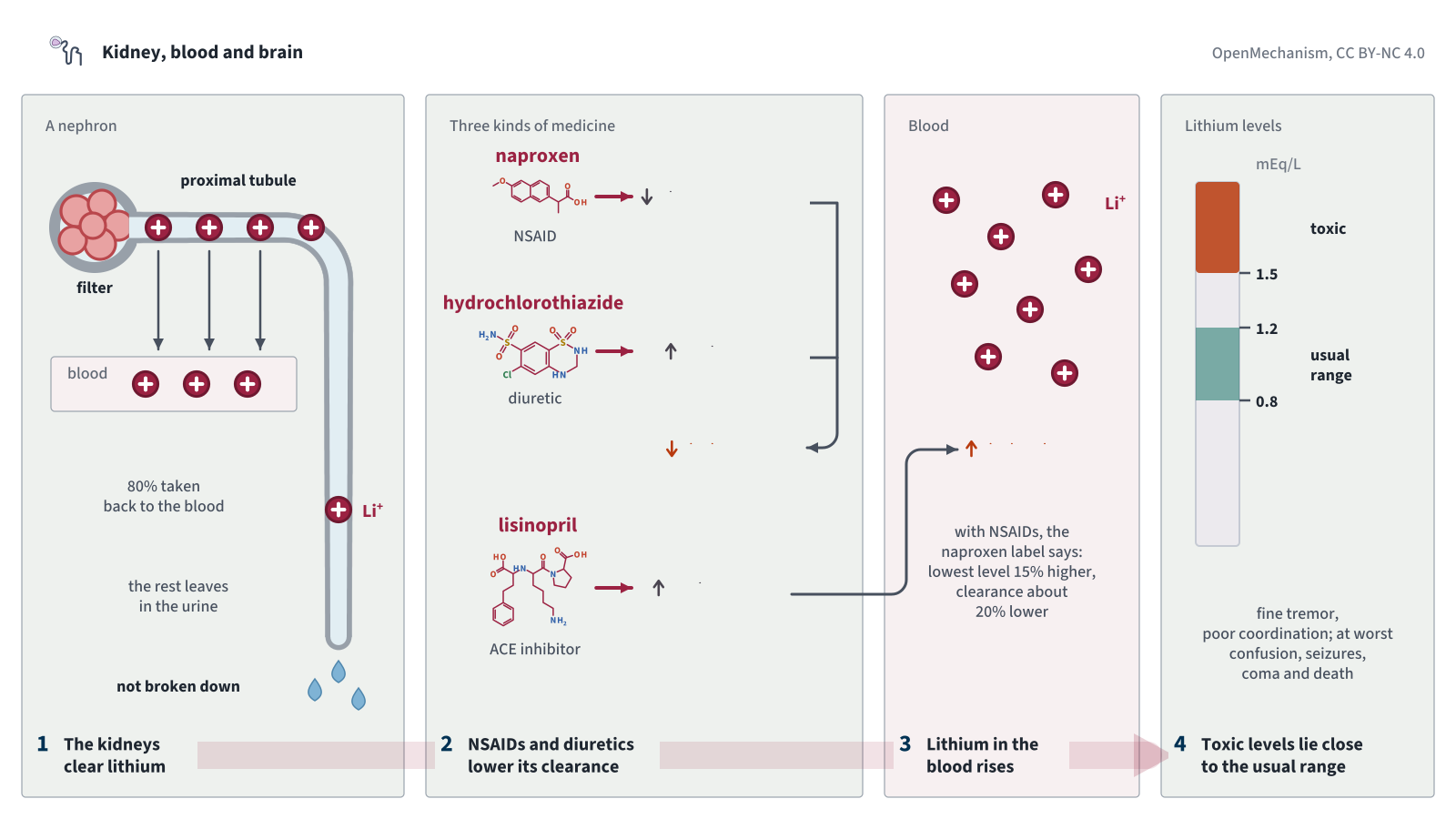
The kidneys clear lithium unchanged, mainly in the urine. NSAIDs such as naproxen lower the kidneys' blood flow and diuretics such as hydrochlorothiazide make the body lose sodium, and both can lower lithium's clearance; ACE inhibitors such as lisinopril also make the body pass sodium. All three can raise lithium's level in the blood. Toxic lithium levels lie close to the usual range, so the rise can bring a fine tremor and, at worst, confusion, seizures, coma and death.
The kidneys clear lithium. Lithium is not broken down. The kidneys filter it from the blood and take 80% of it back in the proximal tubule, and it leaves mainly in the urine, in proportion to its level in the blood.1
NSAIDs and diuretics lower its clearance. lower the kidneys' blood flow, so less lithium is cleared; the naproxen label puts the effect down to NSAIDs blocking prostaglandin making in the kidneys. Diuretics make the body lose sodium, which may reduce lithium's clearance. also make the body pass sodium, and lithium toxicity has been reported when they are taken with lithium; the lithium label says renin-angiotensin system , the group they belong to, raise lithium levels.1,2,3,4
What the source says
“NSAID decrease renal blood flow, resulting in decreased renal clearance and increased serum lithium concentrations.”
“Lithium toxicity has been reported in patients receiving lithium concomitantly with drugs, which cause elimination of sodium, including ACE inhibitors.”
Lithium in the blood rises. With less cleared, lithium builds up in the blood. The naproxen label gives figures: with NSAIDs, the average lowest lithium level rose 15% and the kidneys' clearance of lithium fell by about 20%.2
What the source says
“NSAIDs have produced elevations in plasma lithium levels and reductions in renal lithium clearance.”
Toxic levels lie close to the usual range. Toxic lithium levels, 1.5 mEq/L or more, lie close to the usual treatment range of 0.8 to 1.2 mEq/L, so a rise can tip into toxicity. Its signs in the nervous system range from a fine tremor, lightheadedness and poor coordination to confusion, seizures, coma and death.1
What the source says
“The toxic concentrations for lithium (≥1.5 mEq/L) are close to the therapeutic range (0.8 to 1.2mEq/L).”
“Neurological signs of lithium toxicity range from mild neurological adverse reactions such as fine tremor, lightheadedness, lack of coordination, and weakness”
The labels' advice, on doses, monitoring and taking these medicines together, is left out: this page explains the mechanism, not what to do.
The labels do not give a mechanism for the ACE inhibitors' effect beyond the sodium they make the body pass.
The lithium label names other things that raise the risk too, such as an illness with fever that has just begun, weaker kidneys, losing fluid or becoming dehydrated, significant heart and blood vessel disease, and changes in the blood's salts, especially sodium and potassium.1
Some people who are especially sensitive to lithium can show toxic signs at levels within the usual range.1
Claude Opus 5.5 (AI source check), 7 November 2026: 27 statements compared with their sources, 4 flagged for the reviewer. An automated check, not a medical review.
Key terms
Definitions reworded since this review: antagonist and NSAID. Definitions are shared across pages, so a later rewording does not take the review line off (what a review covers).
Next review due
8 May 2028
Cite this page
Tran D. Lithium and NSAIDs, diuretics or ACE inhibitors [Internet]. OpenMechanism; 2026 [updated 2026 Nov 7; cited 2026 Nov 7]. Available from: https://openmechanism.com/explained/lithium-and-nsaids-diuretics-or-ace-inhibitors