Levodopa and high-protein meals
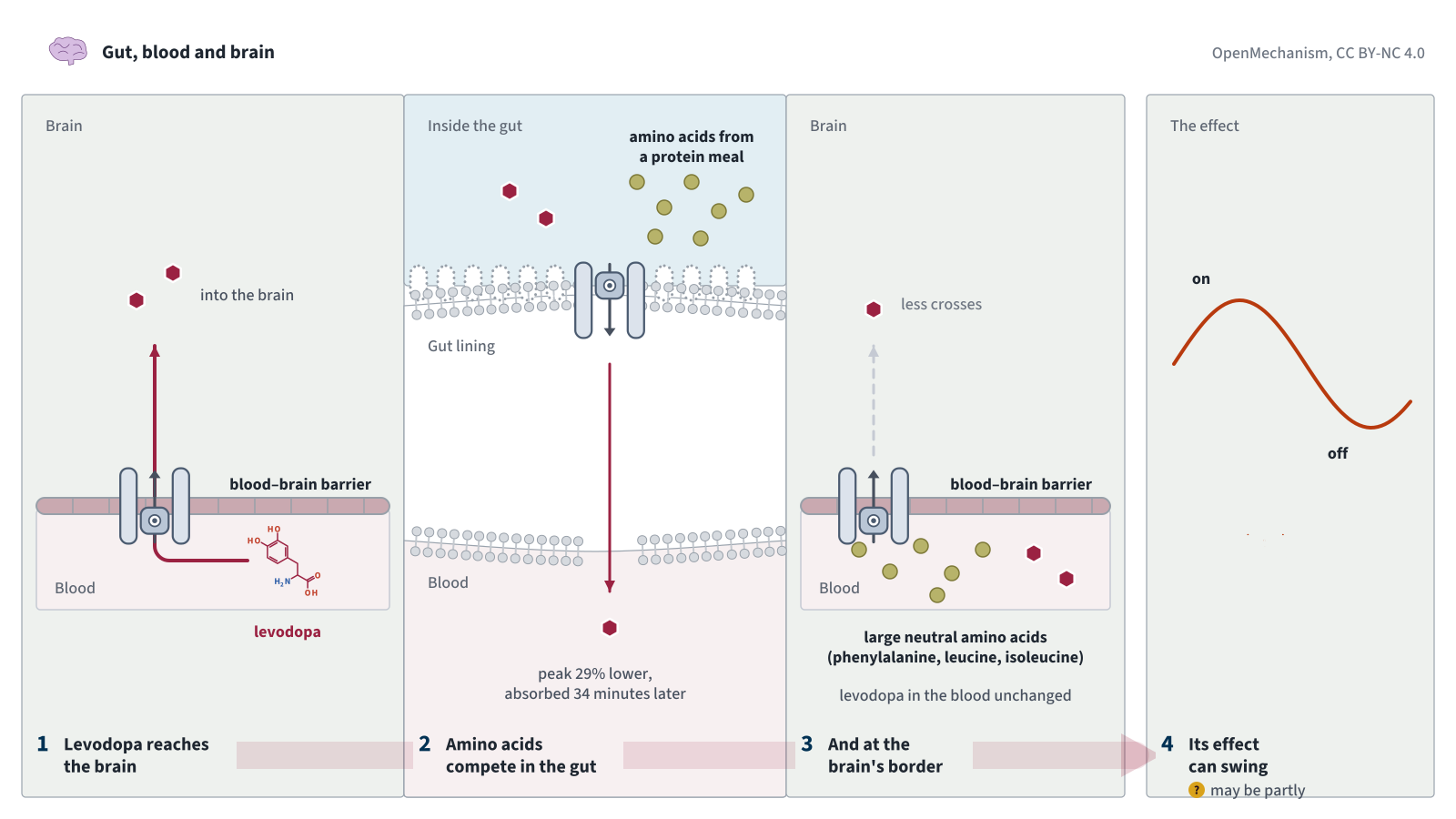
Levodopa crosses into the brain, where it is presumably turned into dopamine. It competes with certain amino acids for transport across the gut wall, so a high-protein diet may delay its absorption. In people with Parkinson disease, high-protein meals, or large neutral amino acids, reversed infused levodopa's effect without lowering its level in the blood, which points to competition for transport into the brain too. Both may be partly behind the swings in levodopa's effect.
- Kind
- Interaction
- Medicines
- Carbidopa and levodopa
- Sources
- 5
Step 4: may be partly
Nutt and colleagues' study concludes: We conclude that interference with absorption of levodopa by food and by competition between large neutral amino acids and levodopa for transport from plasma to the brain may be partly responsible for the fluctuating clinical response in patients with Parkinson's disease.
Clinical study: In 11 people with Parkinson disease and on-off swings, a nearly protein-free diet was compared with a high-protein one; it measured their movement, not transport into the brain: On a nearly zero protein diet, 11 patients with Parkinson's disease with the "on-off" effect demonstrated great sensitivity to levodopa (L-dopa)-carbidopa and reduced fluctuations.
Pincus JH, Barry K, Arch Neurol 1987 (PMID 3827678)
This study was picked with a literature search and is not yet checked by our reviewer.
For teachers: download this drawing.
Step by step
Levodopa reaches the brain. Dopamine itself does not cross the blood-brain barrier, but levodopa, the molecule the body makes it from, does, and is presumably turned into dopamine in the brain.1
What the source says
“Administration of dopamine is ineffective in the treatment of Parkinson's disease apparently because it does not cross the blood-brain barrier.”
Source 1“However, levodopa, the metabolic precursor of dopamine, does cross the blood-brain barrier, and presumably is converted to dopamine in the brain.”
Source 1Amino acids compete in the gut. Levodopa competes with certain amino acids for transport across the gut wall, so a high-protein diet may delay its absorption and reduce how much reaches the blood. In one study, meals cut levodopa's peak level in the blood by 29% and delayed its absorption by 34 minutes.2,3
What the source says
“Since levodopa competes with certain amino acids for transport across the gut wall, the absorption of levodopa may be impaired in some patients on a high protein diet.”
Source 2“a change in diet to foods that are high in protein may delay the absorption of levodopa and may reduce the amount taken up in the circulation.”
Source 2“Meals reduced peak plasma levodopa concentrations by 29 per cent and delayed absorption by 34 minutes.”
Source 3And at the brain's border. Large neutral amino acids also compete with levodopa for transport into the brain. In people with Parkinson disease given levodopa into a vein, high-protein meals, or phenylalanine, leucine or isoleucine, reversed its effect without lowering its level in the blood; glycine and lysine did not.3,4
What the source says
“The modulation of levodopa transport across the blood brain barrier by large neutral amino acids is well documented.”
Source 4“High-protein meals or oral phenylalanine, leucine, or isoleucine (100 mg per kilogram of body weight) reversed the therapeutic effect of infused levodopa without reducing plasma levodopa concentrations.”
Source 3“Glycine and lysine at identical doses had no effect.”
Source 3Its effect can swing. Food slowing levodopa's absorption, and large neutral amino acids competing with it for transport into the brain, may be partly behind the swings in its effect.2,3
What the source says
“We conclude that interference with absorption of levodopa by food and by competition between large neutral amino acids and levodopa for transport from plasma to the brain may be partly responsible for the fluctuating clinical response in patients with Parkinson's disease.”
Source 3“The above factors may reduce the clinical effectiveness of the levodopa or carbidopa and levodopa therapy.”
Source 2
See also
Medicine pages: carbidopa and levodopa.
Other interactions (brain & nerves): lamotrigine with estrogen-containing contraceptives; lithium and NSAIDs, diuretics or ACE inhibitors; MAO inhibitors and tyramine; opioids and benzodiazepines; smoking and olanzapine; tramadol and SSRIs such as sertraline; valproate and lamotrigine; and all 40 interactions.
Conditions: Parkinson disease.
Sources
- 1Sinemet (carbidopa and levodopa): FDA labelClinical Pharmacology: Mechanism of Action. Saved copy
- 2Sinemet (carbidopa and levodopa): FDA labelClinical Pharmacology: Pharmacodynamics; Precautions: Information for Patients. Saved copy
- 3The "on-off" phenomenon in Parkinson's disease. Relation to levodopa absorption and transportNutt JG et al. N Engl J Med 1984 (abstract). Saved copy
- 4Motor fluctuations due to interaction between dietary protein and levodopa in Parkinson's diseaseVirmani T et al. J Clin Mov Disord 2016 (abstract). Saved copy
- 5Influence of dietary protein on motor fluctuations in Parkinson's diseasePincus JH, Barry K. Arch Neurol 1987 (abstract). Saved copy
Notes and limits
- The label's advice on diet is left out: this page explains the mechanism, not what to do.
- The study in steps 2 and 3 was small: nine people whose response to levodopa swung.3
- Excess stomach acid can also delay levodopa's absorption, and iron salts, as in multivitamin tablets, may reduce how much of it the body gets.2
Notes that apply to every page are on How to read a page.
Spotted a mistake? Report an error (hello@openmechanism.com). Since launch, every published error we fix is listed on the corrections page.
Cite this page
Tran D. Levodopa and high-protein meals [Internet]. OpenMechanism; 2026 [updated 2026 Oct 19; cited 2026 Oct 19]. Available from: https://openmechanism.com/explained/levodopa-and-protein-meals