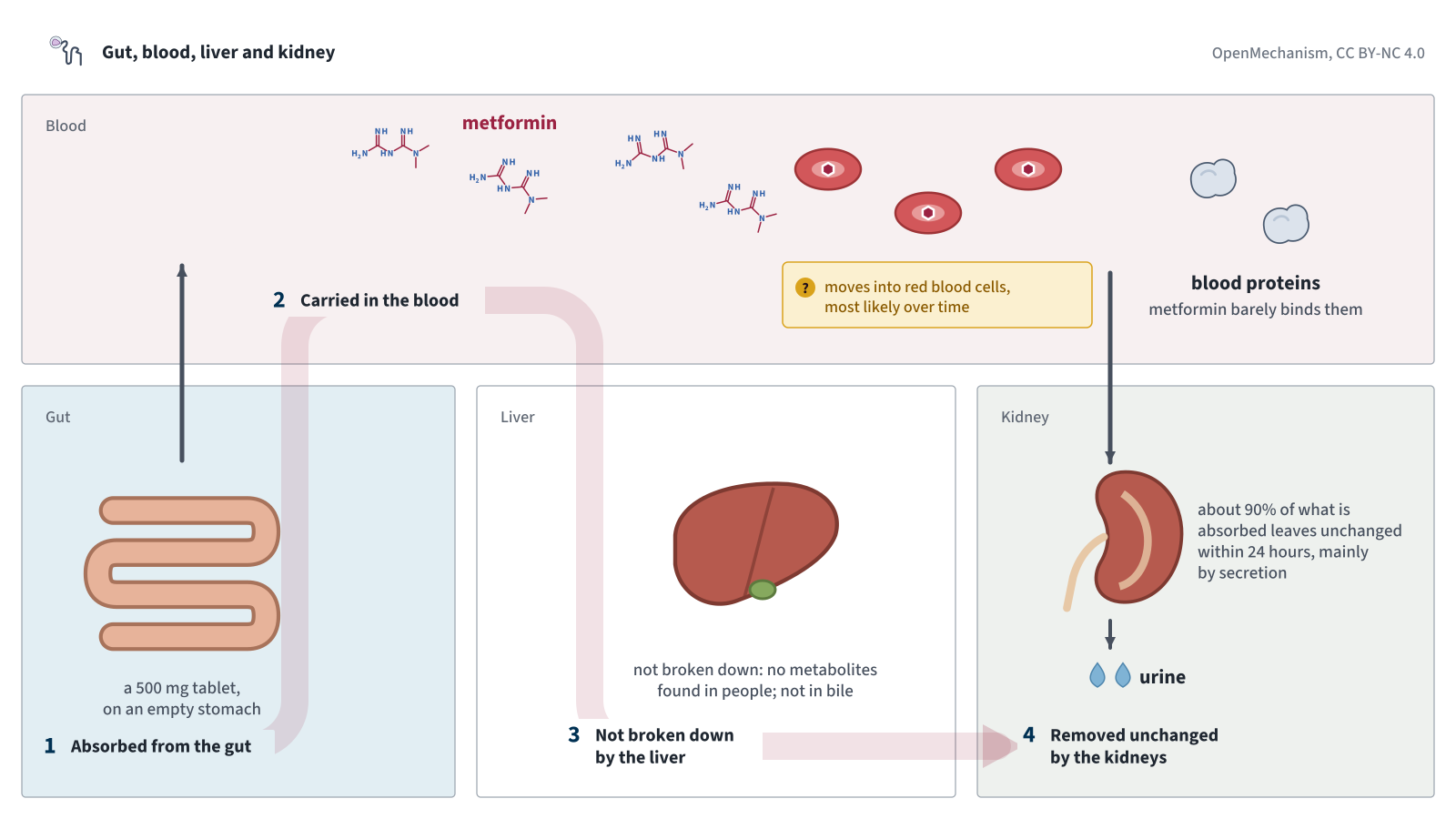
When a 500 mg tablet is taken on an empty stomach, about 50 to 60% of it reaches the blood. Metformin hardly binds to blood proteins and is not broken down by the liver: the kidneys remove it unchanged, mainly by secreting it into the fluid that becomes urine.
Clinical study: In Robert and colleagues' 2003 study of six healthy people given one 850 mg dose, metformin left their red blood cells much more slowly than their plasma: Plasma and erythrocytes concentration-time curves showed that metformin was not detectable in plasma 24 hours after the oral administration, while it remained detectable in erythrocytes up to 48 hours.Robert F et al., Diabetes Metab 2003 (PMID 12909816)
Not broken down by the liver. The liver does not metabolize metformin, no metabolites have been found in people, and it is not excreted in bile.1
What the source says
“Intravenous single-dose studies in normal subjects demonstrate that metformin is excreted unchanged in the urine and does not undergo hepatic metabolism (no metabolites have been identified in humans) nor biliary excretion.”
Removed unchanged by the kidneys. The kidneys remove it unchanged, mainly by secreting it into the fluid that becomes urine; about 90% of what is absorbed leaves this way within 24 hours.1
What the source says
“Renal clearance (see Table 4) is approximately 3.5 times greater than creatinine clearance, which indicates that tubular secretion is the major route of metformin elimination.”
text 70d7b2780fab…; drawings d771d8615ef7…; notes ce137d5f3d2e…
AI source check
Claude Opus 5.5 (AI source check), 30 October 2026: 20 statements compared with their sources, 6 flagged for the reviewer. An automated check, not a medical review.
Next review due
30 April 2028
Cite this page
Tran D. What the body does with metformin [Internet]. OpenMechanism; 2026 [updated 2026 Oct 30; cited 2026 Oct 30]. Available from: https://openmechanism.com/explained/metformin-in-the-body