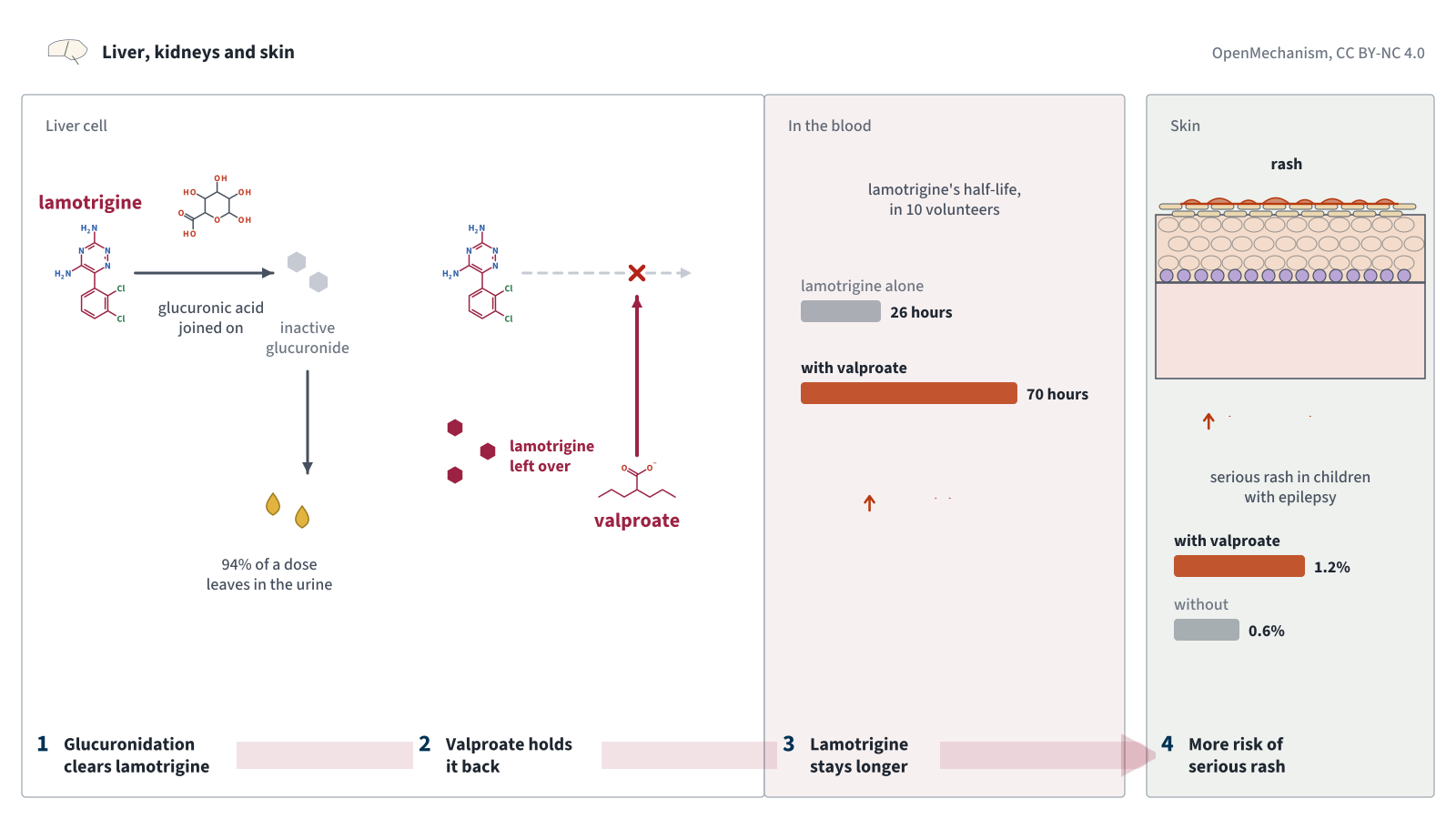
Lamotrigine is broken down mainly by glucuronidation, joined to glucuronic acid into an inactive glucuronide that leaves in the urine. Valproate inhibits this glucuronidation, so lamotrigine stays longer: in healthy volunteers its half-life rose from 26 to 70 hours, and its levels more than double. Taking lamotrigine with valproate is one of the factors that may raise the risk of a serious, potentially life-threatening rash, such as Stevens-Johnson syndrome.
Glucuronidation clears lamotrigine. Lamotrigine is broken down mainly by glucuronidation, joined to glucuronic acid into an inactive glucuronide; in 6 healthy volunteers given one 240 mg dose of radioactively labeled lamotrigine by mouth, 94% of the radioactivity was recovered in the urine.1
What the source says
“Lamotrigine is metabolized predominantly by glucuronic acid conjugation; the major metabolite is an inactive 2-N-glucuronide conjugate.”
“After oral administration of 240 mg of 14 C-lamotrigine (15 μCi) to 6 healthy volunteers, 94% was recovered in the urine and 2% was recovered in the feces.”
Valproate holds it back. Valproate, which includes valproic acid and divalproex sodium, inhibits the glucuronidation of lamotrigine. In a 1992 study, it reduced lamotrigine's elimination, an effect already seen within the first hour, most probably by competing with it for glucuronidation in the liver; the kidneys' part was not impaired.2,3,4,5
What the source says
“Valproic acid (sodium valproate) inhibits the glucuronidation of lamotrigine and increases its half-life”
“Co-administration of valproate can affect the pharmacokinetics of other drugs (e.g., diazepam, ethosuximide, lamotrigine, phenytoin) by inhibiting their metabolism or protein binding displacement”
Lamotrigine stays longer. With valproate, lamotrigine's rose from 26 to 70 hours in 10 healthy volunteers, and its levels rise slightly more than 2-fold.4,5
What the source says
“In a steady-state study involving 10 healthy volunteers, the elimination half-life of lamotrigine increased from 26 to 70 hours with valproate co-administration (a 165% increase).”
More risk of serious rash. The lamotrigine label's boxed warning also lists taking it with valproate, like going over its recommended starting dose, among the factors that may raise the risk of a serious rash, which can be life-threatening; serious skin reactions such as have been reported with the two together. In children with epilepsy taking lamotrigine, serious rash was 1.2% (6 of 482) with valproate and 0.6% (6 of 952) without.4,5
What the source says
“factors that may increase the risk of occurrence or the severity of rash caused by LAMICTAL include (1) coadministration of LAMICTAL with valproate (includes valproic acid and divalproex sodium), (2) exceeding the recommended initial dose of LAMICTAL”
“Serious skin reactions (such as Stevens-Johnson syndrome and toxic epidermal necrolysis) have been reported with concomitant lamotrigine and valproate administration.”
“In pediatric patients who used valproate concomitantly for epilepsy, 1.2% (6 of 482) experienced a serious rash compared with 0.6% (6 of 952) patients not taking valproate.”
“Cases of life-threatening serious rashes, including Stevens-Johnson syndrome and toxic epidermal necrolysis, and/or rash-related death have been caused by lamotrigine.”
The sources' advice, such as dose changes, is left out: this page explains the mechanism, not what to do.
The effect the other way is not consistent: lamotrigine lowered valproate levels by 25% on average in healthy volunteers, but did not change them in trials in people with epilepsy.5
The sources list valproate as a risk factor for the rash but don't say why; this page doesn't tie the rash to the higher lamotrigine levels in step 3.
Claude Opus 5.5 (AI source check), 7 November 2026: 24 statements compared with their sources, 5 flagged for the reviewer. An automated check, not a medical review.
Next review due
8 May 2028
Cite this page
Tran D. Valproate and lamotrigine [Internet]. OpenMechanism; 2026 [updated 2026 Nov 7; cited 2026 Nov 7]. Available from: https://openmechanism.com/explained/valproate-and-lamotrigine