Medically reviewed by Daniel Tran, PharmD, on 12 November 2026.
Why lithium can cause diabetes insipidus
The kidney's collecting ducts take water back into the blood through aquaporin channels, which their cells insert when vasopressin (ADH) tells them to. In mouse kidney cells grown in the lab and in rats, lithium entered these cells mainly through a sodium channel, ENaC, and lowered the number of aquaporin-2 channels. With fewer channels, less water is taken back: long-term lithium may be associated with a weaker ability of the kidneys to concentrate urine, sometimes as nephrogenic diabetes insipidus, with large amounts of urine and great thirst.
- Kind
- Side effect
- Medicines
- Lithium
- Sources
- 7
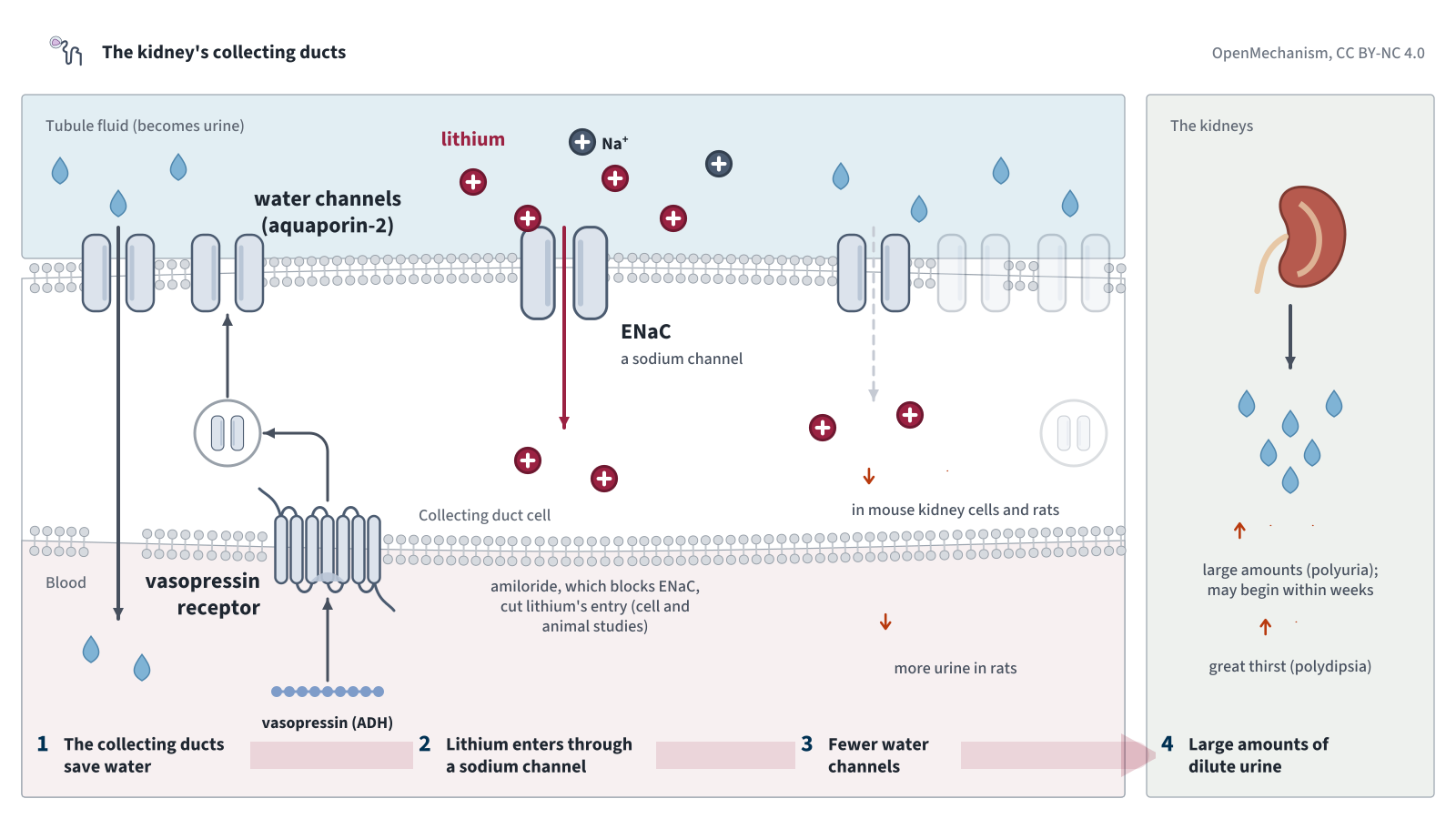
For teachers: download this drawing.
Step by step
The collecting ducts save water. Under the control of the pituitary hormone (vasopressin), the kidney's collecting ducts can take back most of the water passing through them, or almost none. ADH has the principal cells lining the ducts insert aquaporin water channels into their membrane facing the fluid that becomes urine, and water is drawn out through these channels back into the blood.1,2,3,4
What the source says
“Under physiological conditions, excessive loss of water through the urine is prevented by the release of the antidiuretic hormone arginine-vasopressin (AVP) from the posterior pituitary.”
Source 1“During dehydration, arginine vasopressin (AVP) stimulates the expression and trafficking of aquaporin 2 (AQP2) to the apical membrane of CD principal cells, thereby allowing water reabsorption from the primary urine.”
Source 2“Vasopressin increases the water permeability of the renal collecting duct cells, allowing more water to be reabsorbed from collecting duct urine to blood.”
Source 3“The antidiuretic hormone arginine-vasopressin increases the water permeability of the renal collecting ducts and induces the reabsorption of 11 liters of water: the final urinary osmolality is 1200 mmol/kg for a urinary flow rate of 1 litre per 24 hours.”
Source 4“Conversely, when the secretion of AVP is lowered, as for instance upon water ingestion or as a consequence of diabetes insipidus, the CD remains water impermeable leading to enhanced diuresis and urine dilution.”
Source 2Lithium enters through a sodium channel. In cell and animal studies, lithium got into the principal cells mainly through , the sodium channel in the same membrane: amiloride, which blocks ENaC, cut the lithium entering the cells.5
What the source says
“Amiloride blocks the epithelial sodium channel (ENaC) located in the apical membrane of principal cells”
Source 5“Amiloride reduced transcellular lithium transport, intracellular lithium concentration, and lithium-induced inactivation of glycogen synthase kinase 3beta.”
Source 5“These results show that ENaC is the major entry site for lithium in principal cells both in vitro and in vivo.”
Source 5Fewer water channels. In mouse kidney cells grown in the lab, lithium at levels the authors call clinically relevant lowered the number of aquaporin-2 channels that vasopressin calls up. Rats given lithium had fewer aquaporin-2 channels and a smaller share of principal cells, and passed large amounts of urine; amiloride given at the same time lessened all of these changes.5
What the source says
“Using a mouse collecting duct cell line, we found that vasopressin caused an increase in Aquaporin 2 (AQP2) expression which was reduced by clinically relevant lithium concentrations similar to what is seen with in vivo models of this disease.”
Source 5“Treatment of rats with lithium downregulated AQP2 expression, reduced the principal-to-intercalated cell ratio, and caused polyuria, while simultaneous administration of amiloride attenuated all these changes.”
Source 5Large amounts of dilute urine. With fewer channels, less water is taken back. Long-term lithium may be associated with a weaker ability of the kidneys to concentrate urine, sometimes as nephrogenic diabetes insipidus: large amounts of urine (polyuria) and great thirst (polydipsia). The concentrating problem may begin within weeks of starting lithium.6,7
What the source says
“Acutely, vasopressin induces exocytic insertion of AQP2 into the apical plasma membrane to increase collecting duct water reabsorption.”
Source 6“In conditions with acquired nephrogenic diabetes insipidus (eg, lithium treatment, hypokalemia, postobstructive polyuria), AQP2 expression and targeting have been found to be markedly reduced, providing an explanation for the polyuria and the inability to concentrate urine associated with these conditions.”
Source 6“Chronic lithium treatment may be associated with diminution of renal concentrating ability, occasionally presenting as nephrogenic diabetes insipidus, with polyuria and polydipsia.”
Source 7“The concentrating defect and natriuretic effect characteristic of this condition may develop within weeks of lithium initiation.”
Source 7
See also
Medicine pages: lithium.
Related medicines: amiloride.
Other side effects (brain & nerves): why antipsychotics can cause movement problems; why antipsychotics can raise prolactin; why bupropion carries a risk of seizures; why clozapine can lower white blood cells; why morphine slows the gut and breathing; why ropinirole can bring on compulsive urges; why SSRIs can lower sodium; why SSRIs can raise the risk of bleeding; why stimulants can raise heart rate and blood pressure; why too much acetaminophen harms the liver; and all 65 side effects.
Interactions: lithium and NSAIDs, diuretics or ACE inhibitors.
Conditions: diabetes insipidus and bipolar disorder.
Sources
- 1Hereditary Nephrogenic Diabetes Insipidus: Pathophysiology and Possible Treatment. An UpdateMilano S et al. Int J Mol Sci 2017 (abstract). Saved copy
- 2Piezo1-dependent regulation of urinary osmolarityMartins JR et al. Pflugers Arch 2016 (abstract). Saved copy
- 3Vasopressin increases water permeability of kidney collecting duct by inducing translocation of aquaporin-CD water channels to plasma membraneNielsen S et al. Proc Natl Acad Sci U S A 1995 (abstract). Saved copy
- 4[Pathological aspects of water transport in the collecting ducts]Bichet DG. Nephrologie 1996 (abstract). Saved copy
- 5Amiloride blocks lithium entry through the sodium channel thereby attenuating the resultant nephrogenic diabetes insipidusKortenoeven ML et al. Kidney Int 2009 (abstract). Saved copy
- 6Pathophysiology of aquaporin-2 in water balance disordersFrøkiaer J et al. Am J Med Sci 1998 (abstract). Saved copy
- 7Lithium carbonate: FDA label5.2 Lithium-Induced Polyuria. Saved copy
Notes and limits
- The label's advice on monitoring and treatment is left out: this page explains the mechanism, not what to do.
- That lithium enters these cells through ENaC and lowers the water channels comes from mouse kidney cells and rats; the lithium label describes the kidneys' weaker ability to concentrate urine in people, but not how it happens.
- Stopping lithium usually reverses it, but after long-term use it may reverse only in part. The label adds that dehydration in these patients can lead to lithium being retained, and to lithium toxicity.7
Notes that apply to every page are on How to read a page.
Spotted a mistake? Report an error (hello@openmechanism.com). Since launch, every published error we fix is listed on the corrections page.
Medical review
Earlier reviews (1)
Cite this page
Tran D. Why lithium can cause diabetes insipidus [Internet]. OpenMechanism; 2026 [updated 2026 Nov 12; cited 2026 Nov 12]. Available from: https://openmechanism.com/explained/lithium-and-diabetes-insipidus