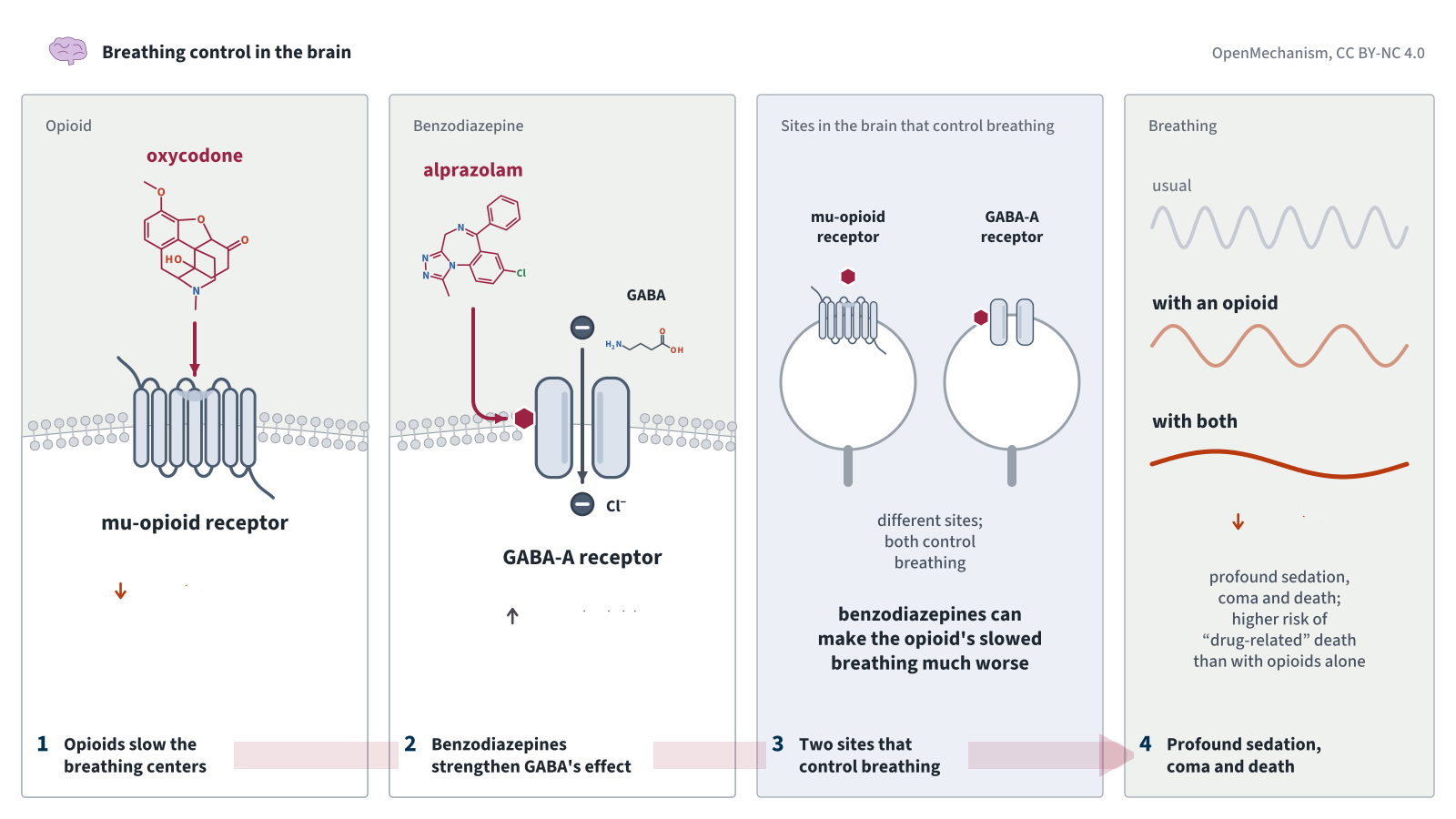
Opioids such as oxycodone slow breathing by acting on the brainstem's breathing centers. Benzodiazepines such as alprazolam strengthen GABA's inhibition at a different receptor site that also controls breathing. Together they may cause profound sedation, slowed breathing, coma and death, a boxed warning on both labels.
Opioids slow the breathing centers. Oxycodone, a full opioid relatively selective for the mu receptor, slows breathing by acting directly on the brainstem's breathing centers, which then respond less to rising carbon dioxide.1
What the source says
“Oxycodone is a full opioid agonist and is relatively selective for the mu receptor, although it can bind to other opioid receptors at higher doses.”
“The respiratory depression involves a reduction in the responsiveness of the brain stem respiratory centers to both increases in CO 2 tension and electrical stimulation.”
Benzodiazepines strengthen GABA's effect. Alprazolam binds the benzodiazepine site of in the brain and strengthens 's inhibition at synapses.2
What the source says
“Alprazolam exerts its effect for the acute treatment of generalized anxiety disorder and panic disorder through binding to the benzodiazepine site of gamma‑aminobutyric acid-A (GABA A ) receptors in the brain and enhances GABA-mediated synaptic inhibition.”
Two sites that control breathing. Benzodiazepines act at GABA-A sites and opioids mainly at mu receptors: different receptor sites in the central nervous system that both control breathing. Combined, benzodiazepines can significantly worsen the slowed breathing that opioids cause.2
What the source says
“The concomitant use of benzodiazepines and opioids increases the risk of respiratory depression because of actions at different receptor sites in the CNS that control respiration.”
“When benzodiazepines and opioids are combined, the potential for benzodiazepines to significantly worsen opioid‑related respiratory depression exists.”
Profound sedation, coma and death. Used together, they may cause profound sedation, slowed breathing, coma and death, a boxed warning on both labels. In observational studies, taking both raised the risk of what the label calls “drug-related mortality” compared with opioids alone.1,2
What the source says
“Concomitant use of benzodiazepines and opioids may result in profound sedation, respiratory depression, coma, and death.”
“Concomitant use of opioids with benzodiazepines or other central nervous system (CNS) depressants, including alcohol, may result in profound sedation, respiratory depression, coma, and death.”
“Observational studies have demonstrated that concomitant use of opioid analgesics and benzodiazepines increases the risk of drug-related mortality compared to use of opioids alone.”
The labels' prescribing and monitoring advice is left out: this page explains the mechanism, not what to do.
The oxycodone label gives the same warning for other medicines that slow the brain, and for alcohol, because their effects add up.1
The drawing's GABA-A receptor is a chloride channel, and chloride usually flows into the nerve cell when GABA opens it. The labels do not mention chloride; two papers back it.3,4
Claude Opus 5.5 (AI source check), 4 November 2026: 24 statements compared with their sources, 6 flagged for the reviewer. An automated check, not a medical review.
Next review due
5 May 2028
Cite this page
Tran D. Opioids and benzodiazepines [Internet]. OpenMechanism; 2026 [updated 2026 Nov 4; cited 2026 Nov 4]. Available from: https://openmechanism.com/explained/opioids-and-benzodiazepines