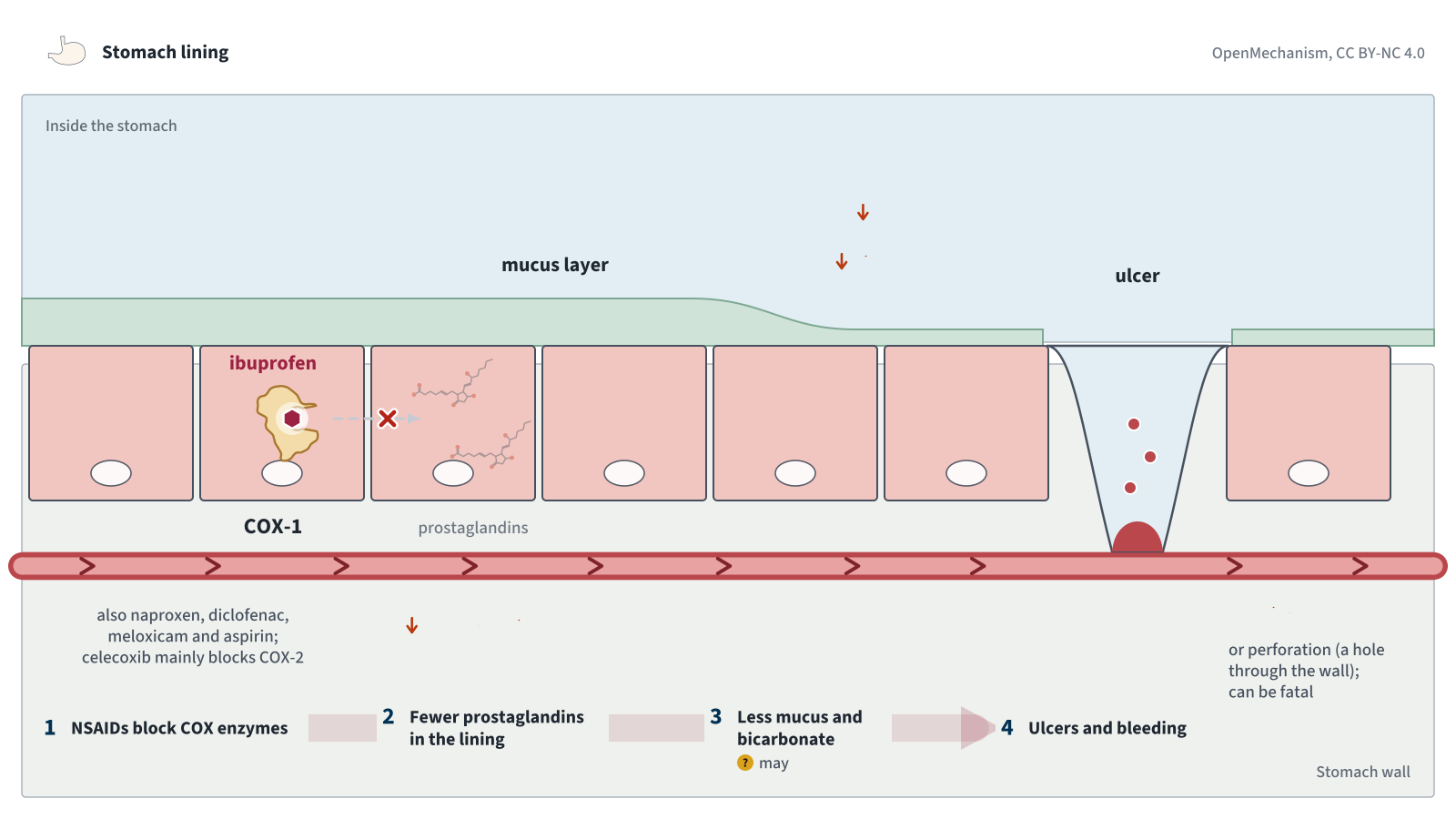
NSAIDs such as ibuprofen and naproxen block the COX enzymes that make prostaglandins. In the stomach lining, COX-1 makes prostaglandins, and with fewer of them the lining may make less mucus and bicarbonate. The labels carry a boxed warning: NSAIDs raise the risk of serious bleeding, ulcers and perforation of the stomach or intestines, which can be fatal.
Schematic, not to scale. COX-1 outline from an ovine (sheep) structure. License CC BY-NC 4.0.
?Step 3: may
The misoprostol label says: NSAIDs inhibit prostaglandin synthesis, and a deficiency of prostaglandins within the gastric mucosa may lead to diminishing bicarbonate and mucus secretion and may contribute to the mucosal damage caused by these agents.
Clinical study: Feldman and Colturi's 1984 study in 11 healthy volunteers calculated the stomach's basal acid and bicarbonate secretion with a two-component model before and after indomethacin (50 mg by mouth every 8 hours, 10 doses), an NSAID that blocks the body's prostaglandin synthesis: Indomethacin increased acid secretion significantly (from 4.9 +/- 1.2 to 7.4 +/- 1.7 mmol/75 min, p less than 0.02) without affecting gastric bicarbonate secretion (control 2.7 +/- 0.8, indomethacin 3.0 +/- 0.7 mmol/75 min; p greater than 0.05). Assuming indomethacin works by cutting the body's prostaglandin synthesis, the authors conclude that endogenous prostaglandins play little, if any, role in the regulation of basal bicarbonate secretion by the stomach. Feldman M, Colturi TJ, Gastroenterology 1984 (PMID 6149164)
NSAIDs block COX enzymes. Ibuprofen, naproxen, diclofenac and meloxicam block both cyclooxygenase enzymes, and , though their labels say how they work is not completely understood. Celecoxib's label says it is believed to work by blocking prostaglandin production, mainly through COX-2. Aspirin blocks the platelets' cyclooxygenase irreversibly.1,2,3,4,5,6
What the source says
“The mechanism of action of CALDOLOR, like that of other NSAIDs, is not completely understood but involves inhibition of cyclooxygenase (COX-1 and COX-2).”
“The mechanism of action of naproxen, like that of other NSAIDs, is not completely understood but involves inhibition of cyclooxygenase (COX-1 and COX-2).”
“The mechanism of action of diclofenac sodium delayed-release tablets, like that of other NSAIDs, is not completely understood but involves inhibition of cyclooxygenase (COX-1 and COX-2).”
“The mechanism of action of meloxicam, like that of other NSAIDs, is not completely understood but involves inhibition of cyclooxygenase (COX-1 and COX-2).”
Fewer prostaglandins in the lining. injure the gut lining by depleting the prostaglandins that COX-1 makes there, and by direct (topical) injury. In healthy volunteers taking aspirin daily for three months, even 10 mg a day cut the stomach lining's prostaglandins to about 40% of their starting level.7,8
What the source says
“NSAIDs injures the upper and lower gut by depleting COX-1 derived prostaglandins and causing topical injury to the mucosa.”
Less mucus and bicarbonate. With fewer prostaglandins in the stomach lining, the lining may make less bicarbonate and mucus, and this may add to the damage NSAIDs cause, the misoprostol label says.9
What the source says
“NSAIDs inhibit prostaglandin synthesis, and a deficiency of prostaglandins within the gastric mucosa may lead to diminishing bicarbonate and mucus secretion and may contribute to the mucosal damage caused by these agents.”
Ulcers and bleeding. The NSAID labels carry a boxed warning: NSAIDs raise the risk of serious bleeding, ulcers and perforation (a hole through the wall) of the stomach or intestines, which can be fatal and can come without warning symptoms. The naproxen label says upper gut ulcers, gross bleeding or perforation happened in about 1% of people treated for 3 to 6 months and about 2% to 4% treated for a year, and that even short-term use is not without risk. The celecoxib label carries the same warning, and the aspirin label warns of severe stomach bleeding.2,5,10
What the source says
“NSAIDs cause an increased risk of serious gastrointestinal (GI) adverse events including bleeding, ulceration, and perforation of the stomach or intestines, which can be fatal. These events can occur at any time during use and without warning symptoms.”
“Upper GI ulcers, gross bleeding, or perforation caused by NSAIDs occurred in approximately 1% of patients treated for 3 to 6 months, and in about 2% to 4% of patients treated for one year. However, even short-term NSAID therapy is not without risk.”
“NSAIDs cause an increased risk of serious gastrointestinal (GI) adverse events including bleeding, ulceration, and perforation of the stomach or intestines, which can be fatal.”
Also used for it: esomeprazole (for lowering the chance of stomach ulcers during continuous NSAID use in adults at risk because they are 60 or older or have had a stomach ulcer: “NEXIUM delayed-release capsules and NEXIUM for delayed-release oral suspension are indicated for the reduction in the occurrence of gastric ulcers associated with continuous NSAID therapy in adult patients at risk for developing gastric ulcers.”11); and misoprostol (for lowering the risk of NSAID-induced stomach ulcers in people at high risk: “Cytotec (misoprostol) is indicated for reducing the risk of NSAID (nonsteroidal anti-inflammatory drugs, including aspirin)–induced gastric ulcers in patients at high risk of complications from gastric ulcer, e.g., the elderly and patients with concomitant debilitating disease, as well as patients at high risk of developing gastric ulceration, such as patients with a history of ulcer. Cytotec has not been shown to reduce the risk of duodenal ulcers in patients taking NSAIDs.”12).
Celecoxib's label says it is believed to work by blocking prostaglandin production, mainly through COX-2, and carries the same boxed warning. In one study fewer ulcers were seen on endoscopy with celecoxib than with diclofenac, but the label adds that in the CLASS trial celecoxib was not statistically different from diclofenac for clinically relevant stomach and gut outcomes, and says such short-term findings have not been shown to mean fewer serious stomach events with long-term use.5
A past ulcer or bleed raised the risk of a bleed more than tenfold. The labels list other risk factors too: longer use; oral corticosteroids, aspirin, blood thinners or SSRIs taken at the same time; smoking; alcohol; older age; poor general health; and advanced liver disease or poor blood clotting (coagulopathy).2
Fewer prostaglandins is one part of the damage: NSAIDs also injure the lining directly.7
The labels' doses and advice on lowering the risk are left out: this page explains the mechanism, not what to do.
text 622834c03b3d…; drawings 37fdfa68be96…; notes adecfa0242b6…
AI source check
Claude Opus 5.5 (AI source check), 13 November 2026: 38 statements compared with their sources, 6 flagged for the reviewer. An automated check, not a medical review.
Conflict of interest
Misoprostol: Pfizer, the reviewer's former employer, makes or markets this medicine. Details
Next review due
14 May 2028
Cite this page
Tran D. Why NSAIDs can cause stomach ulcers and bleeding [Internet]. OpenMechanism; 2026 [updated 2026 Nov 13; cited 2026 Nov 13]. Available from: https://openmechanism.com/explained/nsaid-stomach-bleeding