Lamotrigine with estrogen-containing contraceptives
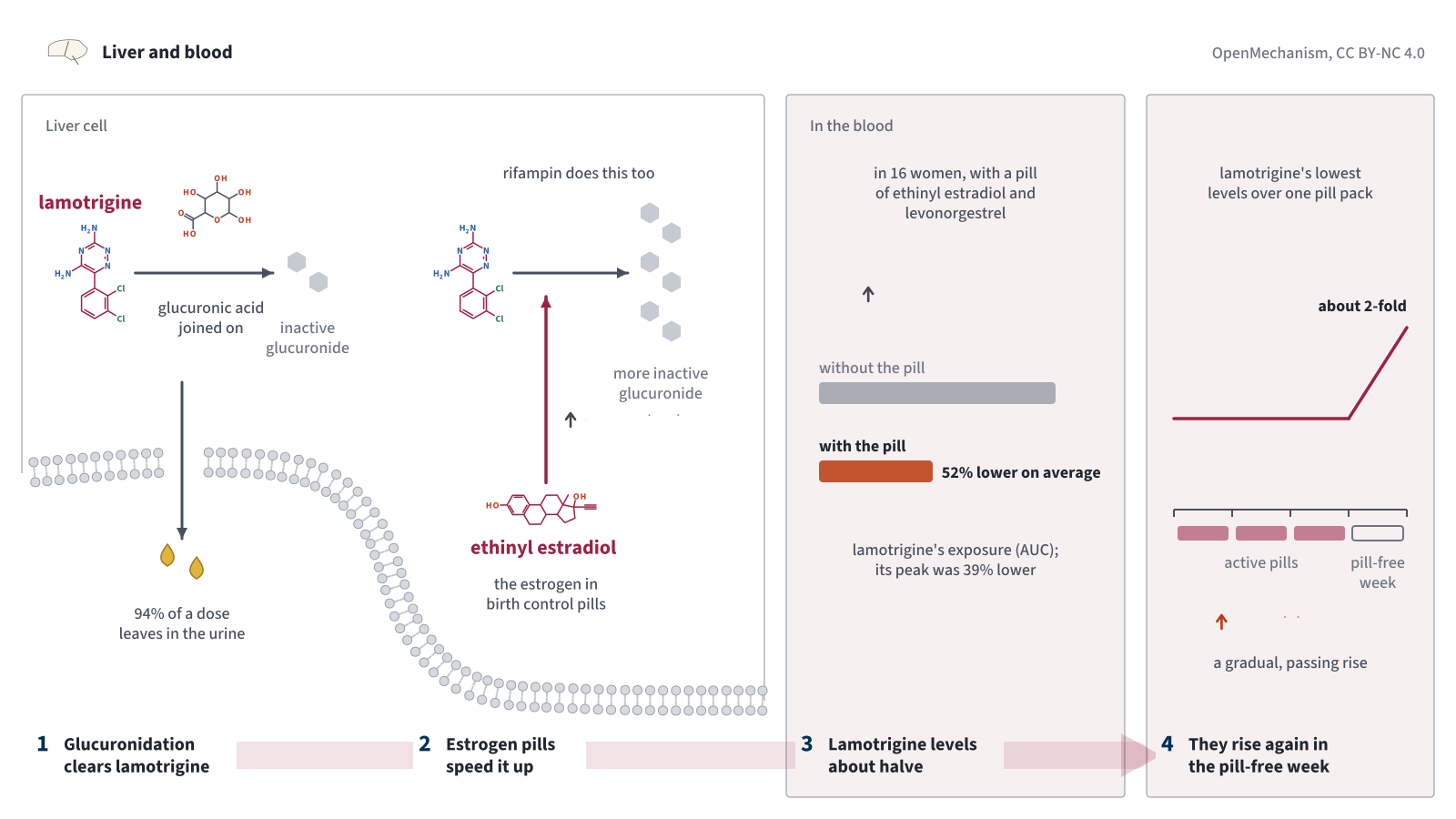
The liver clears lamotrigine mainly by joining it to glucuronic acid. Estrogen-containing birth control pills speed this up: in one study lamotrigine's clearance about doubled and its levels fell by about half. In the pill-free week the levels rose again, about 2-fold.
Glucuronidation clears lamotrigine. Lamotrigine is metabolized mainly by joining it to glucuronic acid, which makes an inactive glucuronide; nearly all of a dose leaves in the urine.1
What the source says
“it is conceivable that plasma concentrations of this metabolite could be increased in patients with a reduced capacity to glucuronidate lamotrigine (e.g., in patients with liver disease, patients taking concomitant medications that inhibit glucuronidation)”
Estrogen pills speed it up. Estrogen-containing birth control pills, like rifampin, speed up lamotrigine's glucuronidation and so its clearance. The label says it has been reported that ethinyl estradiol, the estrogen, and not the progestins, raised lamotrigine's clearance up to 2-fold.1
What the source says
“Estrogen-containing oral contraceptives and other drugs, such as rifampin and protease inhibitors lopinavir/ritonavir and atazanavir/ritonavir, that induce lamotrigine glucuronidation have also been shown to increase the apparent clearance of lamotrigine”
Lamotrigine levels about halve. In 16 female volunteers taking lamotrigine 300 mg a day, a pill with 30 mcg ethinyl estradiol and 150 mcg levonorgestrel about doubled lamotrigine's clearance: its exposure () fell by 52% and its peak by 39%, on average. A norethindrone and ethinyl estradiol label (Alyacen) says such a fall may reduce seizure control.1,2
What the source says
“In 16 female volunteers, an oral contraceptive preparation containing 30 mcg ethinylestradiol and 150 mcg levonorgestrel increased the apparent clearance of lamotrigine (300 mg/day) by approximately 2-fold with mean decreases in AUC of 52% and in C max of 39%.”
“Significant decrease in plasma concentration of lamotrigine has been shown, likely due to induction of lamotrigine glucuronidation. This may reduce seizure control”
They rise again in the pill-free week. During the week of inactive pills, lamotrigine's lowest levels rose gradually, to about twice those at the end of the active pills on average, in women not also taking another medicine that speeds lamotrigine's clearance, such as carbamazepine, phenytoin or rifampin. The label says adverse reactions consistent with the higher levels, such as dizziness, ataxia and diplopia, could occur.1
What the source says
“trough serum lamotrigine concentrations gradually increased and were approximately 2-fold higher on average at the end of the week of the inactive hormone preparation compared with trough lamotrigine concentrations at the end of the active hormone cycle.”
“Gradual transient increases in lamotrigine plasma levels (approximate 2-fold increase) occurred during the week of inactive hormone preparation (pill-free week) for women not also taking a drug that increased the clearance of lamotrigine (carbamazepine, phenytoin, phenobarbital, primidone, or other drugs such as rifampin and the protease inhibitors lopinavir/ritonavir and atazanavir/ritonavir that induce lamotrigine glucuronidation)”
Also part of this interaction: norethindrone and ethinyl estradiol (“Significant decrease in plasma concentration of lamotrigine has been shown, likely due to induction of lamotrigine glucuronidation.”2).
Lamictal (lamotrigine): FDA label12.2 Pharmacodynamics; 12.3 Pharmacokinetics; 7 Drug Interactions; 5.9 Concomitant Use with Estrogen-Containing Products, Including Oral Contraceptives. Saved copy
The labels' dosing advice for women who start or stop these pills is left out: this page explains the mechanism, not what to do.1
In the same study, lamotrigine did not change the pill's ethinyl estradiol but lowered its levonorgestrel (exposure by 19% on average). None of the 16 women showed hormonal signs of ovulation, although their FSH, LH and estradiol showed some loss of suppression of the hypothalamic-pituitary-ovarian axis; the label says the clinical significance of these hormone changes is unknown and that decreased contraceptive efficacy in some patients cannot be excluded.1
Other hormonal contraceptives and hormone therapy have not been studied systematically, though their effect may be similar. The label says it has been reported that progestin-only pills had no effect on lamotrigine levels.1
Claude Opus 5.5 (AI source check), 3 November 2026: 22 statements compared with their sources, 5 flagged for the reviewer. An automated check, not a medical review.
Next review due
4 May 2028
Cite this page
Tran D. Lamotrigine with estrogen-containing contraceptives [Internet]. OpenMechanism; 2026 [updated 2026 Nov 3; cited 2026 Nov 3]. Available from: https://openmechanism.com/explained/lamotrigine-and-estrogen-contraceptives