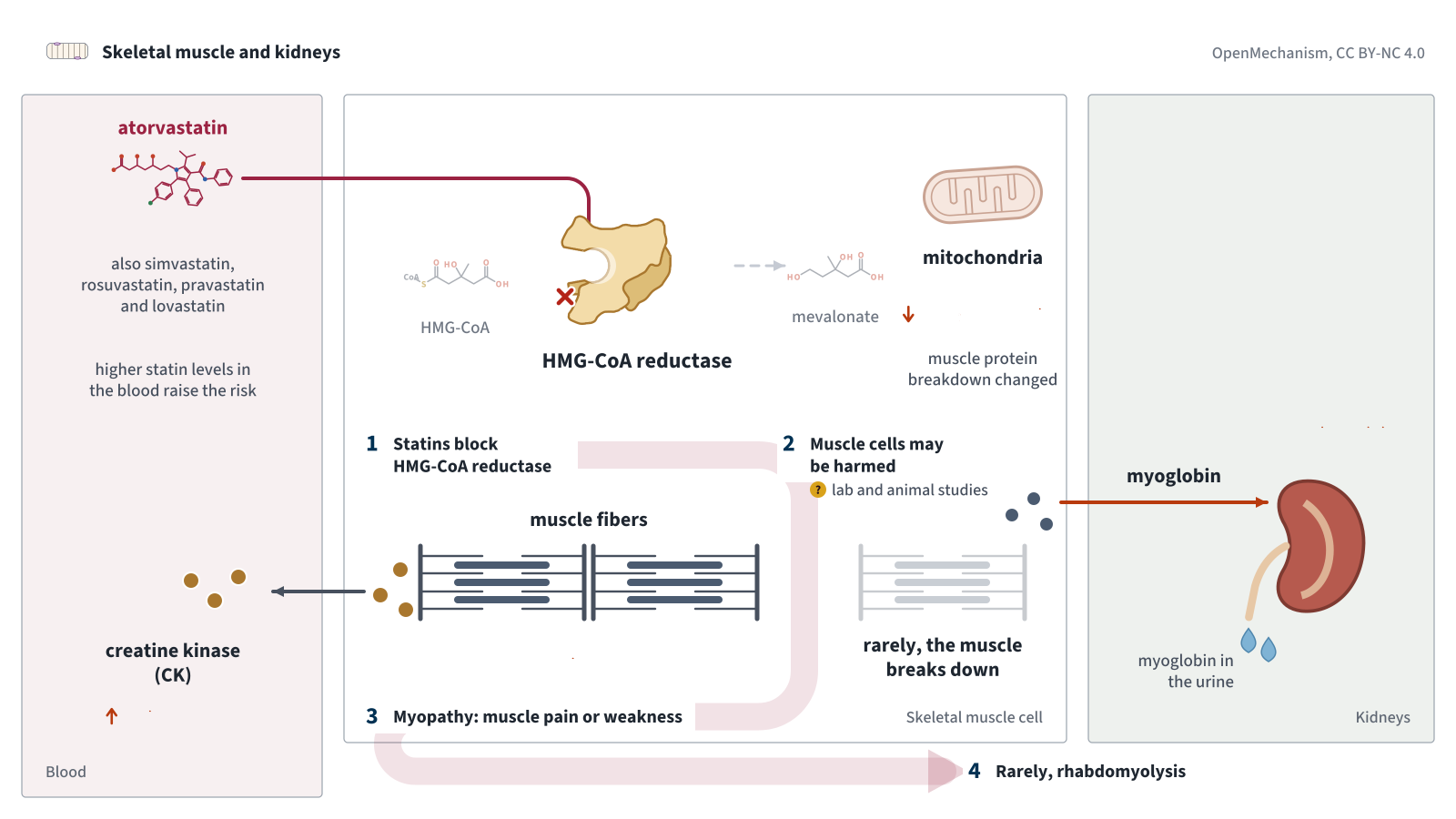
Statins block HMG-CoA reductase, the enzyme of an early step in making cholesterol. Their labels warn of myopathy, muscle pain or weakness with a raised creatine kinase, and rhabdomyolysis, a muscle breakdown that can injure the kidneys and has rarely been fatal. The cause is probably the same enzyme blocked in muscle; how that harms muscle comes mainly from laboratory and animal studies.
Schematic, not to scale. HMG-CoA reductase outline from the structure with atorvastatin. License CC BY-NC 4.0.
?Step 2: lab and animal studies
The European Atherosclerosis Society's 2015 consensus statement says: Preclinical studies show that statins decrease mitochondrial function, attenuate energy production, and alter muscle protein degradation, thereby providing a potential link between statins and muscle symptoms; controlled mechanistic and genetic studies in humans are necessary to further understanding.
Clinical study: A 2013 cross-sectional study in people compared muscle samples from 10 people taking simvastatin with 9 matched people who were not, measuring coenzyme Q10 and the mitochondria's capacity to make energy (OXPHOS capacity): A decreased Q(10) content was accompanied by a decreased maximal OXPHOS capacity in the simvastatin-treated patients.Larsen S et al., J Am Coll Cardiol 2013 (PMID 23287371)
Statins block HMG-CoA reductase. Atorvastatin, simvastatin (through its active form, simvastatin acid), rosuvastatin, pravastatin and lovastatin each block , the enzyme that turns into mevalonate, an early step in making cholesterol.1,2,3,4,5
What the source says
“LIPITOR is a selective, competitive inhibitor of HMG-CoA reductase, the rate-limiting enzyme that converts 3-hydroxy-3-methylglutaryl-coenzyme A to mevalonate, a precursor of sterols, including cholesterol.”
“Simvastatin acid and its metabolites are inhibitors of HMG-CoA reductase, the rate-limiting enzyme that converts HMG-CoA to mevalonate, a precursor of cholesterol.”
“Rosuvastatin tablets is an inhibitor of HMG-CoA reductase, the rate-limiting enzyme that converts 3-hydroxy-3-methylglutaryl coenzyme A to mevalonate, a precursor of cholesterol.”
“Pravastatin is a reversible inhibitor of HMG-CoA reductase, the rate-limiting enzyme that converts HMG-CoA to mevalonate, a precursor of cholesterol.”
“Lovastatin is a specific inhibitor of HMG-CoA reductase, the enzyme which catalyzes the conversion of HMG-CoA to mevalonate. The conversion of HMG-CoA to mevalonate is an early step in the biosynthetic pathway for cholesterol.”
Muscle cells may be harmed. is probably caused by blocking this enzyme in skeletal muscle itself. In laboratory and animal (preclinical) studies, statins lower the mitochondria's function and energy production and change how muscle proteins are broken down: a potential link to muscle symptoms that still needs controlled studies in people.6,7
What the source says
“Myopathy, probably caused by 3-hydroxy-3-methylglutaryl-coenzyme A reductase inhibition in skeletal muscle, rarely occurs in patients taking statins.”
“Preclinical studies show that statins decrease mitochondrial function, attenuate energy production, and alter muscle protein degradation, thereby providing a potential link between statins and muscle symptoms; controlled mechanistic and genetic studies in humans are necessary to further understanding.”
Myopathy: muscle pain or weakness. Statins may cause myopathy: muscle pain, tenderness or weakness with a raised (CK) in the blood, which the simvastatin and lovastatin labels put at more than ten times the upper limit of normal. A European expert panel calls it rare but serious, affecting about 1 in 1,000 to 1 in 10,000 people on standard doses; it is more likely with higher statin levels in the blood. The labels list as risk factors age 65 or older, uncontrolled hypothyroidism, kidney impairment, some other medicines and higher doses; the simvastatin label says Chinese patients, and the rosuvastatin label Asian patients, may be at higher risk.1,2,3,5,7
What the source says
“LIPITOR may cause myopathy (muscle pain, tenderness, or weakness associated with elevated creatine kinase [CK]) and rhabdomyolysis.”
“Statin-associated myopathy, with significant elevation of serum creatine kinase (CK), is a rare but serious side effect of statins, affecting 1 per 1000 to 1 per 10 000 people on standard statin doses.”
“Risk factors for myopathy include age 65 years or greater, uncontrolled hypothyroidism, renal impairment, concomitant use with certain other drugs (including other lipid-lowering therapies), and higher LIPITOR dosage”
“myopathy, defined as unexplained muscle weakness, pain, or tenderness accompanied by creatinine kinase (CK) increases greater than ten times the upper limit of normal (10xULN)”
“occasionally causes myopathy manifested as muscle pain, tenderness or weakness with creatine kinase (CK) above ten times the upper limit of normal (ULN)”
Rarely, rhabdomyolysis. Myopathy sometimes takes the form of , a breakdown of muscle. It has caused acute kidney injury from myoglobin in the urine (myoglobinuria), and rare deaths.3,4,5
What the source says
“Myopathy sometimes takes the form of rhabdomyolysis with or without acute renal failure secondary to myoglobinuria, and rare fatalities have occurred.”
“Acute kidney injury secondary to myoglobinuria and rare fatalities have occurred as a result of rhabdomyolysis in patients treated with statins, including pravastatin.”
“Acute kidney injury secondary to myoglobinuria and rare fatalities have occurred as a result of rhabdomyolysis with statins, including rosuvastatin tablets.”
Can raise or cause it: cyclosporine (“The risk of myopathy and rhabdomyolysis is increased with concomitant use of cyclosporine or gemfibrozil with LIPITOR.”1).
In large placebo-controlled trials, statins caused a small excess of mostly mild muscle pain, and over 90% of the muscle symptoms reported by people taking a statin were not due to the statin.8
The labels say muscle symptoms and CK increases may go away when the statin is stopped.2
Medicines that block CYP3A4, the enzyme that breaks atorvastatin down, or the transporters that carry it can raise its levels and may increase the risk of myopathy and rhabdomyolysis; the atorvastatin and CYP3A4 page explains it.1
The Lipitor label adds that fibrates may cause myopathy when given alone, and that taking them with atorvastatin raises the risk of myopathy and rhabdomyolysis.1
Rarely, statins are linked to immune-mediated necrotizing myopathy (IMNM), an autoimmune muscle disease whose weakness and raised CK persist after the statin is stopped; this page does not cover it.2
The labels' dose limits and management advice are left out: this page explains the mechanism, not what to do.
text e96448f5ae08…; drawings b481f01925dd…; notes 1c2539943d29…
AI source check
Claude Opus 5.5 (AI source check), 29 October 2026: 34 statements compared with their sources, 5 flagged for the reviewer. An automated check, not a medical review.
Conflict of interest
Atorvastatin: Pfizer, the reviewer's former employer, used to market this medicine as Lipitor. The label this site cites is from Viatris. Details
Key terms
Definitions reworded since this review: myopathy and rhabdomyolysis. Definitions are shared across pages, so a later rewording does not take the review line off (what a review covers).
Next review due
29 April 2028
Cite this page
Tran D. Why statins can cause muscle problems [Internet]. OpenMechanism; 2026 [updated 2026 Oct 29; cited 2026 Oct 29]. Available from: https://openmechanism.com/explained/statin-muscle-problems