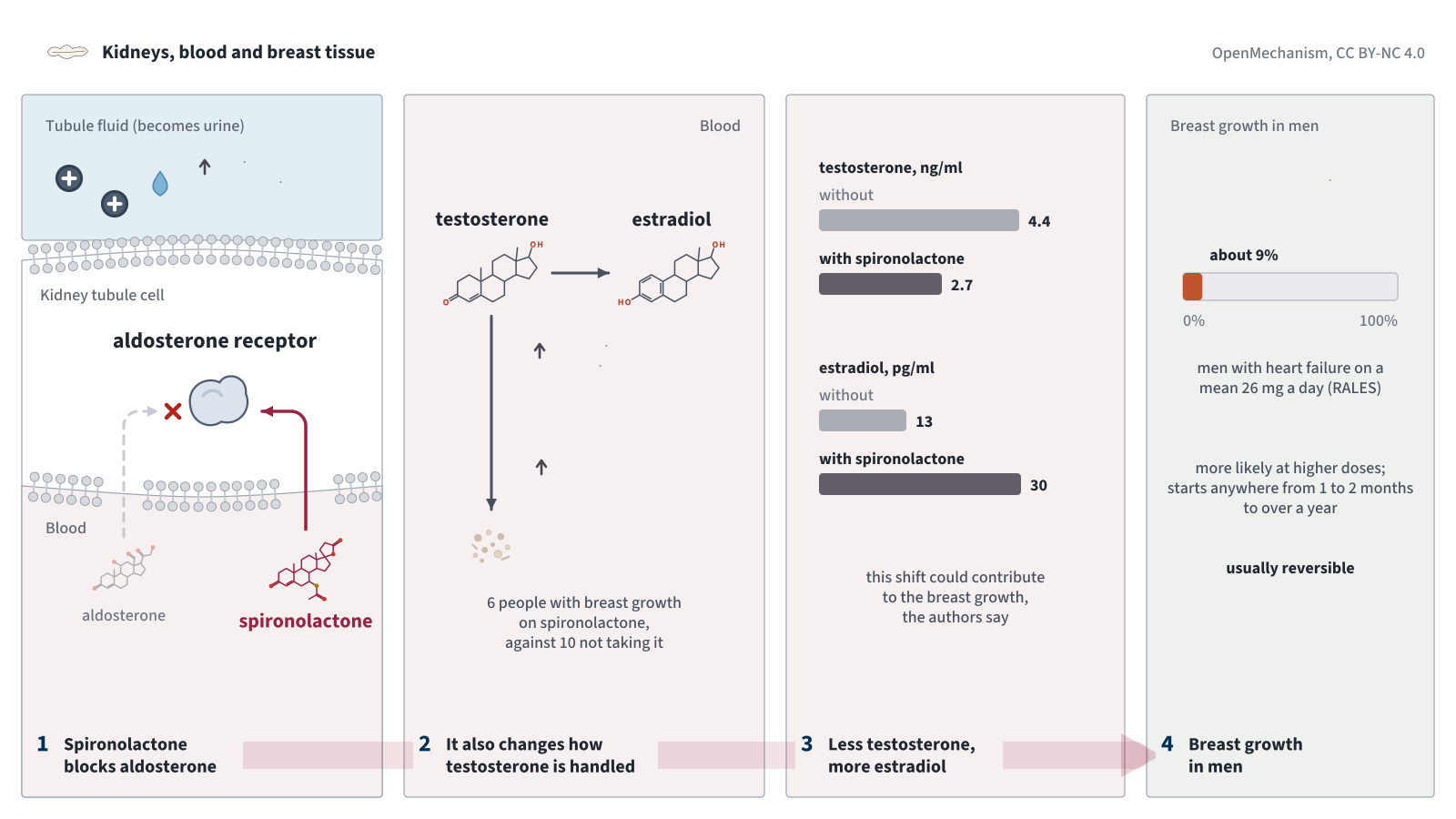
Spironolactone blocks aldosterone, so the kidneys excrete more salt and water. It can also cause breast growth in men (gynecomastia), more often at higher doses and usually reversible. In a small study, men who had developed breast growth on it had less testosterone and more estradiol than people not taking it, mainly because testosterone was cleared faster and more of it was turned into estradiol.
Spironolactone blocks aldosterone. Spironolactone works mainly by competing with for its receptors in the kidney tubule, so more sodium and water leave in the urine while potassium is kept.1
What the source says
“Spironolactone and its active metabolites are specific pharmacologic antagonists of aldosterone, acting primarily through competitive binding of receptors at the aldosterone-dependent sodium-potassium exchange site in the distal convoluted renal tubule.”
It also changes how testosterone is handled. In a study of 16 people with high blood pressure, the 6 treated with spironolactone, who developed breast growth, cleared testosterone faster and turned more of it into estradiol, an estrogen.2
What the source says
“Peripheral blood levels of testosterone, estradiol, luteinizing hormone, and follicle-stimulating hormone and the metabolic clearance rates of testosterone and estradiol, as well as the peripheral conversion of testosterone into estradiol, were measured in 16 patients with hypertension.”
“These changes were primarily due to significant increases in the metabolic clearance rate of testosterone (P less than 0.02) and in the rate of peripheral conversion of testosterone into estradiol (P less than 0.001) in the spironolactone-treated group.”
Less testosterone, more estradiol. Their testosterone was lower than in the 10 people not taking it (2.7 against 4.4 ng/ml) and their estradiol higher (30 against 13 pg/ml). The authors say this shifted balance could contribute to the breast growth.2
What the source says
“The blood testosterone level in the spironolactone-treated group (2.7 +/- 0.5 ng/ml) was significantly less (P less than 0.02) than in the control group (4.4 +/- 0.4 ng/ml).”
“On the other hand, blood estradiol levels in the spironolactone group (30 +/- 4 pg/ml) were significantly greater (P less than 0.01) than in the control group (13 +/- 2 pg/ml).”
“Thus, spironolactone does alter the peripheral metabolism of testosterone resulting in changes in the ratio of testosterone to estradiol, which could contribute to the production of gynecomastia.”
Breast growth in men. Spironolactone can cause gynecomastia: in the RALES trial, about 9% of men with heart failure taking a mean 26 mg a day developed it. The risk rises with the dose, it can start anywhere from 1 to 2 months to over a year, and it is usually reversible.3
What the source says
“ALDACTONE can cause gynecomastia. In RALES, patients with heart failure treated with a mean dose of 26 mg of spironolactone once daily, about 9% of the male subjects developed gynecomastia.”
“The risk of gynecomastia increases in a dose-dependent manner with an onset that varies widely from 1–2 months to over a year. Gynecomastia is usually reversible.”
Claude Opus 5.5 (AI source check), 29 October 2026: 22 statements compared with their sources, 7 flagged for the reviewer. An automated check, not a medical review.
Conflict of interest
Spironolactone: Pfizer, the reviewer's former employer, makes or markets this medicine. Details
Next review due
29 April 2028
Cite this page
Tran D. Why spironolactone can cause breast growth [Internet]. OpenMechanism; 2026 [updated 2026 Oct 29; cited 2026 Oct 29]. Available from: https://openmechanism.com/explained/spironolactone-and-breast-growth