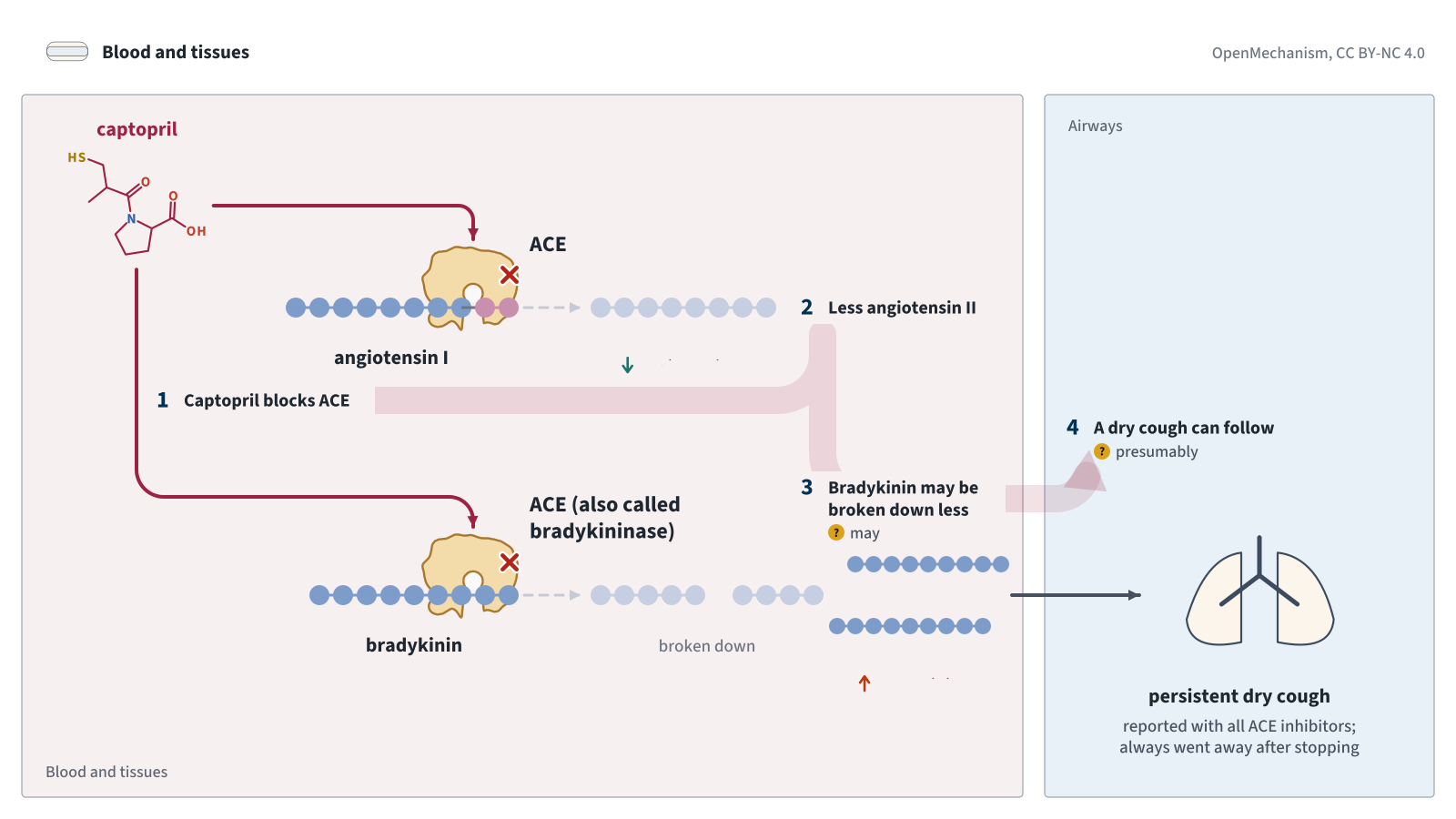
Captopril and the other ACE inhibitors block ACE, the enzyme that makes angiotensin II. ACE also breaks down a peptide called bradykinin. The label says a persistent dry cough, reported with all ACE inhibitors, is presumably caused by bradykinin being broken down less.
Schematic, not to scale. ACE outline from the structure with lisinopril. License CC BY-NC 4.0.
?Step 3: may
The captopril label says: ACE is identical to “bradykininase”, and captopril tablets may also interfere with the degradation of the vasodepressor peptide, bradykinin.
Clinical study: In a 1998 randomized, single-blind study of 27 people (20 with normal and 7 with high blood pressure), studied while salt-depleted (10 mmol of sodium a day) and given the drugs on four separate study days, a bradykinin-receptor blocker weakened captopril's effect on blood pressure: These data confirm that bradykinin contributes to the short-term effects of ACE inhibition on blood pressure in normotensive and hypertensive personsGainer JV et al., N Engl J Med 1998 (PMID 9791144)
?Step 4: presumably
The captopril label says: Presumably due to the inhibition of the degradation of endogenous bradykinin, persistent nonproductive cough has been reported with all ACE inhibitors, always resolving after discontinuation of therapy.
Clinical study: In a double-blind trial in 135 people with high blood pressure whose cough on an ACE inhibitor came back when they took one again, cough was reported less often over 8 weeks with losartan, which blocks the angiotensin II receptor rather than ACE, than with lisinopril, an ACE inhibitor; the abstract reports no bradykinin measurements: The incidence of cough related to the type 1 Ang II receptor antagonist losartan is significantly lower than that observed with lisinopril, and similar to that observed with hydrochlorothiazide in patients with a rechallenged ACE inhibitor cough.Lacourcière Y et al., J Hypertens 1994 (PMID 7706699)
Captopril blocks ACE. Captopril is a competitive inhibitor of , the enzyme that turns angiotensin I into .1
What the source says
“Captopril is a specific competitive inhibitor of angiotensin I-converting enzyme (ACE), the enzyme responsible for the conversion of angiotensin I to angiotensin II.”
Bradykinin may be broken down less. ACE is the same enzyme as bradykininase, which breaks down the peptide bradykinin, so captopril may also slow the breakdown of bradykinin.1
What the source says
“ACE is identical to “bradykininase”, and captopril tablets may also interfere with the degradation of the vasodepressor peptide, bradykinin.”
A dry cough can follow. The label says a persistent dry cough, reported with all ACE inhibitors, is presumably due to this slower breakdown of bradykinin, and that it always resolved after the medicine was stopped.1
What the source says
“Presumably due to the inhibition of the degradation of endogenous bradykinin, persistent nonproductive cough has been reported with all ACE inhibitors, always resolving after discontinuation of therapy.”
The label says the cough is “presumably” caused by bradykinin; the cause is not proven.1
In captopril's clinical trials, cough was reported in 0.5 to 2% of patients.1
Swelling of the face, lips or airway (angioedema) is also reported with ACE inhibitors; the label lists it under reactions it presumes come from ACE inhibitors' effects on bradykinin and other substances.1
text 5e9c28c7a8ce…; drawings a9e046fa079d…; notes 6dd118a0384b…
AI source check
Claude Opus 5.5 (AI source check), 28 October 2026: 41 statements compared with their sources, 0 flagged for the reviewer. An automated check, not a medical review.
Next review due
28 April 2028
Cite this page
Tran D. Why ACE inhibitors can cause a dry cough [Internet]. OpenMechanism; 2026 [updated 2026 Oct 28; cited 2026 Oct 28]. Available from: https://openmechanism.com/explained/ace-inhibitor-cough