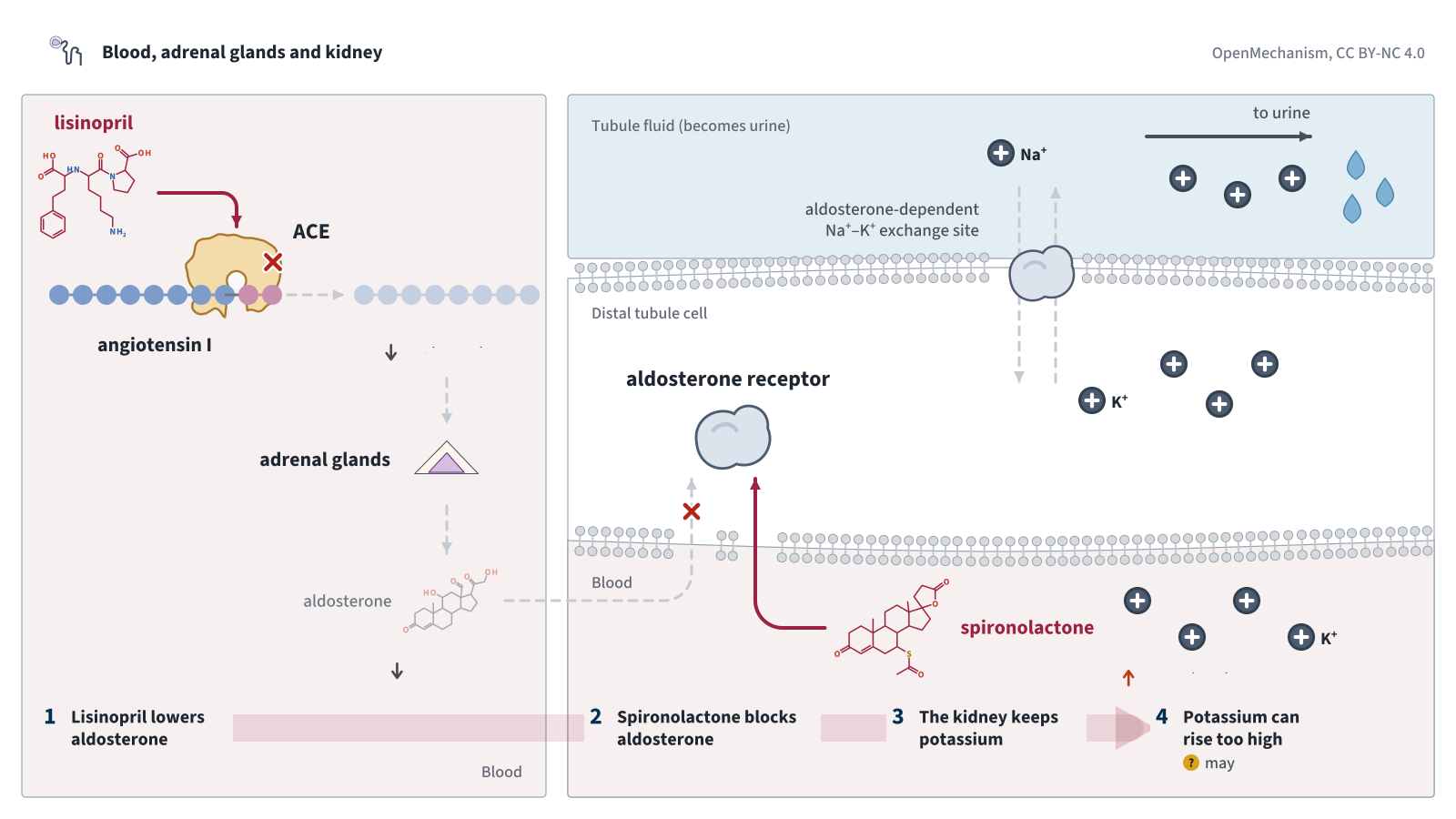
ACE inhibitors such as lisinopril lower the hormone aldosterone, and spironolactone blocks its action in the kidney, which then keeps potassium. The labels say that taken together they raise the risk of hyperkalemia, too much potassium in the blood, and the spironolactone label says it may be severe.
The Aldactone label says: Concomitant administration of ALDACTONE with potassium supplementation or drugs that can increase potassium may lead to severe hyperkalemia.
Clinical study: In a 2004 population-based study that followed linked prescription and hospital records for more than 1.3 million adults 66 or older in Ontario, Canada, from 1994 through 2001, spironolactone prescriptions for people taking ACE inhibitors who had recently been in the hospital for heart failure rose after a trial (RALES) showed its benefit in severe heart failure; the study counted hospital admissions and deaths with hyperkalemia: The rate of hospitalization for hyperkalemia rose from 2.4 per 1000 patients in 1994 to 11.0 per 1000 patients in 2001 … the associated mortality rose from 0.3 per 1000 to 2.0 per 1000 patientsJuurlink DN et al., N Engl J Med 2004 (PMID 15295047)
Lisinopril lowers aldosterone. Lisinopril, an , blocks ACE, the enzyme that turns angiotensin I into . Angiotensin II makes the adrenal glands release , so with less of it, less aldosterone is released.1
What the source says
“Lisinopril inhibits angiotensin-converting enzyme (ACE) in human subjects and animals. ACE is a peptidyl dipeptidase that catalyzes the conversion of angiotensin I to the vasoconstrictor substance, angiotensin II. Angiotensin II also stimulates aldosterone secretion by the adrenal cortex.”
Spironolactone blocks aldosterone. Spironolactone blocks aldosterone mainly by competing with it for its receptors at the aldosterone-dependent sodium-potassium exchange site in the kidney's distal tubule.2
What the source says
“Spironolactone and its active metabolites are specific pharmacologic antagonists of aldosterone, acting primarily through competitive binding of receptors at the aldosterone-dependent sodium-potassium exchange site in the distal convoluted renal tubule.”
The kidney keeps potassium. Spironolactone makes the kidney pass more sodium and water into the urine while it keeps potassium. The lower aldosterone from lisinopril may also raise blood potassium a little on its own.1,2
What the source says
“Spironolactone causes increased amounts of sodium and water to be excreted, while potassium is retained.”
Potassium can rise too high. The labels say taking the two together raises the risk of , too much potassium in the blood. The lisinopril label names spironolactone among the medicines that can increase the risk, and the spironolactone label names ACE inhibitors among the medicines that increase it, and says that taking spironolactone with them may lead to severe hyperkalemia.1,2
What the source says
“Potassium-sparing diuretics (spironolactone, amiloride, triamterene, and others) can increase the risk of hyperkalemia.”
“ALDACTONE can cause hyperkalemia. This risk is increased by impaired renal function or concomitant potassium supplementation, potassium-containing salt substitutes or drugs that increase potassium, such as angiotensin converting enzyme inhibitors and angiotensin receptor blockers”
“or drugs that can increase potassium, including ACE inhibitors, angiotensin II antagonists, non-steroidal anti-inflammatory drugs (NSAIDs), heparin and low molecular weight heparin, may lead to severe hyperkalemia”
Also part of this interaction: enalapril (“Inhibition of ACE results in decreased plasma angiotensin II, which leads to decreased vasopressor activity and to decreased aldosterone secretion. Although the latter decrease is small, it results in small increases of serum potassium.”3); captopril (“Since captopril decreases aldosterone production, elevation of serum potassium may occur.”4); and benazepril (“Inhibition of ACE results in decreased plasma angiotensin II, which leads to decreased vasopressor activity and to decreased aldosterone secretion. The latter decrease may result in a small increase of serum potassium.”5).
The labels' doses and management advice are left out: this page explains the mechanism, not what to do.
The labels name other things that raise the risk too, such as weaker kidney function, diabetes, potassium supplements and salt substitutes that contain potassium.1
The labels do not say how much more potassium the kidney keeps when the two are taken together.
text 2a23bd6e5134…; drawings 07f7b1ea24d9…; notes 47a668ce6709…
AI source check
Claude Opus 5.5 (AI source check), 28 October 2026: 28 statements compared with their sources, 3 flagged for the reviewer. An automated check, not a medical review.
Conflict of interest
Spironolactone: Pfizer, the reviewer's former employer, makes or markets this medicine. Details
Next review due
28 April 2028
Cite this page
Tran D. ACE inhibitors and spironolactone [Internet]. OpenMechanism; 2026 [updated 2026 Oct 28; cited 2026 Oct 28]. Available from: https://openmechanism.com/explained/ace-inhibitors-and-spironolactone