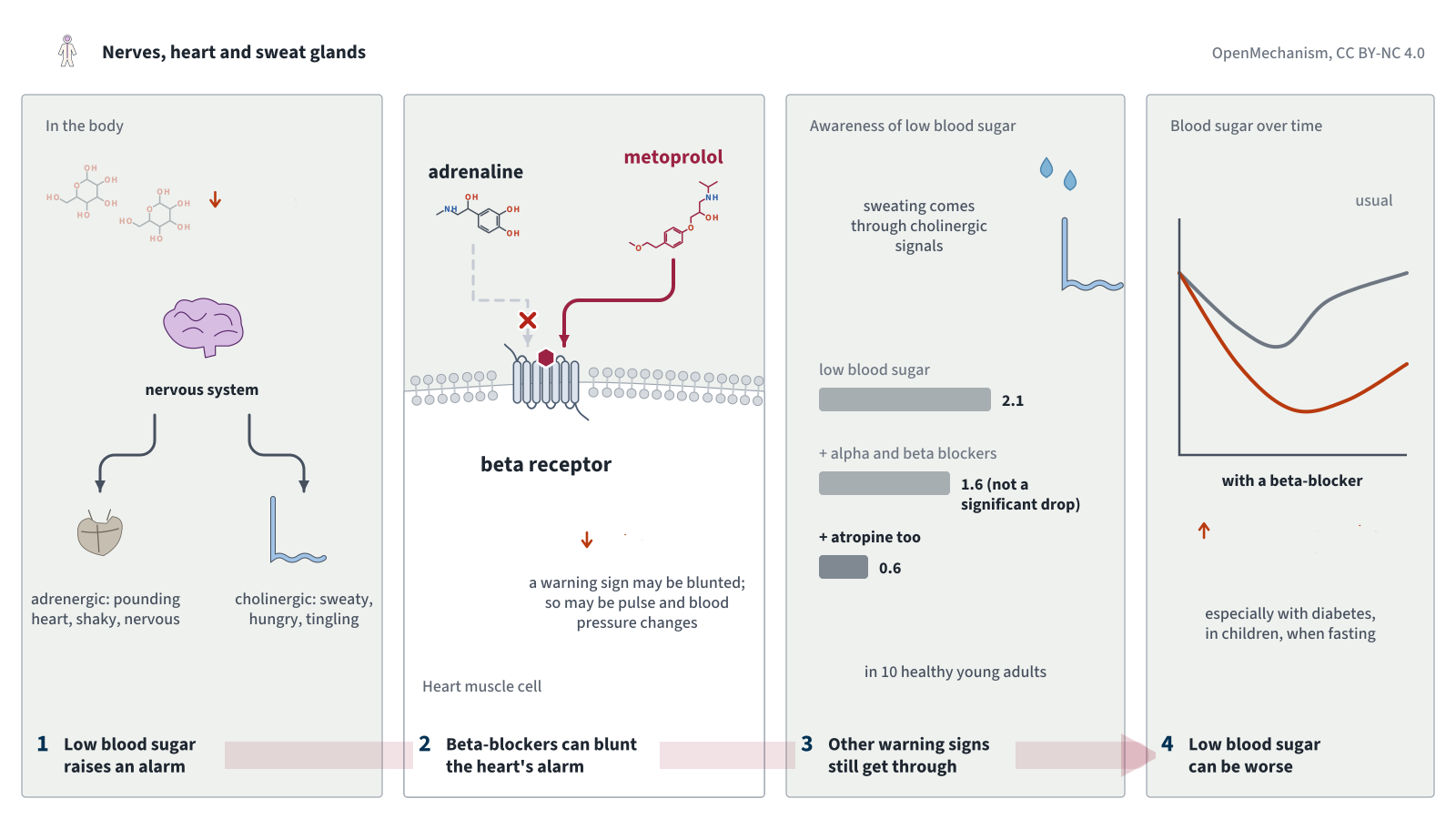
When blood sugar falls too low, the nervous system raises the alarm; in a study of 10 healthy young adults, a pounding heart, shakiness and nervousness came through adrenergic signals, and sweating and hunger through cholinergic ones. Beta-blockers such as metoprolol and propranolol may block early warning signs such as a fast heartbeat, and the insulin label lists them among medicines that may blunt the signs of low blood sugar. They may also raise the risk of severe or long-lasting low blood sugar. In the same study, awareness of low blood sugar still came through when adrenergic signals were blocked.
Low blood sugar raises an alarm. When blood sugar falls too low, the nervous system sends warning signs. In a study of healthy young adults, a pounding heart, shakiness and nervousness came through adrenergic signals, and sweating, hunger and tingling through cholinergic ones.1
What the source says
“Awareness of hypoglycemia and 19 symptoms were quantitated in 10 normal, young adults, each studied on four occasions in random sequence”
Beta-blockers can blunt the heart's alarm. Beta-blockers may block early warning signs of low blood sugar, such as a fast heartbeat (tachycardia) and changes in pulse and blood pressure, and the insulin label lists them among medicines that may blunt its signs and symptoms.2,3,4
What the source says
“Beta-blockers may prevent early warning signs of hypoglycemia, such as tachycardia”
“Beta-adrenergic blockade may prevent the appearance of certain premonitory signs and symptoms (pulse rate and pressure changes) of acute hypoglycemia, especially in labile insulin-dependent diabetics.”
Other warning signs still get through. In the same study, blocking adrenergic signals (alpha and beta together, with phentolamine and propranolol) did not significantly lower awareness of low blood sugar, while blocking cholinergic signals as well, with atropine, cut it by about 70%.1
What the source says
“clamped hypoglycemia with combined alpha- and beta-adrenergic blockade (phentolamine and propranolol)”
“This increase was not reduced significantly by adrenergic blockade (1.6 +/- 0.5), but was reduced significantly and substantially (approximately 70%) by pan-autonomic blockade (0.6 +/- 0.3).”
Low blood sugar can be worse. Beta-blockers may also raise the risk of severe or long-lasting low blood sugar at any time during treatment, especially in people with diabetes, children and people who are fasting.2
What the source says
“Beta-blockers may prevent early warning signs of hypoglycemia, such as tachycardia, and increase the risk for severe or prolonged hypoglycemia at any time during treatment, especially in patients with diabetes mellitus or children and patients who are fasting (i.e., surgery, not eating regularly, or are vomiting).”
The labels' advice on checking blood sugar is left out: this page explains the mechanism, not what to do.
The study gave alpha- and beta-blockers together to healthy young adults; it did not test a beta-blocker alone or people with diabetes.1
The insulin label says awareness of low blood sugar may be weaker in people taking medicines that block the sympathetic nervous system, such as beta-blockers, and also in people with long-standing diabetes or diabetic nerve damage, or after repeated low blood sugar.5
The metoprolol label gives the blunted warning signs and the higher risk of severe or long-lasting low blood sugar as separate effects; the labels don't say that one causes the other.2
Claude Opus 5.5 (AI source check), 30 October 2026: 25 statements compared with their sources, 9 flagged for the reviewer. An automated check, not a medical review.
Next review due
30 April 2028
Cite this page
Tran D. Why beta-blockers can hide low blood sugar [Internet]. OpenMechanism; 2026 [updated 2026 Oct 30; cited 2026 Oct 30]. Available from: https://openmechanism.com/explained/beta-blockers-and-low-blood-sugar