Timolol
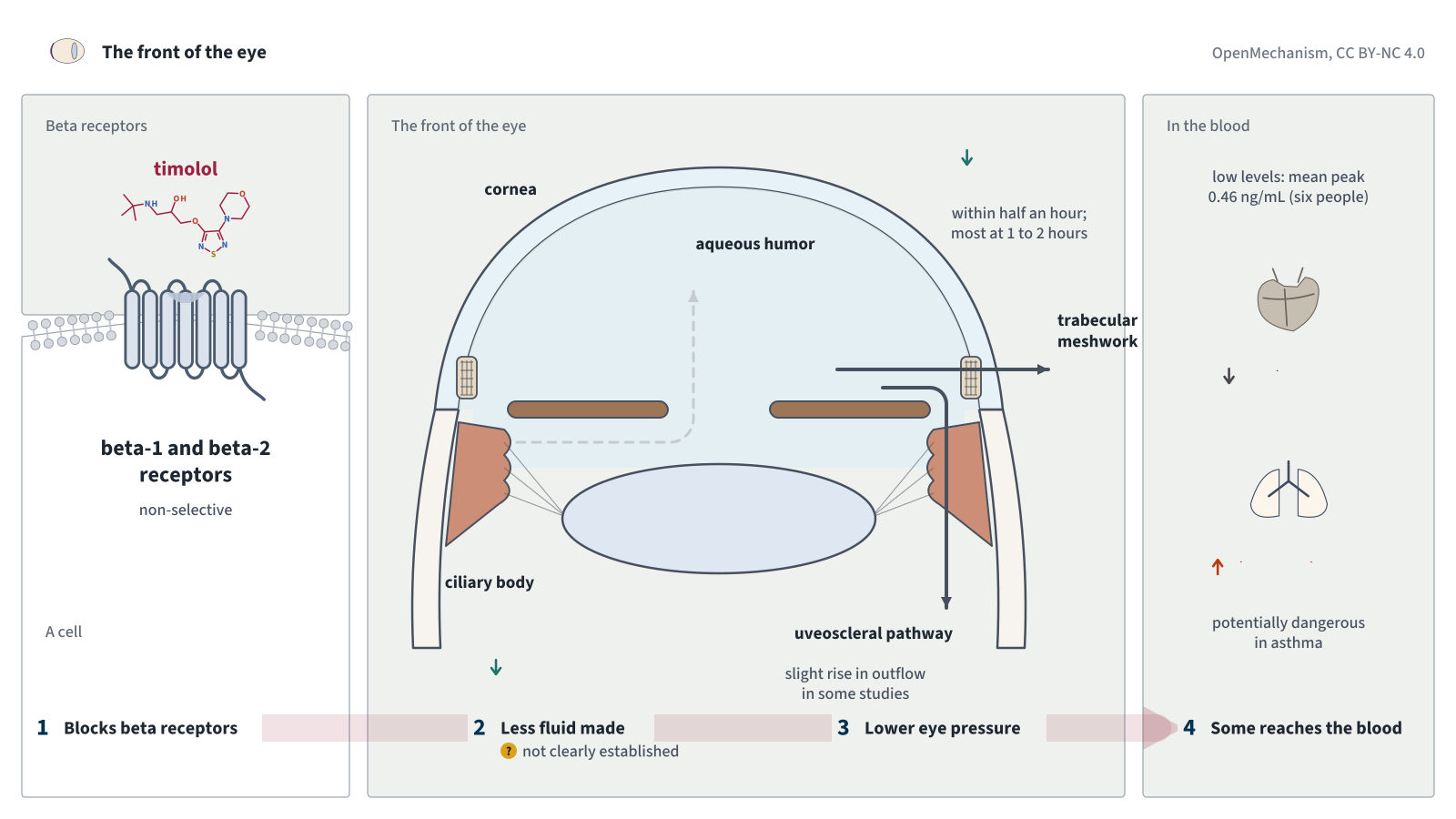
Timolol eye drops block beta-1 and beta-2 receptors. How this lowers eye pressure is not clearly established; studies suggest the main effect may be that the eye makes less of its fluid, the aqueous humor. The pressure starts to fall within half an hour. A little timolol reaches the blood, where beta blocking lowers the heart's output and raises resistance in the airways.
- Acts on
- Beta-1 and beta-2 adrenergic receptors (non-selective)
- Where
- The front of the eye
- Medicine type
- Small molecule
- Used for
- Eyes & ears
- Drug class
- Beta blockers
Also called Timoptic.
Step 2: not clearly established
The Timoptic (timolol) label says: The precise mechanism of the ocular hypotensive action of TIMOPTIC is not clearly established at this time. … Tonography and fluorophotometry studies in man suggest that its predominant action may be related to reduced aqueous formation.
Source 1: Timoptic (timolol maleate ophthalmic solution): FDA label, Clinical Pharmacology
Clinical study: In a randomized, placebo-controlled study of a single drop in 23 people with normal eyes, measured by fluorophotometry: Timolol suppressed aqueous formation in all subjects.
Coakes RL, Brubaker RF, Arch Ophthalmol 1978 (PMID 363105)
This study was picked with a literature search and is not yet checked by our reviewer.
How it works
Blocks beta receptors. Timolol blocks both beta-1 and beta-2 adrenergic receptors (it is non-selective), without significant intrinsic sympathomimetic, direct heart-depressing or local anesthetic (membrane-stabilizing) activity.1
Less fluid made. The ciliary body and the trabecular meshwork are the two main structures that handle the aqueous humor, the fluid inside the front of the eye. How timolol lowers eye pressure is not clearly established: tonography and fluorophotometry studies in people suggest its main action may be making less aqueous humor, though some studies also saw a slight increase in outflow.1,2
Lower eye pressure. Timolol lowers raised and normal eye pressure, with or without glaucoma. The fall starts within half an hour of a drop, is greatest in 1 to 2 hours and can last up to 24 hours.1
Some reaches the blood. With drops twice a day, timolol reached the blood at low levels (a mean peak of 0.46 ng/mL in six people). Beta blockade lowers the heart's output, and in the airways it raises resistance, which is potentially dangerous in people with asthma.1
For teachers: download this drawing.
See also
Condition pages: glaucoma.
Other beta blockers: atenolol, carvedilol, esmolol, labetalol, metoprolol, nebivolol, propranolol and sotalol.
Explained: why beta-blockers can tighten the airways.
Related drawings: pilocarpine (lowers eye pressure by draining more fluid through the trabecular meshwork).
Sources
- 1Timoptic (timolol maleate ophthalmic solution): FDA labelClinical Pharmacology
- 2Aqueous humor dynamics: a reviewGoel M et al., Open Ophthalmol J 2010 (abstract)
- 3ChEMBL CHEMBL499Target and action classification: Beta-1 adrenergic receptor antagonist; Beta-2 adrenergic receptor antagonist
- 4The mechanism of timolol in lowering intraocular pressure. In the normal eyeCoakes RL, Brubaker RF. Arch Ophthalmol 1978 (abstract)
Spotted a mistake? Report an error (hello@openmechanism.com). Since launch, every published error we fix is listed on the corrections page.
Notes and limits
- A schematic teaching drawing: not to scale, not exact structures, binding poses or a complete pathway, and not a guide to dosing, treatment or how a person will respond.
- The label says the precise mechanism of timolol's ocular hypotensive action is not clearly established, and that studies suggest its predominant action may be related to reduced aqueous formation.
All recorded limits are on the evidence page, and notes that apply to every page are on How to read a page. Version 1.0.0, not yet medically reviewed.
Cite this page
Tran D. Timolol [Internet]. OpenMechanism; 2026 [updated 2026 Oct 11; cited 2026 Oct 11]. Available from: https://openmechanism.com/medicines/timolol