Why the combined pill raises the risk of blood clots
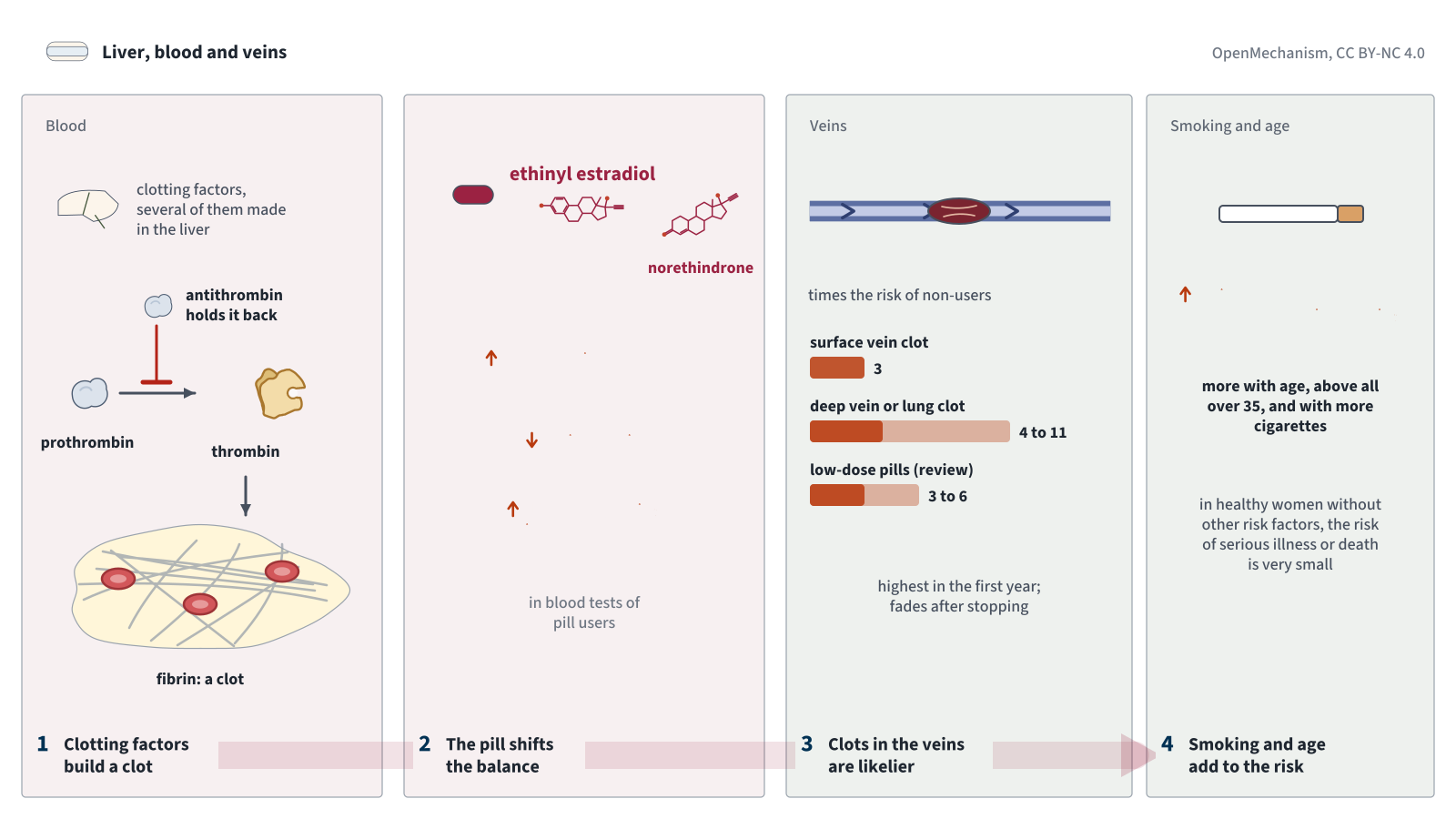
Clotting factors, several of them made in the liver, build clots, and antithrombin holds the process back. In blood tests the combined pill may raise several clotting factors and lower antithrombin. In case-control studies users had 3 to 11 times the risk of clots in the veins (a review puts it at 3 to 6 times with low-dose pills), and the risk is highest in the first year. With the pill, smoking raises the risk of serious heart and blood vessel events, more so with age.
- Kind
- Side effect
- Medicines
- Norethindrone and ethinyl estradiol
- Sources
- 8
For teachers: download this drawing.
Step by step
Clotting factors build a clot. Clotting factors, several of them made in the liver, build a clot step by step: prothrombin becomes thrombin, and thrombin turns fibrinogen into fibrin. Antithrombin holds the process back.1,2,3,4
What the source says
“naturally-occurring vitamin K, which is necessary for the production via the liver of active prothrombin (factor II), proconvertin (factor VII), plasma thromboplastin component (factor IX), and Stuart factor (factor X).”
Source 1“The cascade starts with exposure of tissue factor from the damaged endothelium and culminates with conversion of prothrombin to thrombin”
Source 2“Because thrombin (serine protease) enables the conversion of fibrinogen into fibrin during the coagulation cascade, its inhibition prevents the development of a thrombus.”
Source 3“Several control mechanisms exist for localizing fibrin formation to the site of injury including tissue factor pathway inhibitor, protein C system, antithrombin, and glycosaminoglycans on the vessel wall.”
Source 4The pill shifts the balance. Combined pills may change blood tests: prothrombin and factors VII, VIII, IX and X go up, antithrombin goes down, and platelets clump more readily in a test with norepinephrine.5
Clots in the veins are likelier. In case-control studies, pill users had 3 times the risk of a first clot in a surface vein and 4 to 11 times the risk of a deep vein clot or a clot in the lungs; a review puts the risk with low-dose pills at 3 to 6 times. It is highest in the first year and when restarting after a break of four weeks or more, and it fades after stopping.6,7
What the source says
“Case control studies have found the relative risk of users compared to nonusers to be 3 for the first episode of superficial venous thrombosis, 4 to 11 for deep vein thrombosis or pulmonary embolism, and 1.5 to 6 for women with predisposing conditions for venous thromboembolic disease.”
Source 6“The risk of venous thrombosis during low-dose oral contraceptive use is three- to sixfold increased compared with that of nonusers.”
Source 7“VTE risk is highest in the first year of use and when restarting hormonal contraception after a break of four weeks or longer.”
Source 6“The risk of thromboembolic disease associated with oral contraceptives gradually disappears after combined oral contraceptive (COC) use is stopped.”
Source 6Smoking and age add to the risk. Smoking raises the risk of serious heart and blood vessel events with the pill, more so with age, particularly over 35, and with more cigarettes; in healthy women without other risk factors the risk of serious illness or death is very small.6
What the source says
“Cigarette smoking increases the risk of serious cardiovascular events from combination oral contraceptive use.”
Source 6“This risk increases with age, particularly in women over 35 years of age, and with the number of cigarettes smoked.”
Source 6“although the risk of serious morbidity or mortality is very small in healthy women without underlying risk factors.”
Source 6
See also
Medicine pages: norethindrone and ethinyl estradiol.
Other side effects (urinary & reproductive): why anticholinergic medicines cause dry mouth, constipation and confusion; why sildenafil can change color vision; and all 65 side effects.
Conditions: blood clots in the veins.
Interactions: rifampin and other medicines; lamotrigine with estrogen-containing contraceptives; and sugammadex and hormonal contraceptives.
Sources
- 1Phytonadione injectable emulsion (vitamin K1): FDA label12.1 Mechanism of Action. Saved copy
- 2The prothrombin-prothrombinase interactionStojanovski BM et al. Subcell Biochem 2024 (abstract). Saved copy
- 3Pradaxa (dabigatran etexilate): FDA label12.1 Mechanism of Action. Saved copy
- 4From normal to pathological hemostasisLasne D et al. Can J Anaesth 2006 (abstract). Saved copy
- 5Alyacen (norethindrone and ethinyl estradiol): FDA labelPrecautions 9 (Interactions with Laboratory Tests). Saved copy
- 6Alyacen (norethindrone and ethinyl estradiol): FDA labelBoxed Warning; Warnings (opening paragraphs and 1, Thromboembolic Disorders). Saved copy
- 7Venous and arterial thrombosis during oral contraceptive use: risks and risk factorsTanis BC, Rosendaal FR. Semin Vasc Med 2003 (abstract). Saved copy
- 8Human alpha-thrombin with an active-site inhibitor (PPACK)PDB 1PPB; Bode, W. et al. EMBO J. 1989;8:3467-3475. The thrombin outline in the drawing is traced from this structure. Saved copy
Notes and limits
- The label's figures come mostly from studies of pills with more estrogen and progestogen than those used today.6
- The risk is not only from the estrogen: pills with some progestogens carry twice the risk of others.7
Notes that apply to every page are on How to read a page.
Spotted a mistake? Report an error (hello@openmechanism.com). Since launch, every published error we fix is listed on the corrections page.
Cite this page
Tran D. Why the combined pill raises the risk of blood clots [Internet]. OpenMechanism; 2026 [updated 2026 Nov 13; cited 2026 Nov 13]. Available from: https://openmechanism.com/explained/combined-pill-and-blood-clots