Why heparin can raise potassium
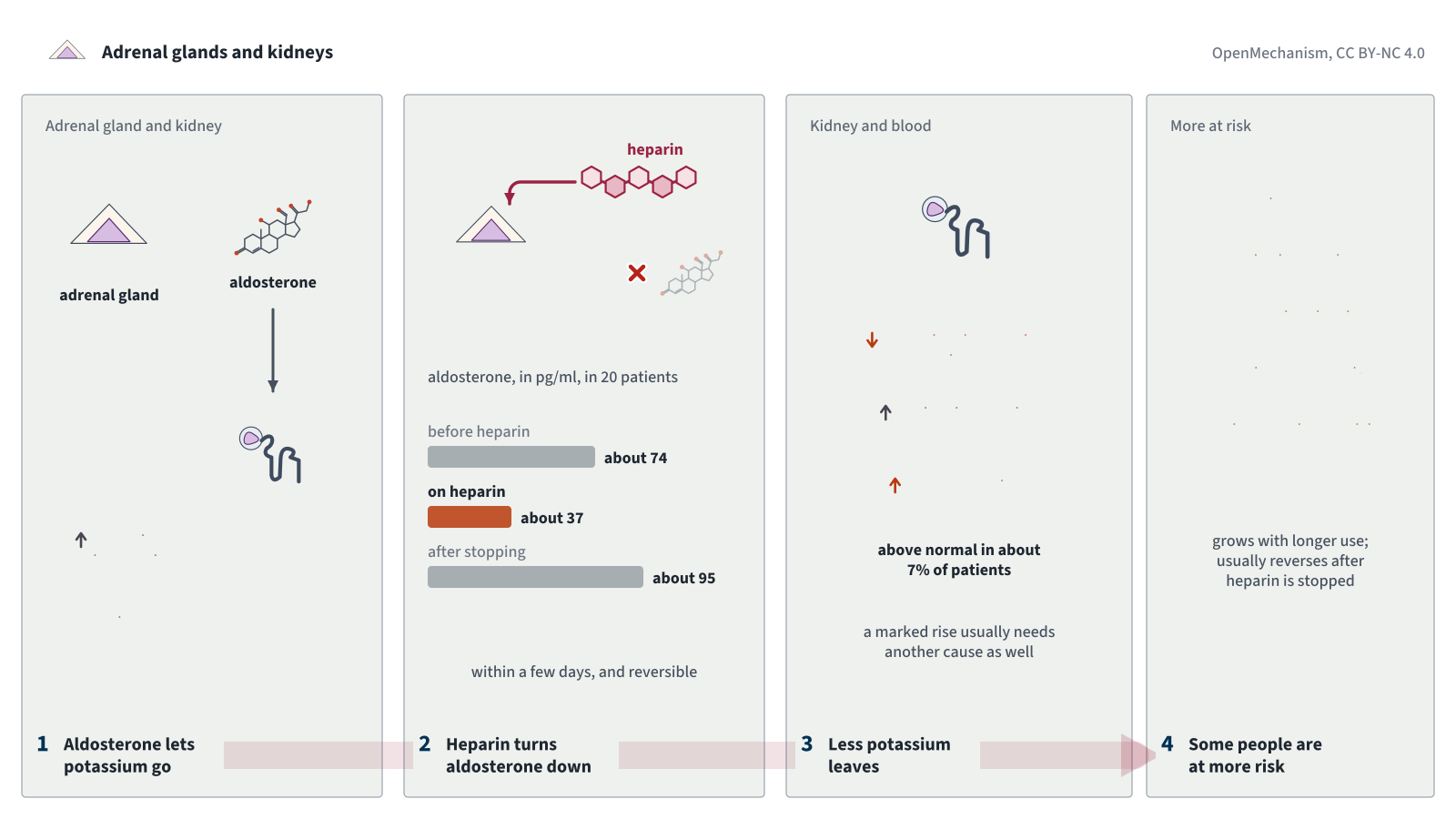
Aldosterone makes the kidneys let potassium go. Heparin can suppress the adrenal glands' aldosterone, within days and reversibly; in one study it about halved. Less potassium then leaves in the urine, and potassium can rise, mostly when diabetes, kidney failure, acidosis or certain medicines add to it.
- Kind
- Side effect
- Medicines
- Heparin
- Sources
- 5
For teachers: download this drawing.
Step by step
Aldosterone lets potassium go. , a mineralocorticoid from the adrenal glands, helps balance sodium and potassium: it makes the kidneys excrete more potassium and keep more sodium.1,2
What the source says
“The adrenal glands make two main types of hormones: cortisol and aldosterone.”
Source 1“Aldosterone belongs to a class of hormones called mineralocorticoids.”
Source 1“Aldosterone helps maintain the balance of the minerals sodium and potassium in your blood.”
Source 1“Mineralocorticoids act on the distal tubules of the kidney to enhance the reabsorption of sodium ions from the tubular fluid into the plasma; they increase the urinary excretion of both potassium and hydrogen ions.”
Source 2Heparin turns aldosterone down. Heparin can suppress the adrenal glands' release of aldosterone. A review calls heparin a predictable, potent inhibitor of aldosterone production, sparing the other corticosteroids; the fall comes within a few days and reverses. In 20 patients, aldosterone fell from about 74 to 37 pg/ml on heparin and rose to about 95 after it was stopped.3,4,5
What the source says
“Heparin can suppress adrenal secretion of aldosterone leading to hyperkalemia, particularly in patients with diabetes mellitus, chronic renal failure, pre-existing metabolic acidosis, a raised plasma potassium, or taking potassium sparing drugs.”
Source 3“Heparin and its congeners are predictable, potent inhibitors of aldosterone production.”
Source 4“This inhibitory effect is specific for the zona glomerulosa; other corticosteroids are not affected.”
Source 4“Aldosterone suppression occurs within a few days of initiation of therapy, is reversible, and is independent of either anticoagulant effect or route of administration.”
Source 4“We have examined plasma aldosterone, PRA, and aldosterone to renin activity ratios in 20 patients before, during and after treatment with heparin.”
Source 5“during heparin treatment from 73.5 +/- 20.5 to 36.8 +/- 11.2 pg/ml (P less than 0.05) and rose after its withdrawal to 94.8 +/- 37.1 p/ml (P less than 0.05).”
Source 5Less potassium leaves. With less aldosterone, more sodium leaves in the urine and, less predictably, less potassium does. Potassium above normal comes in about 7% of patients; a marked rise usually needs something else upsetting the balance, above all kidney failure, diabetes or certain medicines.4
What the source says
“Aldosterone suppression results in natriuresis and less predictably in decreased excretion of potassium.”
Source 4“Greater than normal serum potassium levels occur in about 7% of patients, but marked hyperkalemia generally requires the presence of additional factors perturbing potassium balance (in particular, renal insufficiency, diabetes mellitus, or the use of certain medications).”
Source 4Some people are at more risk. The label names diabetes, chronic kidney failure, existing metabolic acidosis, an already raised potassium and potassium-sparing medicines. The risk appears to grow the longer heparin is used, and it usually reverses when heparin is stopped.3
What the source says
“Heparin can suppress adrenal secretion of aldosterone leading to hyperkalemia, particularly in patients with diabetes mellitus, chronic renal failure, pre-existing metabolic acidosis, a raised plasma potassium, or taking potassium sparing drugs.”
Source 3“The risk of hyperkalemia appears to increase with duration of therapy but is usually reversible upon discontinuation of heparin.”
Source 3
See also
Medicine pages: heparin.
Other side effects (blood & clotting): why heparin can lower platelets and cause clots; and all 65 side effects.
Conditions: high blood potassium and blood clots in the veins.
Interactions: ACE inhibitors and spironolactone; and protamine and heparin.
Sources
- 1Adrenal insufficiency and Addison's diseaseNIDDK, last reviewed September 2018 (Definition & Facts). Saved copy
- 2Fludrocortisone acetate tablets: FDA labelClinical Pharmacology. Saved copy
- 3Heparin sodium injection (Hospira): FDA label5.8 Hyperkalemia. Saved copy
- 4Heparin-induced aldosterone suppression and hyperkalemiaOster JR et al. Am J Med 1995 (abstract). Saved copy
- 5Routine heparin therapy inhibits adrenal aldosterone productionO'Kelly R et al. J Clin Endocrinol Metab 1983 (abstract). Saved copy
Notes and limits
- How heparin lowers aldosterone is not settled: a review says it appears to cut the number and grip of the angiotensin II receptors in the glands' outer layer, probably not the only way.4
Notes that apply to every page are on How to read a page.
Spotted a mistake? Report an error (hello@openmechanism.com). Since launch, every published error we fix is listed on the corrections page.
Cite this page
Tran D. Why heparin can raise potassium [Internet]. OpenMechanism; 2026 [updated 2026 Nov 13; cited 2026 Nov 13]. Available from: https://openmechanism.com/explained/heparin-and-high-potassium