Protamine and heparin
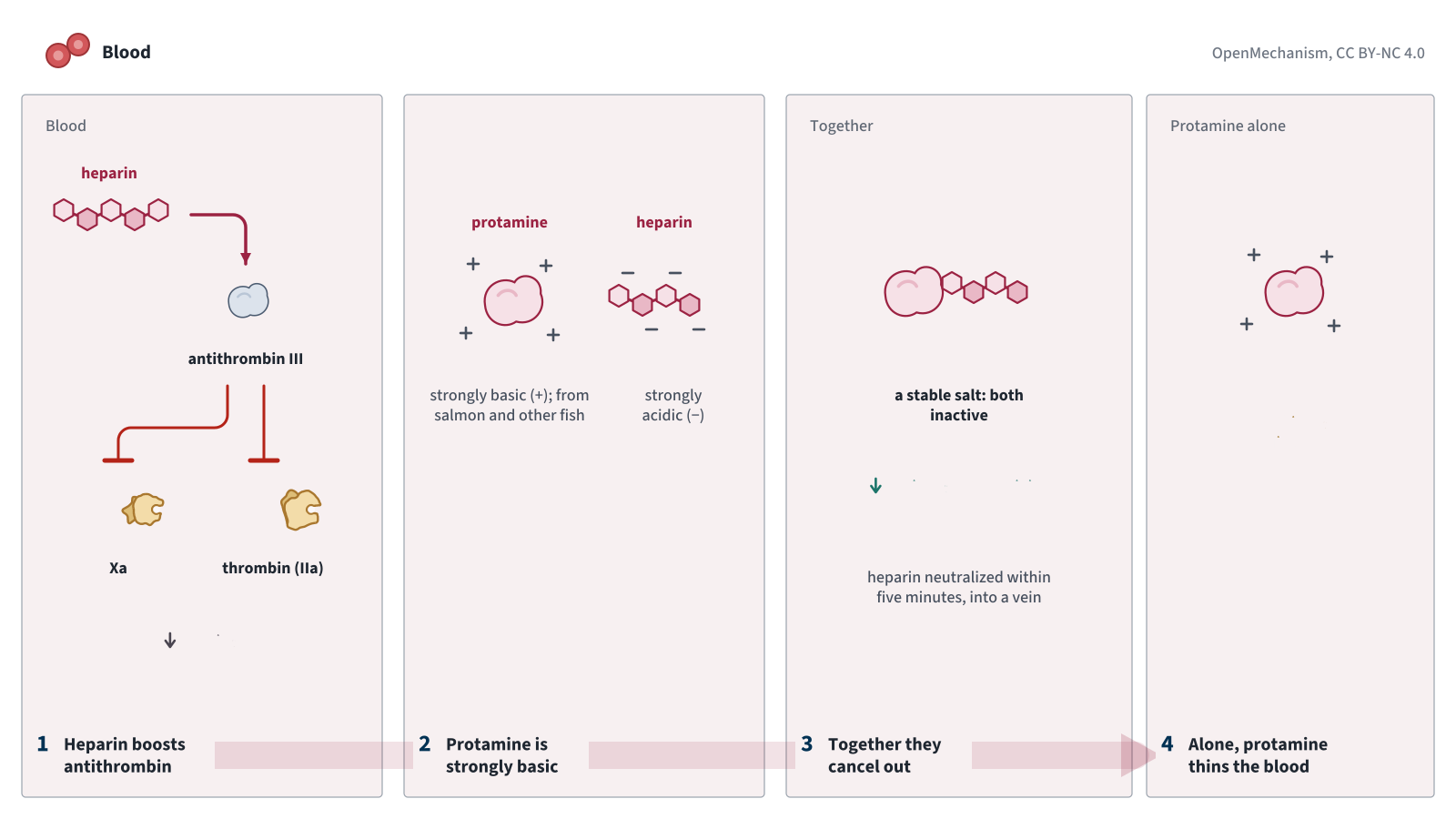
Heparin works by making antithrombin far more active against clotting factors Xa and IIa. Heparin is strongly acidic; protamine, a small protein from fish sperm, is strongly basic. Together they form a stable salt and both lose their effect, within five minutes of protamine going into a vein.
- Kind
- Interaction
- Sources
- 4
For teachers: download this drawing.
Step by step
Heparin boosts antithrombin. Heparin changes the shape of antithrombin III, a protein in the blood, making it far more active against activated clotting factors, mainly Xa and IIa (thrombin).1
What the source says
“Heparin interacts with the naturally occurring plasma protein, Antithrombin III, to induce a conformational change, which markedly enhances the serine protease activity of Antithrombin III, thereby inhibiting the activated coagulation factors involved in the clotting sequence, particularly Xa and IIa.”
Source 1Protamine is strongly basic. Protamines are small proteins, rich in arginine and strongly basic, found in the sperm of salmon and other fish. Heparin, by contrast, is strongly acidic.2
What the source says
“Protamines are simple proteins of low molecular weight that are rich in arginine and strongly basic. They occur in the sperm of salmon and certain other species of fish.”
Source 2“However, when it is given in the presence of heparin (which is strongly acidic), a stable salt is formed and the anticoagulant activity of both drugs is lost.”
Source 2Together they cancel out. The positively charged protamine and the negatively charged heparin bind into an inactive complex, a stable salt, and both lose their activity. Heparin is neutralized within five minutes of protamine going into a vein.2
What the source says
“The cationic hydrogenated protamine at a pH of 6.8 to 7.1 reacts with anionic heparin at a pH of 5.0 to 7.5 to form an inactive complex.”
Source 2“However, when it is given in the presence of heparin (which is strongly acidic), a stable salt is formed and the anticoagulant activity of both drugs is lost.”
Source 2“Neutralization of heparin occurs within five minutes after intravenous administration of an appropriate dose of protamine sulfate.”
Source 2Alone, protamine thins the blood. Given on its own, protamine has an anticoagulant effect of its own; it is a weak anticoagulant.2
See also
Medicine pages: protamine and heparin.
Other interactions (antidotes & reversal): digoxin immune Fab and digoxin; idarucizumab and dabigatran; leucovorin with methotrexate and with fluorouracil; reversing rocuronium with sugammadex or neostigmine; sugammadex and hormonal contraceptives; and all 40 interactions.
Side effects: why heparin can lower platelets and cause clots; and why heparin can raise potassium.
Conditions: blood clots in the veins and bleeding on blood thinners.
Sources
- 1Heparin sodium injection: FDA label12.1 Mechanism of Action. Saved copy
- 2Protamine sulfate injection: FDA labelIndications and Usage; Description; Clinical Pharmacology. Saved copy
- 3Factor Xa with apixabanPDB 2P16; Pinto, D.J. et al. J.Med.Chem. 2007;50:5339-5356. The factor Xa outline in the drawing is traced from this structure. Saved copy
- 4Human alpha-thrombin with an active-site inhibitor (PPACK)PDB 1PPB; Bode, W. et al. EMBO J. 1989;8:3467-3475. The thrombin outline in the drawing is traced from this structure. Saved copy
Notes and limits
- What happens to the heparin-protamine complex is not known; it has been postulated that protamine may be broken down, freeing heparin.2
Notes that apply to every page are on How to read a page.
Spotted a mistake? Report an error (hello@openmechanism.com). Since launch, every published error we fix is listed on the corrections page.
Cite this page
Tran D. Protamine and heparin [Internet]. OpenMechanism; 2026 [updated 2026 Oct 20; cited 2026 Oct 20]. Available from: https://openmechanism.com/explained/protamine-and-heparin