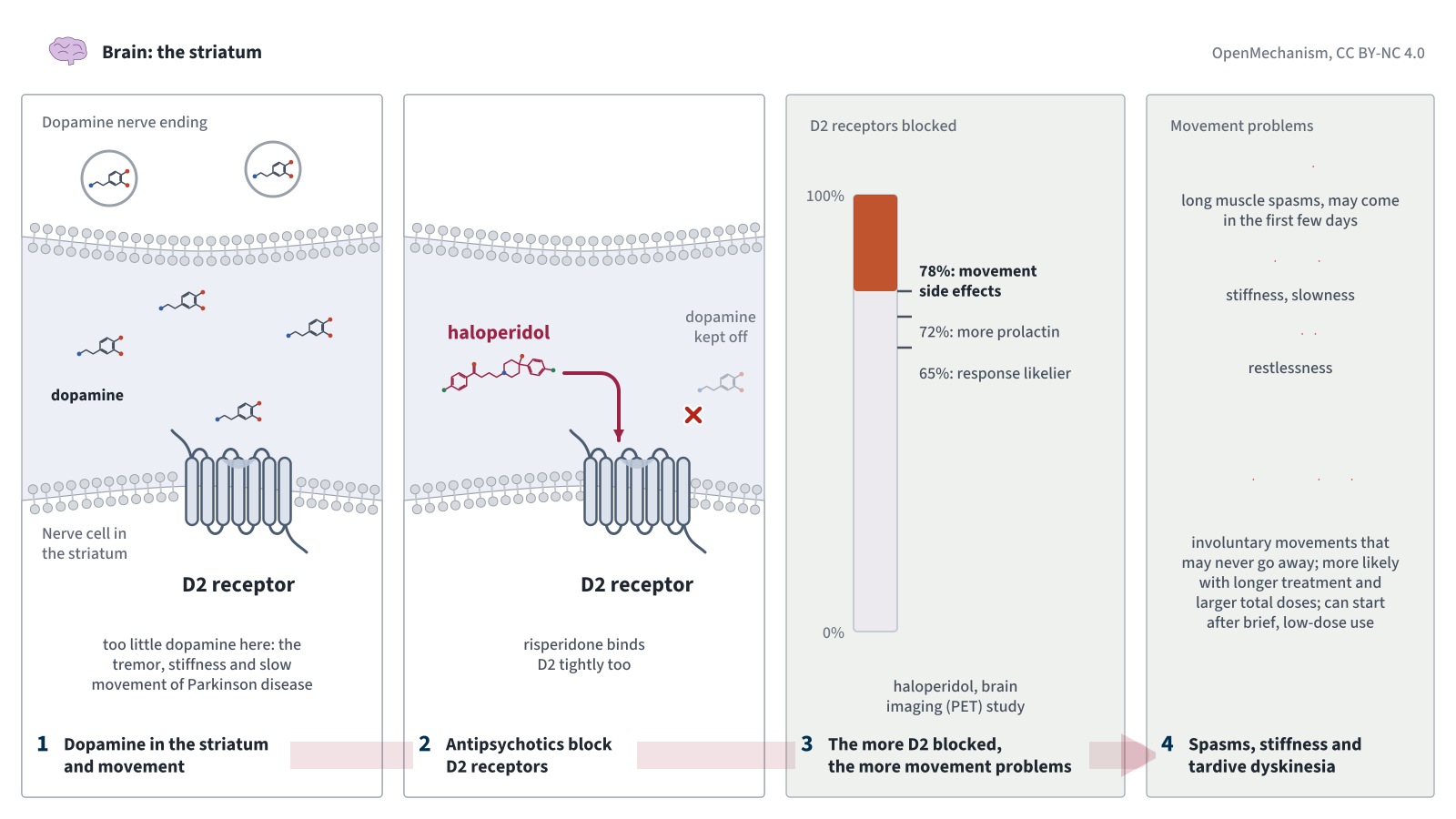
Antipsychotics such as haloperidol and risperidone block dopamine's D2 receptors. In Parkinson disease, current evidence relates slow, stiff movement to too little dopamine in the striatum, part of the brain, and in a brain imaging study the more D2 receptors haloperidol blocked, the likelier movement side effects became. They include muscle spasms, Parkinson-like stiffness and tremor, and restlessness; tardive dyskinesia, which may not go away, can also develop.
Dopamine in the striatum and movement. In Parkinson disease, current evidence indicates that the resting tremor, stiffness and slow movements are related to too little dopamine in the corpus striatum, part of the brain.1
What the source says
“Current evidence indicates that symptoms of Parkinson's disease are related to depletion of dopamine in the corpus striatum.”
Antipsychotics block D2 receptors. Antipsychotics block dopamine's . Haloperidol is an at D2 receptors in the brain, and risperidone binds them tightly (a 1993 brain imaging (PET) study in three healthy men who took one 1 mg dose measured its binding at D2 receptors in the striatum); the labels say this may be how they work in schizophrenia, for risperidone together with blocking serotonin receptors, though the mechanism is unclear.2,3,4,5
“The mechanism of action of haloperidol for the treatment of schizophrenia is unclear. However, its efficacy could be mediated through its activity as an antagonist at central dopamine type 2 receptors.”
“The mechanism of action of risperidone in schizophrenia is unclear. The drug's therapeutic activity in schizophrenia could be mediated through a combination of dopamine Type 2 (D 2 ) and serotonin Type 2 (5HT 2 ) receptor antagonism.”
The more D2 blocked, the more movement problems. In Kapur and colleagues' 2000 double-blind brain imaging (PET) study of 22 people with a first episode of schizophrenia randomly assigned to haloperidol 1.0 or 2.5 mg a day (raised to 5.0 mg a day if they did not respond), the share of D2 receptors blocked predicted clinical response, high prolactin and movement (extrapyramidal) side effects, which became significantly more likely once it passed 65%, 72% and 78%, respectively. A 2001 review says the older antipsychotics seem to cause movement side effects at doses that block more than about 80% of the striatum's D2 receptors, and in two fixed-dose trials of risperidone in adults with schizophrenia, they were more common at higher doses.2,4,6
What the source says
“In a double-blind study, 22 patients with first-episode schizophrenia were randomly assigned to 1.0 or 2. 5 mg/day of haloperidol.”
“The likelihood of clinical response, hyperprolactinemia, and extrapyramidal side effects increased significantly as D(2) occupancy exceeded 65%, 72%, and 78%, respectively.”
“Production of extrapyramidal side effects by typical drugs seems to be due to the use of the drugs at doses where striatal D2 receptor occupancy exceeds approximately 80%.”
“Data from two fixed-dose trials in adults with schizophrenia provided evidence of dose-relatedness for extrapyramidal symptoms associated with RISPERDAL treatment.”
Spasms, stiffness and tardive dyskinesia. In risperidone's trials the most common side effects included parkinsonism (stiffness and slowness), akathisia (restlessness), dystonia and tremor. Dystonia, long abnormal contractions of muscle groups, may come in susceptible people in the first few days of treatment. Tardive dyskinesia, involuntary movements that may not go away, can also develop; its risk, and the chance it becomes permanent, grow with the length of treatment and the total dose, but it can develop after relatively brief treatment, even at low doses, and may also start after treatment stops.4
What the source says
“The most common adverse reactions in clinical trials (>5% and twice placebo) were parkinsonism, akathisia, dystonia, tremor”
“Tardive dyskinesia, a syndrome consisting of potentially irreversible, involuntary, dyskinetic movements, may develop in patients treated with antipsychotic drugs.”
“The risk of developing tardive dyskinesia and the likelihood that it will become irreversible increase with the duration of treatment and the cumulative dose.”
Can raise or cause it: metoclopramide (“Metoclopramide, including Reglan, can cause tardive dyskinesia (TD), a potentially irreversible serious movement disorder.”8).
The labels' dosing and management advice are left out: this page explains the mechanism, not what to do.
Not every antipsychotic fits the pattern: a 2003 paper says aripiprazole occupies up to 95% of the striatum's D2-like receptors at usual doses, yet movement side effects are no more common with it than with placebo; its authors' most likely explanation is that aripiprazole weakly and partly switches these receptors on (weak partial agonism).7
The Risperdal label says tardive dyskinesia appears most common in older people, especially older women, but who will develop it cannot be predicted, and whether antipsychotics differ in how likely they are to cause it is unknown.4
The imaging study was of haloperidol only, and measured side effects after 2 and 4 weeks of treatment.2
None of the sources names tardive dyskinesia when it ties movement side effects to how many D2 receptors are blocked; the Risperdal label ties tardive dyskinesia's risk to the length of treatment and the total dose.4
Claude Opus 5.5 (AI source check), 7 November 2026: 29 statements compared with their sources, 6 flagged for the reviewer. An automated check, not a medical review.
Key terms
Definitions reworded since this review: antagonist. Definitions are shared across pages, so a later rewording does not take the review line off (what a review covers).
Next review due
8 May 2028
Cite this page
Tran D. Why antipsychotics can cause movement problems [Internet]. OpenMechanism; 2026 [updated 2026 Nov 7; cited 2026 Nov 7]. Available from: https://openmechanism.com/explained/antipsychotic-movement-problems