Why ropinirole can bring on compulsive urges
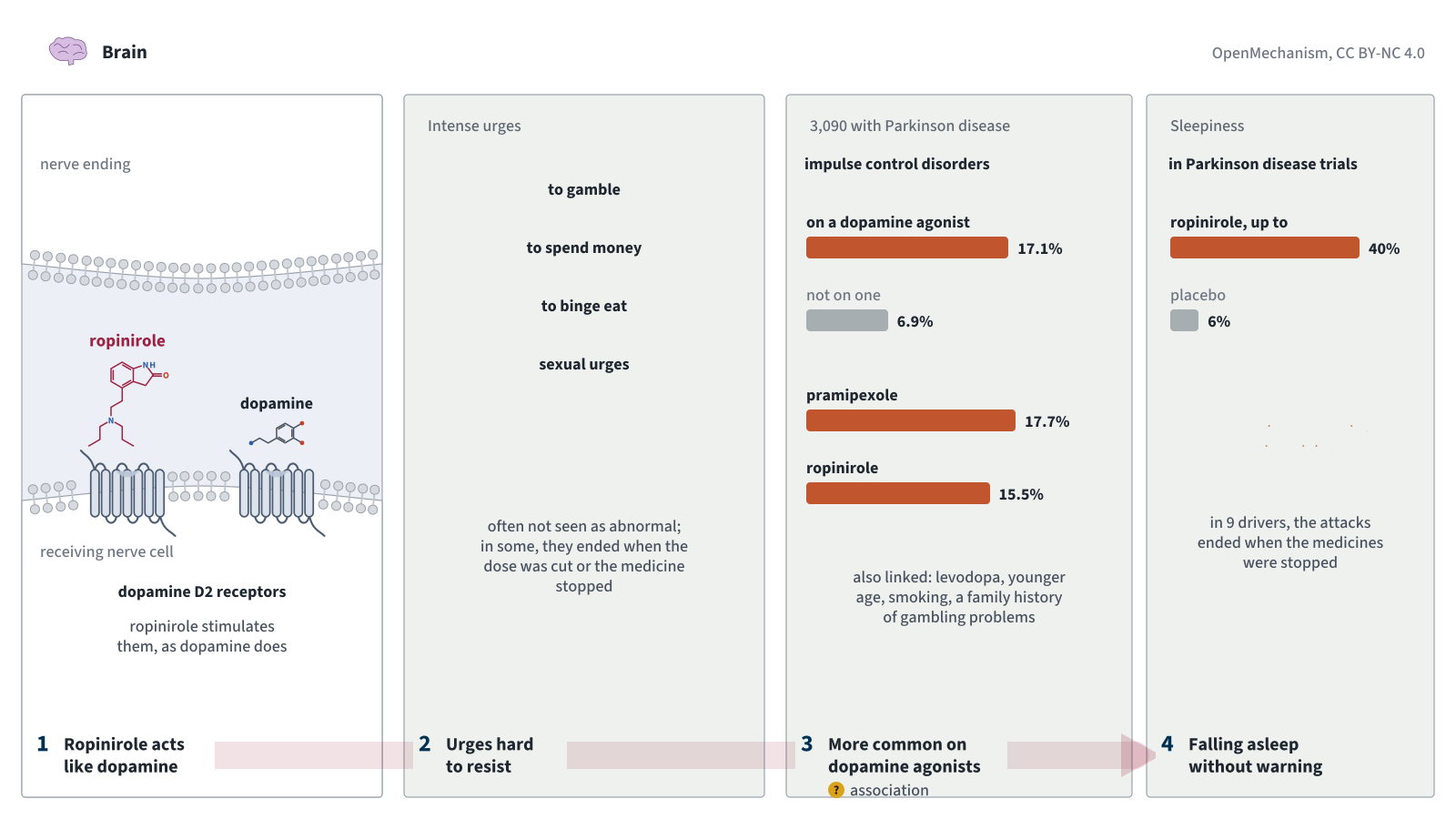
Ropinirole, a dopamine agonist, treats Parkinson disease and restless legs syndrome. Medicines that raise the brain's dopamine activity can bring intense urges to gamble, spend, eat or have sex, which people may not recognize; in one Parkinson disease study, 17% of people on a dopamine agonist had them, against 7% of others. People can also fall asleep without warning.
- Kind
- Side effect
- Medicines
- Ropinirole
- Sources
- 4
Step 3: association
The Weintraub 2010 study says: Dopamine agonist treatment in PD is associated with 2- to 3.5-fold increased odds of having an ICD.
Clinical study: An earlier study of 272 people with Parkinson disease at two centers; it too found an association, and could not show how dopamine agonists bring the urges on: In a multivariate model, treatment with a dopamine agonist (P = .01) and a history of ICD symptoms prior to PD onset (P = .02) predicted current ICD. … daily doses of dopamine agonists were higher in patients with an ICD than in dopamine agonist-treated patients without an ICD
Weintraub D et al., Arch Neurol 2006 (PMID 16831966)
This study was picked with a literature search and is not yet checked by our reviewer.
For teachers: download this drawing.
Step by step
Ropinirole acts like dopamine. Ropinirole, a dopamine used for Parkinson disease and moderate-to-severe restless legs syndrome, is thought to work by stimulating , in the caudate-putamen for Parkinson disease, though exactly how is unknown.1
What the source says
“Ropinirole tablets are a non-ergoline dopamine agonist indicated for the treatment of Parkinson’s disease (PD) and moderate-to-severe primary Restless Legs Syndrome (RLS).”
Source 1“The precise mechanism of action of ropinirole as a treatment for Parkinson's disease is unknown, although it is thought to be related to its ability to stimulate dopamine D 2 receptors within the caudate-putamen in the brain.”
Source 1“The precise mechanism of action of ropinirole as a treatment for RLS is unknown, although it is thought to be related to its ability to stimulate dopamine receptors.”
Source 1Urges hard to resist. Reports suggest that people taking medicines that raise the brain's dopamine activity, ropinirole among them, can have intense urges to gamble, spend, binge eat or have sex that they cannot control; in some, though not all, the urges stopped when the dose was lowered or the medicine stopped. People may not see these behaviors as abnormal.1
What the source says
“Reports suggest that patients can experience intense urges to gamble, increased sexual urges, intense urges to spend money, binge or compulsive eating, and/or other intense urges, and the inability to control these urges while taking one or more of the medications, including ropinirole tablets, that increase central dopaminergic tone.”
Source 1“In some cases, although not all, these urges were reported to have stopped when the dose was reduced or the medication was discontinued.”
Source 1“Because patients may not recognize these behaviors as abnormal”
Source 1More common on dopamine agonists. Among 3,090 people with Parkinson disease, 13.6% had an impulse control disorder: 17.1% of those on a dopamine agonist against 6.9% of others, with similar rates on pramipexole and ropinirole. Levodopa, younger age, being unmarried, smoking and a family history of gambling problems were also linked to them.2
What the source says
“Three thousand ninety patients with treated idiopathic PD receiving routine clinical care at 46 movement disorder centers in the United States and Canada.”
Source 2“An ICD was identified in 13.6% of patients (gambling in 5.0%, compulsive sexual behavior in 3.5%, compulsive buying in 5.7%, and binge-eating disorder in 4.3%)”
Source 2“Impulse control disorders were more common in patients treated with a dopamine agonist than in patients not taking a dopamine agonist (17.1% vs 6.9%”
Source 2“Impulse control disorder frequency was similar for pramipexole and ropinirole (17.7% vs 15.5%”
Source 2“Additional variables independently associated with ICDs were levodopa use, living in the United States, younger age, being unmarried, current cigarette smoking, and a family history of gambling problems.”
Source 2Falling asleep without warning. People on ropinirole have fallen asleep during daily activities, including driving, sometimes causing accidents; some felt no warning, and some events came more than a year after starting. Sleepiness was common in trials: up to 40% on ropinirole in Parkinson disease, against 6% on placebo. In one report, nine people with Parkinson disease, eight on pramipexole and one on ropinirole, fell asleep at the wheel and crashed, and the attacks stopped when the medicines did.1,3
What the source says
“Patients treated with ropinirole tablets have reported falling asleep while engaged in activities of daily living, including driving or operating machinery, which sometimes resulted in accidents.”
Source 1“Although many of these patients reported somnolence while on ropinirole tablets, some perceived that they had no warning signs, such as excessive drowsiness, and believed that they were alert immediately prior to the event.”
Source 1“Some have reported these events more than 1 year after initiation of treatment.”
Source 1“In controlled clinical trials, somnolence was commonly reported in patients receiving ropinirole tablets and was more frequent in Parkinson's disease (up to 40% ropinirole tablets, 6% placebo)”
Source 1“Eight PD patients taking pramipexole and one taking ropinirole fell asleep while driving, causing accidents.”
Source 3“The attacks ceased when the drugs were stopped.”
Source 3
See also
Medicine pages: ropinirole.
Other side effects (brain & nerves): why antipsychotics can cause movement problems; why antipsychotics can raise prolactin; why bupropion carries a risk of seizures; why clozapine can lower white blood cells; why lithium can cause diabetes insipidus; why morphine slows the gut and breathing; why SSRIs can lower sodium; why SSRIs can raise the risk of bleeding; why stimulants can raise heart rate and blood pressure; why too much acetaminophen harms the liver; and all 65 side effects.
Conditions: Parkinson disease.
Sources
- 1Ropinirole tablets: FDA label1 Indications and Usage; 5.1 Falling Asleep during Activities of Daily Living and Somnolence; 5.6 Impulse Control/Compulsive Behaviors; 5.8 Withdrawal Symptoms; 12.1 Mechanism of Action. Saved copy
- 2Impulse control disorders in Parkinson disease: a cross-sectional study of 3090 patientsWeintraub D et al. Arch Neurol 2010 (abstract). Saved copy
- 3Falling asleep at the wheel: motor vehicle mishaps in persons taking pramipexole and ropiniroleFrucht S et al. Neurology 1999 (abstract). Saved copy
- 4Association of dopamine agonist use with impulse control disorders in Parkinson diseaseWeintraub D et al. Arch Neurol 2006 (abstract). Saved copy
Notes and limits
- The study shows an association, two- to three-and-a-half-fold higher odds on a dopamine agonist, and the other factors suggest a complex link that needs more study.2
- Lowering or stopping a dopamine agonist can bring withdrawal symptoms: sleeplessness, apathy, anxiety, low mood, tiredness, sweating and pain.1
Notes that apply to every page are on How to read a page.
Spotted a mistake? Report an error (hello@openmechanism.com). Since launch, every published error we fix is listed on the corrections page.
Cite this page
Tran D. Why ropinirole can bring on compulsive urges [Internet]. OpenMechanism; 2026 [updated 2026 Oct 21; cited 2026 Oct 21]. Available from: https://openmechanism.com/explained/ropinirole-and-impulse-control