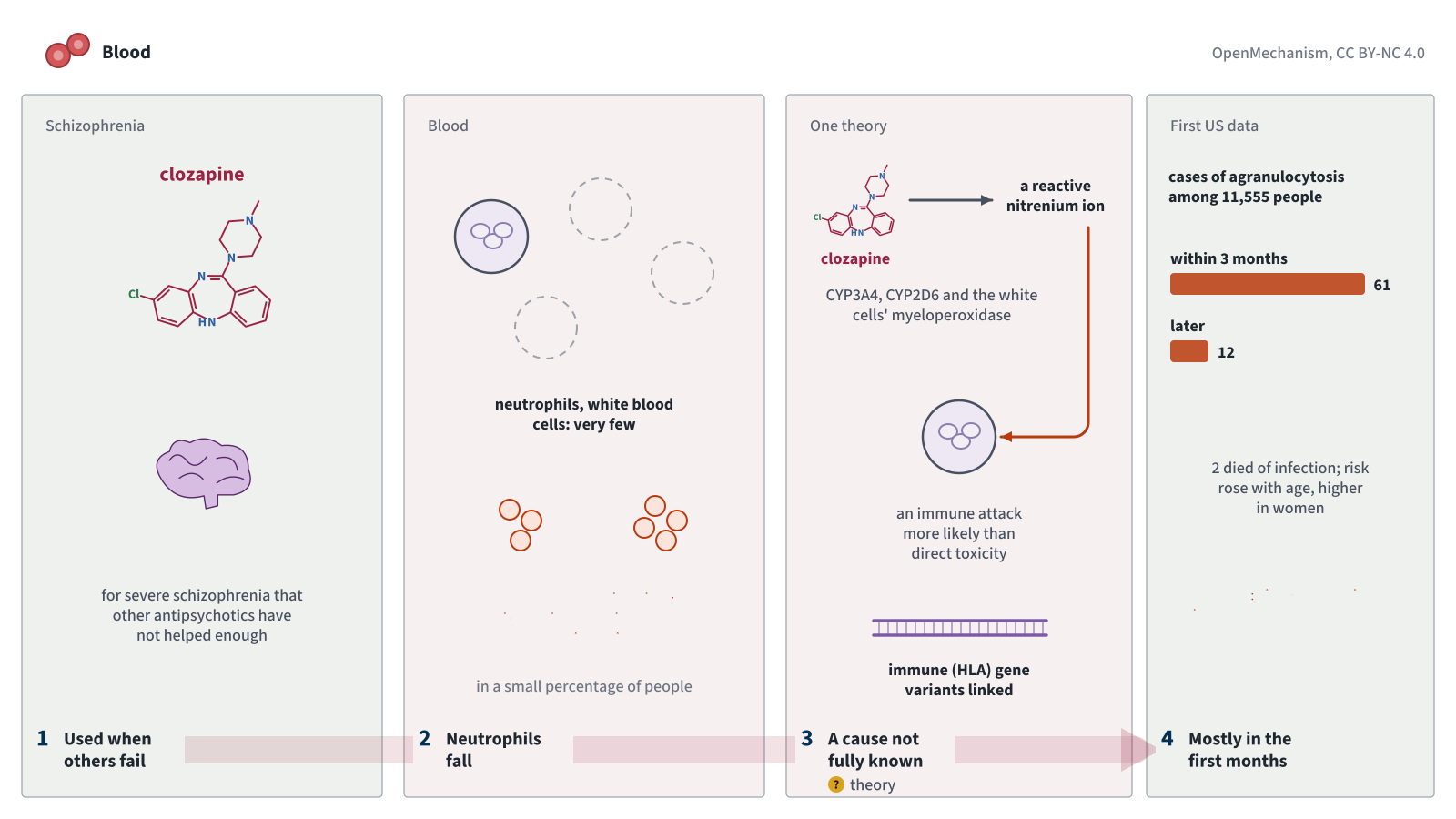
Clozapine is used for severe schizophrenia that other antipsychotics have not helped enough. In a small percentage of people it causes severe neutropenia, very few neutrophils, white blood cells, with a higher risk of serious, even fatal, infections. The risk of severe neutropenia appears greatest in the first months. The cause is not fully known; one theory is a reactive product of clozapine, with immune genes involved.
The Wiciński 2018 review says: The current theory suggests reactive oxygen species - nitrenium ion as the most important factor of CIAG. … The mechanism of CIAG seems to have an autoimmune background, rather than toxic.
Clinical study: Goldstein and colleagues' 2014 genetic study of 163 people who had clozapine-induced agranulocytosis or low granulocytes used genome-wide genotyping and whole-exome sequencing; it looked for risk genes, not the reactive metabolite: We find that two loci in the major histocompatibility complex are independently associated with CIAG: a single amino acid in HLA-DQB1 (126Q) (P=4.7 × 10(-14), odds ratio (OR)=0.19, 95% confidence interval (CI)=0.12-0.29) and an amino acid change in the extracellular binding pocket of HLA-B (158T) (P=6.4 × 10(-10), OR=3.3, 95% CI=2.3-4.9). These associations dovetail with the roles of these genes in immunogenetic phenotypes and adverse drug responses for other medications, and provide insight into the pathophysiology of CIAG.Goldstein JI et al., Nat Commun 2014 (PMID 25187353)
Used when others fail. Clozapine is used for severe schizophrenia that has not responded well enough to other antipsychotics. Because of its risks of severe neutropenia and of seizures, its label keeps this use for people in whom the standard medicines have not worked well enough. The label also lists it for reducing the risk of recurrent suicidal behavior in people with schizophrenia or schizoaffective disorder judged to be at chronic risk of it.1
What the source says
“CLOZARIL is indicated for the treatment of severely ill patients with schizophrenia who fail to respond adequately to standard antipsychotic treatment.”
“Because of the risks of severe neutropenia and of seizure associated with its use, CLOZARIL should be used only in patients who have failed to respond adequately to standard antipsychotic treatment”
“CLOZARIL is indicated for reducing the risk of recurrent suicidal behavior in patients with schizophrenia or schizoaffective disorder who are judged to be at chronic risk for re-experiencing suicidal behavior, based on history and recent clinical state.”
Neutrophils fall. Clozapine has caused severe neutropenia, fewer than 500 neutrophils in each microliter of blood, which is linked to a higher risk of serious, even fatal, infections. The label says it is not dose dependent and happens in a small percentage of people; a 2020 review puts clozapine-induced agranulocytosis at up to 0.8% of patients.2,3
What the source says
“CLOZARIL has caused severe neutropenia (absolute neutrophil count (ANC) less than 500/μL) [see Adverse Reactions ( 6.1 , 6.2 )] and is associated with an increased risk of serious and potentially fatal infections.”
A cause not fully known. The label calls the mechanism unknown. One theory is that clozapine is turned into a reactive nitrenium ion, mainly by the enzymes and and by the myeloperoxidase system in white blood cells, and an autoimmune process seems more likely than direct toxicity; changes in immune () genes are linked to it.2,4
What the source says
“The mechanism by which CLOZARIL causes neutropenia is unknown.”
“An important component of CIAG pathogenesis is genetic aberration in human leukocyte antigen genes, and also genes associated with apoptosis and ubiquitination.”
Mostly in the first months. The risk appears greatest in the first 18 weeks. In US data from February 1990 to April 1991, when a weekly white-cell count was required to receive the medicine, 73 of 11,555 people developed agranulocytosis, 61 of them within three months, and 2 died of infection; the risk rose with age and was higher in women.2,5
What the source says
“The risk of severe neutropenia appears greatest during the first 18 weeks of CLOZARIL treatment.”
“After clozapine was approved by the Food and Drug Administration, it became available for marketing in the United States in February 1990 only as part of a special surveillance system (the Clozaril Patient Management System, or CPMS), in which a weekly white-cell count was required for the patient to receive a supply of the drug.”
“We evaluated the CPMS data for February 1990 through April 1991 by survival analysis to determine the incidence of agranulocytosis and the effects of potential risk factors such as age and sex.”
People with benign ethnic neutropenia (also called Duffy-null associated neutrophil count) generally have lower baseline neutrophil counts without a higher risk of infection or of clozapine-induced neutropenia, and the label sets different thresholds for them; a 2020 review comments on the importance of recognizing benign ethnic neutropenia as a potential impediment to giving clozapine, since a significant proportion of people taking clozapine in the Western hemisphere are Black.2,3
The authors of the 1993 report of these US data concluded that the hazard can be reduced by monitoring the white-cell count; a weekly count was required for everyone in those data.5
The label calls for neutrophil counts before and throughout treatment; its other monitoring and dosing advice is left out.2
text 7fcdb6e636e8…; drawings e866a2fc2a15…; notes b4b377ac0410…
AI source check
Claude Opus 5.5 (AI source check), 7 November 2026: 26 statements compared with their sources, 7 flagged for the reviewer. An automated check, not a medical review.
Key terms
Definitions reworded since this review: CYP3A4 and HLA. Definitions are shared across pages, so a later rewording does not take the review line off (what a review covers).
Next review due
8 May 2028
Cite this page
Tran D. Why clozapine can lower white blood cells [Internet]. OpenMechanism; 2026 [updated 2026 Nov 7; cited 2026 Nov 7]. Available from: https://openmechanism.com/explained/clozapine-and-neutropenia