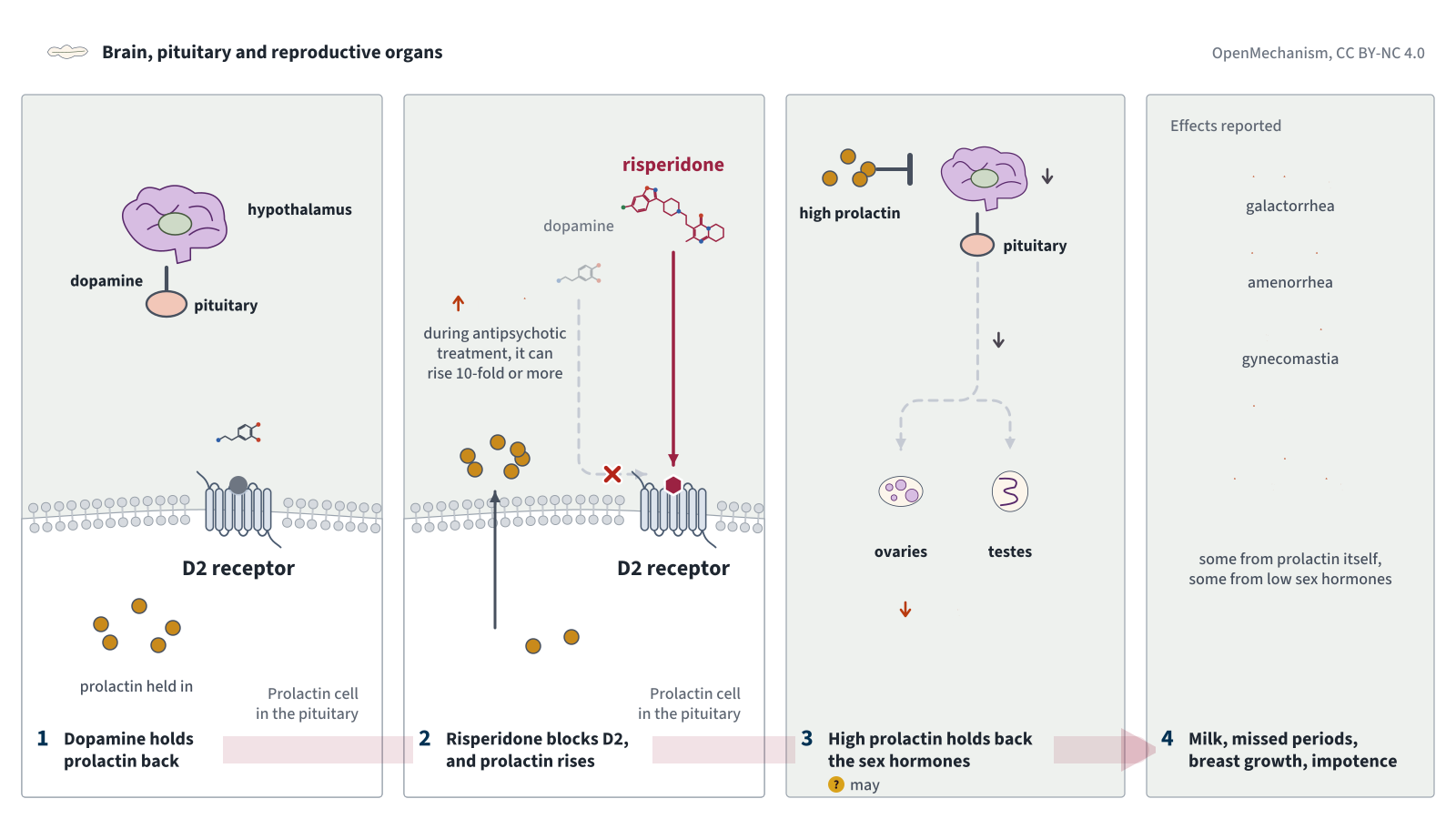
Dopamine from the hypothalamus holds back prolactin, the pituitary hormone that promotes milk production. Antipsychotics that block dopamine D2 receptors, such as risperidone, lift that brake, and prolactin rises. High prolactin may hold back the hormones that drive the ovaries and testes; milk discharge, missed periods, breast growth in men and impotence have been reported.
Clinical study: In Smith and colleagues' 2002 study of 67 outpatients with schizophrenia who had taken older (typical) antipsychotics for at least 2 years, the authors measured prolactin, the sex hormones and the pituitary's gonadotropins and compared them with the normal range; they conclude (the HPG axis is the hypothalamic-pituitary-gonadal axis): in females, the level of hyperprolactinaemia is correlated with the degree of suppression of the HPG axis … In males, prolactin levels remain within normal limits, but at the upper end, with no apparent disturbance of reproductive hormones.Smith S et al., J Clin Psychopharmacol 2002 (PMID 11910254)
Dopamine holds prolactin back. Prolactin, a hormone of the anterior pituitary, promotes milk production. Dopamine from nerve tracts in the hypothalamus reaches the pituitary in hypophysial portal blood and, through type-2 (D2) , holds back the cells that make prolactin (lactotrophs).1,2
What the source says
“Prolactin (PRL) released from lactotrophs of the anterior pituitary gland in response to the suckling by the offspring is the major hormonal signal responsible for stimulation of milk synthesis in the mammary glands.”
“Dopamine binds to type-2 dopamine receptors that are functionally linked to membrane channels and G proteins and suppresses the high intrinsic secretory activity of the pituitary lactotrophs.”
Risperidone blocks D2, and prolactin rises. Risperidone blocks . Like other medicines that block them, it raises prolactin, and the rise lasts through long-term treatment; risperidone is linked with higher prolactin than other antipsychotics. A 2004 review says that during antipsychotic treatment, prolactin can rise 10-fold or more above its level before treatment.3,4,5
What the source says
“The drug's therapeutic activity in schizophrenia could be mediated through a combination of dopamine Type 2 (D 2 ) and serotonin Type 2 (5HT 2 ) receptor antagonism.”
“As with other drugs that antagonize dopamine D 2 receptors, RISPERDAL elevates prolactin levels and the elevation persists during chronic administration.”
High prolactin holds back the sex hormones. High prolactin may suppress GnRH, the hypothalamus's signal to the pituitary, so the pituitary releases less of the hormones that drive the ovaries and testes (gonadotropins); in turn, they may make less of their sex hormones, in women and in men.4,5
What the source says
“Hyperprolactinemia may suppress hypothalamic GnRH, resulting in reduced pituitary gonadotropin secretion. This, in turn, may inhibit reproductive function by impairing gonadal steroidogenesis in both female and male patients.”
Milk, missed periods, breast growth, impotence. Milk discharge (galactorrhea), missed periods (amenorrhea), breast growth in men (gynecomastia) and impotence have been reported with medicines that raise prolactin. Some come from prolactin acting directly, others from the low sex hormones; long-standing high prolactin with low sex hormones may lead to thinner bones, in women and in men.4,5
What the source says
“Galactorrhea, amenorrhea, gynecomastia, and impotence have been reported in patients receiving prolactin-elevating compounds.”
“Some symptoms of hyperprolactinaemia result from a direct effect of prolactin on target tissues but others result from hypogonadism caused by prolactin disrupting the normal functioning of the hypothalamic-pituitary-gonadal axis.”
In a 2004 review, high prolactin was frequent with older antipsychotics and with risperidone and amisulpride, but rare with aripiprazole, clozapine, olanzapine, quetiapine or ziprasidone.5
A 2004 review says the data conflict on whether high prolactin is linked to a higher risk of breast cancer in women, and the Risperdal label says published epidemiologic studies of the link have shown inconsistent results.4,5
The sources say medicines that block D2 receptors raise prolactin, and that dopamine holds back the pituitary's prolactin cells through D2 receptors; they don't say where the medicine itself acts.2,4
text 1cca44b77443…; drawings 80d5a737fbb3…; notes 205dcae5c005…
AI source check
Claude Opus 5.5 (AI source check), 7 November 2026: 32 statements compared with their sources, 5 flagged for the reviewer. An automated check, not a medical review.
text 1c645c3ce72d…; drawings 80d5a737fbb3…; notes 205dcae5c005…
AI source check
The file of this review’s AI source check was later saved over by the check for the review of 12 November 2026, so its own date and counts are not shown. An automated check, not a medical review.
Next review due
8 May 2028
Cite this page
Tran D. Why antipsychotics can raise prolactin [Internet]. OpenMechanism; 2026 [updated 2026 Nov 12; cited 2026 Nov 12]. Available from: https://openmechanism.com/explained/antipsychotics-and-prolactin