Why too much acetaminophen harms the liver
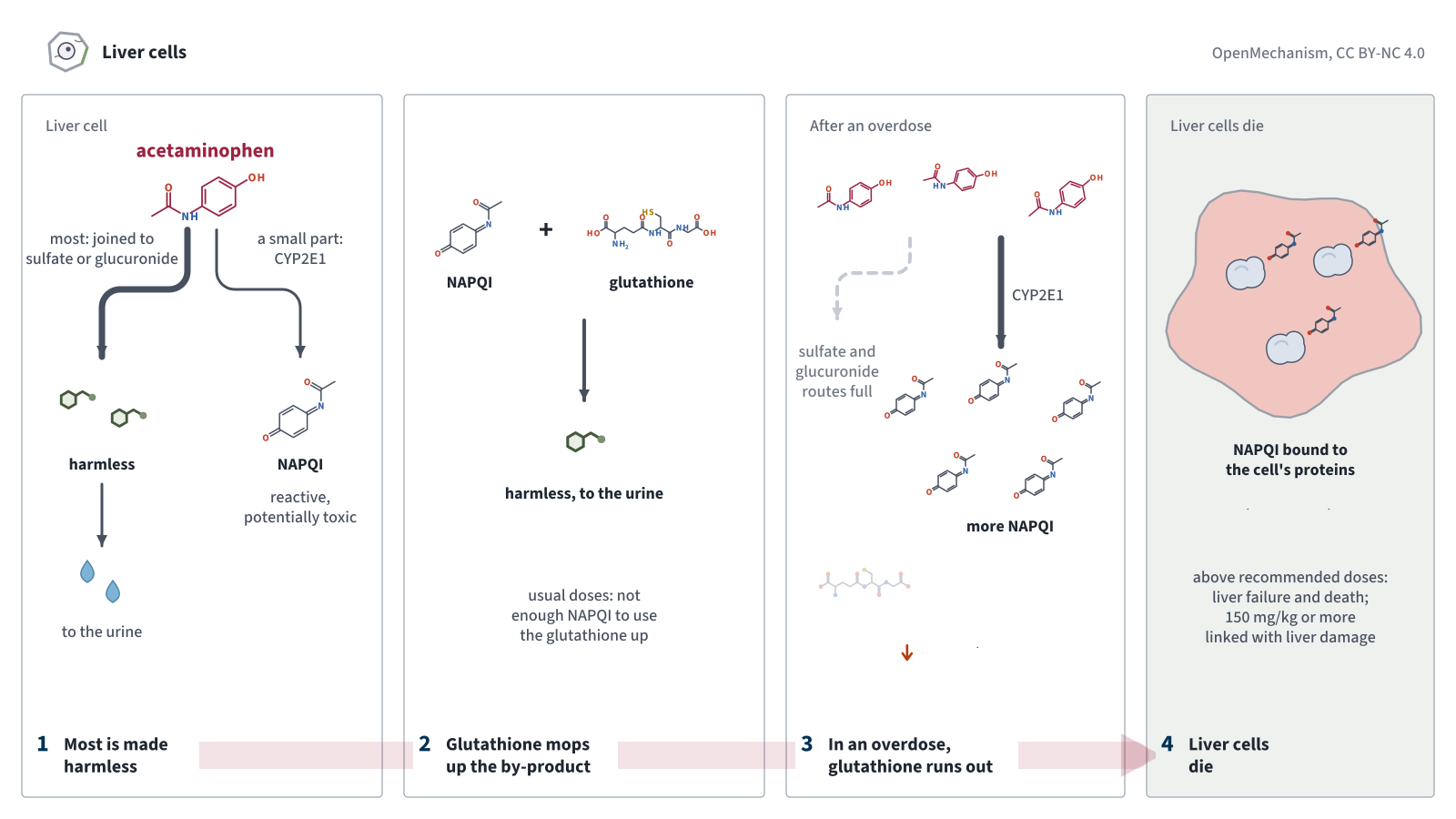
The liver makes most acetaminophen harmless, but a small part becomes a reactive by-product, NAPQI, which glutathione mops up. After a large overdose the usual routes are full, more NAPQI is made, and it may use up the liver's glutathione, bind the liver cells' proteins and kill them. Doses higher than recommended can lead to liver failure and death.
- Kind
- Side effect
- Medicines
- Acetaminophen
- Sources
- 4
For teachers: download this drawing.
Step by step
Most is made harmless. The liver breaks acetaminophen down in three main ways: most is joined to sulfate or glucuronide and leaves in the urine, and a small part is changed by the enzyme CYP2E1 into a reactive, potentially toxic by-product, NAPQI.1,2
What the source says
“Acetaminophen is primarily metabolized in the liver by first-order kinetics and involves three principal separate pathways: Conjugation with glucuronide, conjugation with sulfate, and oxidation via the cytochrome P450 enzyme pathway, primarily CYP2E1, to form a reactive intermediate metabolite (N-acetyl-p-benzoquinone imine or NAPQI).”
Source 1“It is extensively metabolized in the liver to form principally the sulfate and glucoronide conjugates which are excreted in the urine.”
Source 2“A small fraction of an ingested dose is metabolized in the liver by isozyme CYP2E1 of the cytochrome P-450 mixed function oxidase enzyme system to form a reactive, potentially toxic, intermediate metabolite.”
Source 2Glutathione mops up the by-product. At usual doses, NAPQI is quickly joined to the liver's glutathione and turned into harmless products that the kidneys pass. Usual doses are not thought to make enough NAPQI to use the glutathione up.1,2
What the source says
“With therapeutic doses, NAPQI undergoes rapid conjugation with glutathione and is then further metabolized to form cysteine and mercapturic acid conjugates.”
Source 1“The toxic metabolite preferentially conjugates with hepatic glutathione to form nontoxic cysteine and mercapturic acid derivatives, which are then excreted by the kidney.”
Source 2“Recommended therapeutic doses of acetaminophen are not believed to saturate the glucuronide and sulfate conjugation pathways and therefore are not expected to result in the formation of sufficient reactive metabolite to deplete glutathione stores.”
Source 2In an overdose, glutathione runs out. After a large overdose, the sulfate and glucuronide routes are full, so more acetaminophen goes down the CYP2E1 route and more NAPQI is made. This may use up the liver's glutathione.2
What the source says
“However, following ingestion of a large overdose, the glucuronide and sulfate conjugation pathways are saturated resulting in a larger fraction of the drug being metabolized via the cytochrome P-450 pathway and therefore, the amount of acetaminophen metabolized to the reactive intermediate increases.”
Source 2“The increased formation of the reactive metabolite may deplete the hepatic stores of glutathione”
Source 2Liver cells die. NAPQI can then bind proteins inside the liver cells, and the cells die. Doses higher than recommended can injure the liver, with a risk of liver failure and death; doses of 150 mg/kg or more have been linked with liver damage.2,3,4
What the source says
“with subsequent binding of the metabolite to protein molecules within the hepatocyte resulting in cellular necrosis”
Source 2“Administration of acetaminophen in doses higher than recommended may result in hepatic injury, including the risk of liver failure and death”
Source 3“Acetaminophen doses of 150 mg/kg or greater have been associated with hepatotoxicity.”
Source 4
See also
Medicine pages: acetaminophen.
Also used for it: acetylcysteine (for preventing or lessening liver injury after too much acetaminophen: “ACETADOTE is indicated to prevent or lessen hepatic injury after ingestion of a potentially hepatotoxic quantity of acetaminophen”4).
Other side effects (brain & nerves): why antipsychotics can cause movement problems; why antipsychotics can raise prolactin; why bupropion carries a risk of seizures; why clozapine can lower white blood cells; why lithium can cause diabetes insipidus; why morphine slows the gut and breathing; why ropinirole can bring on compulsive urges; why SSRIs can lower sodium; why SSRIs can raise the risk of bleeding; why stimulants can raise heart rate and blood pressure; and all 65 side effects.
Conditions: acute pain and period pain; and acetaminophen overdose.
The medicine in the body: codeine, tramadol and the CYP2D6 gene.
Sources
- 1Acetaminophen injection: FDA label12.3 Pharmacokinetics: Metabolism. Saved copy
- 2Acetylcysteine injection (Fresenius Kabi): FDA label12.1 Mechanism of Action: Acetaminophen Overdose. Saved copy
- 3Acetaminophen injection: FDA label5.1 Hepatic Injury. Saved copy
- 4Acetadote (acetylcysteine): FDA label1 Indications and Usage; 12.1 Mechanism of Action. Saved copy
Notes and limits
- The labels' doses, blood-level chart and treatment advice are left out: this page explains the mechanism, not what to do.
- The antidote, acetylcysteine, probably protects the liver by keeping up or restoring its glutathione, or by binding the toxic by-product itself.4
- The label advises caution with liver disease, alcoholism, long-term undernutrition, severe low blood volume or severe kidney impairment, and counts acetaminophen from every product, combination products included, toward the daily maximum.3
Notes that apply to every page are on How to read a page.
Spotted a mistake? Report an error (hello@openmechanism.com). Since launch, every published error we fix is listed on the corrections page.
Cite this page
Tran D. Why too much acetaminophen harms the liver [Internet]. OpenMechanism; 2026 [updated 2026 Oct 20; cited 2026 Oct 20]. Available from: https://openmechanism.com/explained/acetaminophen-and-the-liver