Why morphine slows the gut and breathing
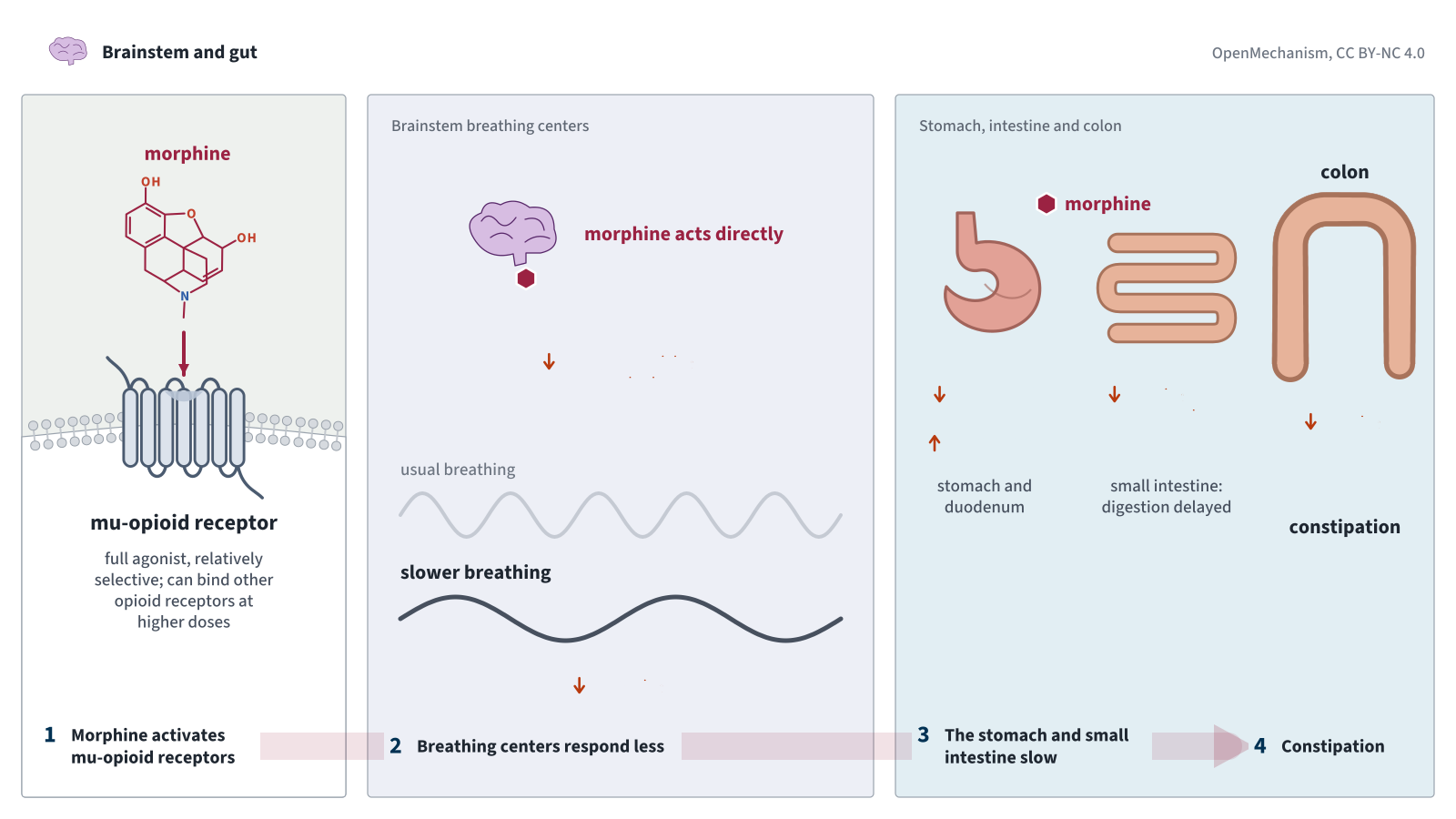
Morphine is a full opioid agonist that mainly acts on mu-opioid receptors. Its label describes two effects besides pain relief: the brainstem's breathing centers respond less to carbon dioxide, so breathing slows, and the stomach, small intestine and colon move food along less, which causes constipation.
- Kind
- Side effect
- Medicines
- Morphine
- Sources
- 1
For teachers: download this drawing.
Step by step
Morphine activates mu-opioid receptors. Morphine is a full opioid that is relatively selective for the mu-opioid receptor, though it can bind other opioid receptors at higher doses.1
What the source says
“Morphine is a full opioid agonist and is relatively selective for the mu-opioid receptor, although it can bind to other opioid receptors at higher doses.”
Source 1Breathing centers respond less. Morphine acts directly on the brainstem's breathing centers, which then respond less to rising carbon dioxide, so breathing slows.1
What the source says
“Morphine produces respiratory depression by direct action on brainstem respiratory centers. The respiratory depression involves a reduction in the responsiveness of the brainstem respiratory centers to both increases in carbon dioxide tension and electrical stimulation.”
Source 1The stomach and small intestine slow. The stomach and duodenum move less while their muscle tone rises, and digestion in the small intestine is delayed.1
What the source says
“Morphine causes a reduction in motility associated with an increase in smooth muscle tone in the antrum of the stomach and in the duodenum. Digestion of food in the small intestine is delayed and propulsive contractions are decreased.”
Source 1Constipation. In the colon the pushing waves weaken while tone can rise to the point of spasm, which causes constipation.1
What the source says
“Propulsive peristaltic waves in the colon are decreased, while tone may be increased to the point of spasm, resulting in constipation.”
Source 1
See also
Medicine pages: morphine.
Related medicines: naloxone.
Other side effects (brain & nerves): why antipsychotics can cause movement problems; why antipsychotics can raise prolactin; why bupropion carries a risk of seizures; why clozapine can lower white blood cells; why lithium can cause diabetes insipidus; why ropinirole can bring on compulsive urges; why SSRIs can lower sodium; why SSRIs can raise the risk of bleeding; why stimulants can raise heart rate and blood pressure; why too much acetaminophen harms the liver; and all 65 side effects.
The medicine in the body: codeine, tramadol and the CYP2D6 gene.
Interactions: opioids and benzodiazepines.
Conditions: severe and persistent pain.
Sources
- 1MS Contin (morphine sulfate): FDA label12.1 Mechanism of Action; 12.2 Pharmacodynamics. Saved copy
Notes and limits
- These statements come from one morphine label; other opioids have their own labels.
- The label names the mu-opioid receptor in its mechanism section; it does not say which receptors cause each effect.
Notes that apply to every page are on How to read a page.
Spotted a mistake? Report an error (hello@openmechanism.com). Since launch, every published error we fix is listed on the corrections page.
Cite this page
Tran D. Why morphine slows the gut and breathing [Internet]. OpenMechanism; 2026 [updated 2026 Oct 20; cited 2026 Oct 20]. Available from: https://openmechanism.com/explained/morphine-gut-and-breathing