Why trimethoprim can raise potassium
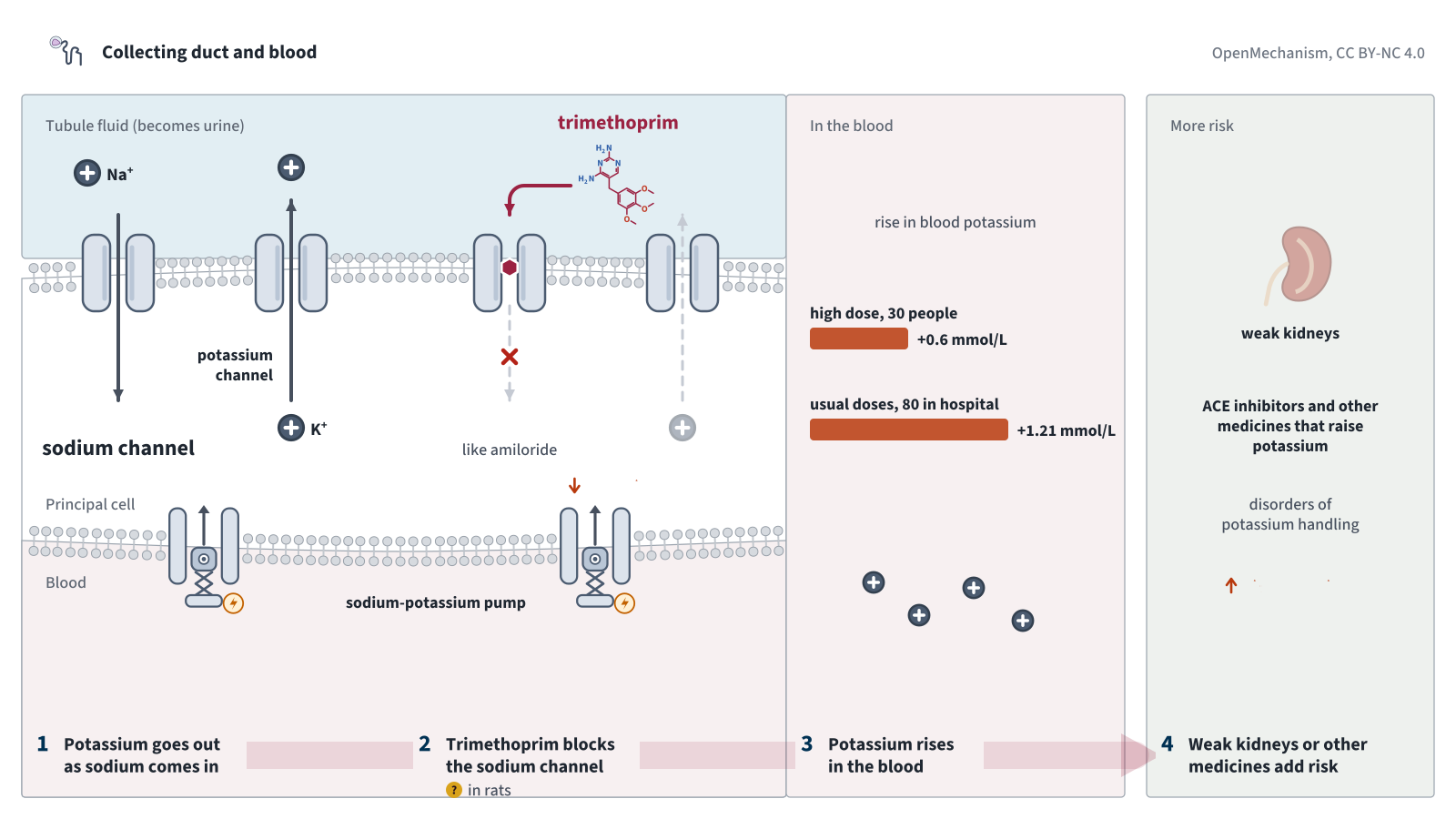
In the collecting duct, principal cells take sodium back from the urine and secrete potassium into it; when less sodium is taken back, less potassium is secreted. In rats, trimethoprim, like the diuretic amiloride, blocked the sodium channels at the end of the nephron, and potassium secretion fell. In people taking it, blood potassium rose: by 0.6 mmol/L on average on high doses, and by 1.21 mmol/L in hospital patients on usual doses. The risk is greater with kidney disease, disorders of potassium handling or other medicines that raise potassium, such as ACE inhibitors.
- Kind
- Side effect
- Medicines
- Sulfamethoxazole and trimethoprim, Amiloride
- Sources
- 5
Step 2: in rats
Velázquez and colleagues' study in rats says: Trimethoprim (1 mmol/L) in tubule fluid inhibited distal tubule potassium secretion by 59% (Cl, 26% to 92%) and depolarized the lumen-negative transepithelial voltage by 66% (Cl, 46% to 85%).
Clinical study: A second study, of 80 people in hospital on usual doses of trimethoprim-sulfamethoxazole against 25 on other antibiotics, measured blood potassium, not the channel: The serum potassium concentration in the treatment group (mean +/- SD) was 3.89 +/- 0.46 mmol/L (95% CI, 3.79 to 3.99 mmol/L), and it increased by 1.21 mmol/L (CI, 1.09 to 1.32 mmol/L) 4.6 +/- 2.2 days after trimethoprim-sulfamethoxazole therapy was initiated.
Alappan R et al., Ann Intern Med 1996 (PMID 8554227)
This study was picked with a literature search and is not yet checked by our reviewer.
For teachers: download this drawing.
Step by step
Potassium goes out as sodium comes in. In the collecting duct, principal cells have separate channels for sodium and for potassium on the side facing the urine: sodium is taken back from the urine and potassium is secreted into it, and when less sodium is taken back, less potassium is secreted.1,2
What the source says
“The apical cell membrane of principal cells of the cortical collecting duct is characterized by separate potassium and sodium conductances.”
Source 1“Increased cell potassium uptake across the basolateral cell membrane due to stimulation of Na-K ATPase”
Source 1“Amiloride HCl exerts its potassium sparing effect through the inhibition of sodium reabsorption at the distal convoluted tubule, cortical collecting tubule and collecting duct; this decreases the net negative potential of the tubular lumen and reduces both potassium and hydrogen secretion and their subsequent excretion.”
Source 2Trimethoprim blocks the sodium channel. In rats, trimethoprim, like the diuretic amiloride, blocked the sodium channels on the urine side of the cells at the end of the : the voltage across the tubule wall fell, and potassium secretion was held back, as amiloride's label describes for amiloride.2,3
What the source says
“Trimethoprim (1 mmol/L) in tubule fluid inhibited distal tubule potassium secretion by 59% (Cl, 26% to 92%) and depolarized the lumen-negative transepithelial voltage by 66% (Cl, 46% to 85%).”
Source 3“Trimethoprim (an organic cation) acts like amiloride and blocks apical membrane sodium channels in the mammalian distal nephron.”
Source 3“As a consequence, the transepithelial voltage is reduced and potassium secretion is inhibited.”
Source 3“Amiloride HCl exerts its potassium sparing effect through the inhibition of sodium reabsorption at the distal convoluted tubule, cortical collecting tubule and collecting duct; this decreases the net negative potential of the tubular lumen and reduces both potassium and hydrogen secretion and their subsequent excretion.”
Source 2“Amiloride HCl is a potassium-conserving (antikaliuretic) drug that possesses weak (compared with thiazide diuretics) natriuretic, diuretic, and antihypertensive activity.”
Source 2Potassium rises in the blood. In 30 people with on high-dose trimethoprim, blood potassium rose by 0.6 mmol/L on average, though their adrenal glands and kidney filtering worked normally, and went above 5 mmol/L in 15 of them. In 80 people in hospital on usual doses, it rose by 1.21 mmol/L, 4.6 days after the start on average.3,4
What the source says
“Thirty consecutive patients who were treated with trimethoprim-containing drugs.”
Source 3“All patients included in the study had the acquired immunodeficiency syndrome (AIDS).”
Source 3“Humans: high dose (20 mg/kg per day) of trimethoprim therapy.”
Source 3“Trimethoprim increased the serum potassium concentration by 0.6 mmol/L (95% Cl, 0.29 to 0.95 mmol/L) despite normal adrenocortical function and glomerular filtration rate.”
Source 3“Serum potassium levels greater than 5 mmol/L were observed during trimethoprim treatment in 15 of 30 patients.”
Source 3“Eighty patients treated with standard-dose trimethoprim-sulfamethoxazole”
Source 4“and it increased by 1.21 mmol/L (CI, 1.09 to 1.32 mmol/L) 4.6 +/- 2.2 days after trimethoprim-sulfamethoxazole therapy was initiated.”
Source 4Weak kidneys or other medicines add risk. High potassium is more likely in people with kidney disease or disorders of potassium handling, or with other medicines that raise potassium, such as ; in the hospital study, people with a higher creatinine reached higher peaks.4,5
What the source says
“The trimethoprim component of sulfamethoxazole and trimethoprim may cause hyperkalemia when administered to patients with underlying disorders of potassium metabolism, with renal insufficiency or when given concomitantly with drugs known to induce hyperkalemia, such as angiotensin converting enzyme inhibitors.”
Source 5“Patients with a serum creatinine level of 106 mumol/L (1.2 mg/dL) or more developed a higher peak potassium concentration (5.37 +/- 0.59 mmol/L [CI, 5.15 to 5.59 mmol/L]) than patients with a serum creatinine level of less than 106 mumol/L (4.95 +/- 0.48 mmol/L [CI, 4.80 to 5.08 mmol/L]).”
Source 4
See also
Medicine pages: sulfamethoxazole and trimethoprim; and amiloride.
Other side effects (infections): why amphotericin B can harm the kidneys; why antibiotics can cause C. difficile diarrhea; why fast vancomycin infusions cause flushing; why fluoroquinolones such as ciprofloxacin can damage tendons; why gentamicin can damage hearing and balance; why isoniazid can damage nerves; why linezolid can cause lactic acidosis and nerve damage; why tetracyclines can stain developing teeth; why vancomycin can harm the kidneys; and all 65 side effects.
Conditions: high blood potassium, Pneumocystis pneumonia (PCP) and urinary tract infections.
Interactions: ACE inhibitors and spironolactone; and methotrexate with NSAIDs or trimethoprim-sulfamethoxazole.
Sources
- 1Cellular electrophysiology of potassium transport in the mammalian cortical collecting tubuleKoeppen B, Giebisch G. Pflugers Arch 1985 (abstract). Saved copy
- 2Amiloride hydrochloride tablets: FDA labelClinical Pharmacology. Saved copy
- 3Renal mechanism of trimethoprim-induced hyperkalemiaVelázquez H et al. Ann Intern Med 1993 (abstract). Saved copy
- 4Hyperkalemia in hospitalized patients treated with trimethoprim-sulfamethoxazoleAlappan R et al. Ann Intern Med 1996 (abstract). Saved copy
- 5Sulfamethoxazole and trimethoprim tablets: FDA labelPrecautions; Drug Interactions. Saved copy
Notes and limits
- The label's advice on checking potassium is left out: this page explains the mechanism, not what to do.
- It is the trimethoprim in the combination, not the sulfamethoxazole, that the label names.5
- High doses, as used for Pneumocystis pneumonia, raise potassium in a substantial number of people.5
Notes that apply to every page are on How to read a page.
Spotted a mistake? Report an error (hello@openmechanism.com). Since launch, every published error we fix is listed on the corrections page.
Cite this page
Tran D. Why trimethoprim can raise potassium [Internet]. OpenMechanism; 2026 [updated 2026 Nov 13; cited 2026 Nov 13]. Available from: https://openmechanism.com/explained/trimethoprim-and-high-potassium