Medically reviewed by Daniel Tran, PharmD, on 13 November 2026.
Why insulin and albuterol can lower potassium
Most of the body's potassium is inside cells, kept there by sodium-potassium pumps, and skeletal muscle holds the largest store. All insulins shift potassium from the blood into cells, and beta-2 agonists such as albuterol possibly do too; muscle research puts both down to faster sodium-potassium pumps in skeletal muscle. With insulin, the potassium is moved, not lost, but blood potassium can fall too low (hypokalemia), which, untreated, may cause paralysis of the breathing muscles, dangerous heart rhythms and death.
- Kind
- Side effect
- Medicines
- Insulin glargine, Albuterol
- Sources
- 8
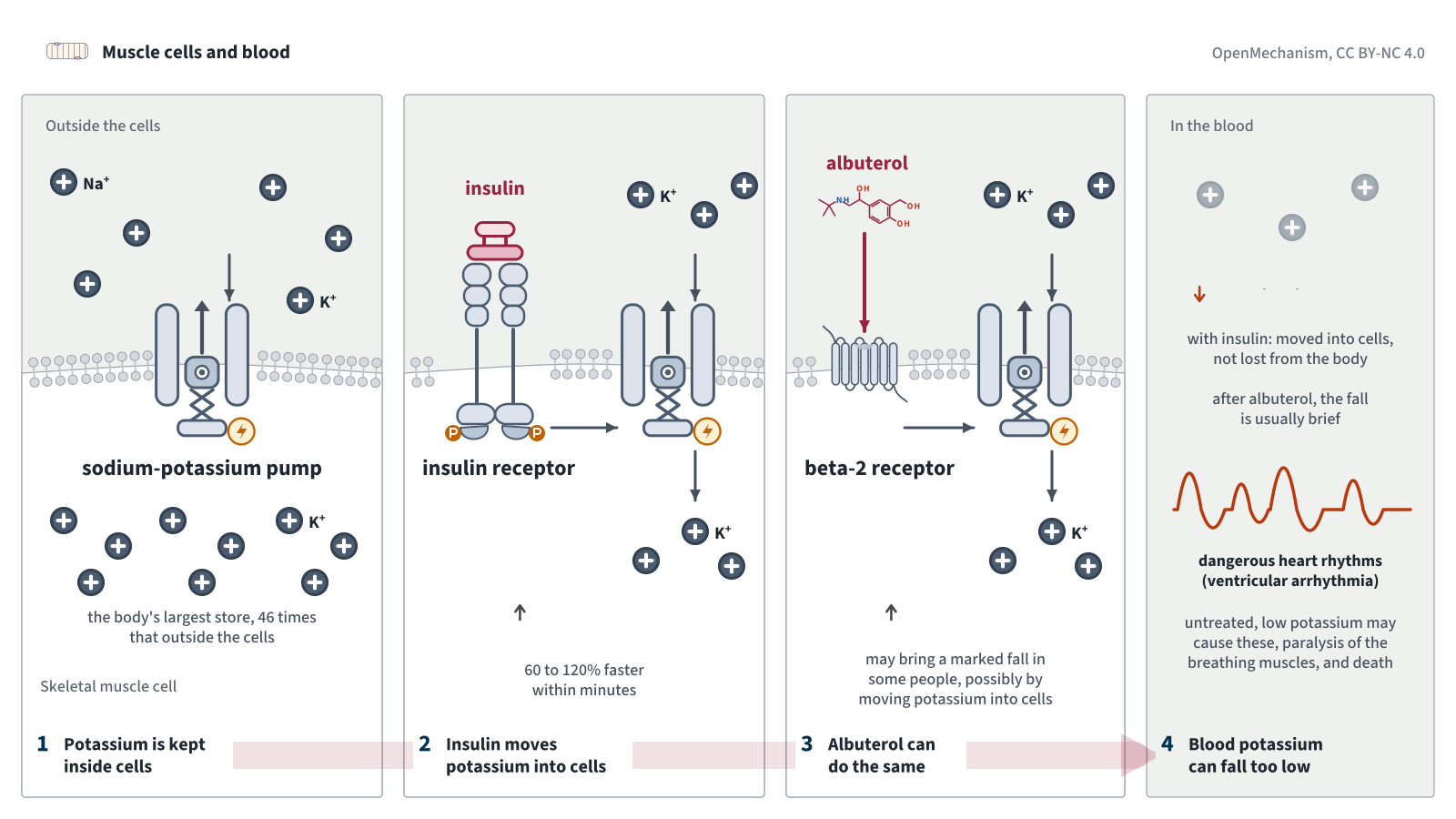
For teachers: download this drawing.
Step by step
Potassium is kept inside cells. Potassium is the main positive ion inside cells. Sodium-potassium pumps keep it there, so the blood holds little, and skeletal muscle holds the body's largest store: 46 times as much as all the fluid outside the cells.1,2,3
What the source says
“Potassium is the chief cation of body cells (160 mEq/liter of intracellular water). It is found in low concentration in plasma and extracellular fluids (3.5 to 5.0 mEq/liter in a healthy adult).”
Source 1“This enzyme, the “sodium pump,” is responsible for maintaining the intracellular milieu throughout the body by moving sodium ions out of and potassium ions into cells.”
Source 2“Human skeletal muscles contain the largest single pool of K+ in the body (2600 mmol, 46 times the total K+ content of the extracellular space).”
Source 3Insulin moves potassium into cells. All insulins shift potassium out of the blood and the fluid around cells and into the cells. In skeletal muscle, insulin is one of several hormones that speed up the sodium-potassium pumps, raising their rate by 60 to 120% within a few minutes.4,5
What the source says
“All insulins, including LANTUS, cause a shift in potassium from the extracellular to intracellular space, possibly leading to hypokalemia.”
Source 4“A variety of hormones (insulin, insulin-like growth factor I, adrenaline, noradrenaline, calcitonin gene-related peptide, calcitonin, amylin) increase the rate of active Na+, K+ transport by 60-120% within a few minutes.”
Source 5Albuterol can do the same. Beta-2 such as albuterol may cause a marked fall in blood potassium in some people, possibly by moving it into cells. Muscle research counts beta-2 agonists, insulin and the body's own catecholamines among the things that can lower blood potassium by stimulating the sodium-potassium pumps in skeletal muscle.3,6
What the source says
“VENTOLIN HFA is a beta 2 -adrenergic agonist”
Source 6“Beta-adrenergic agonist medicines may produce significant hypokalemia in some patients, possibly through intracellular shunting, which has the potential to produce adverse cardiovascular effects”
Source 6“Hypokalemia may be induced by the stimulation of the Na+,K+ pumps in skeletal muscles seen postexercise, or by catecholamines, beta2 agonists, pheochromocytoma, theophylline, caffeine or insulin”
Source 3Blood potassium can fall too low. With insulin, the potassium has moved, not left the body, but its level in the blood can fall too low (hypokalemia). After albuterol the fall is usually brief. Untreated, low potassium may cause paralysis of the breathing muscles, dangerous heart rhythms (ventricular arrhythmia) and death.4,6,7
What the source says
“All insulins, including LANTUS, cause a shift in potassium from the extracellular to intracellular space, possibly leading to hypokalemia.”
Source 4“Lower than normal levels of potassium in the circulating blood.”
Source 7“The decrease in serum potassium is usually transient”
Source 6“Untreated hypokalemia may cause respiratory paralysis, ventricular arrhythmia, and death.”
Source 4
See also
Medicine pages: insulin glargine and albuterol.
Other side effects (hormones & metabolism): why GLP-1 medicines slow the stomach, why metformin can cause lactic acidosis, why SGLT2 inhibitors can cause genital yeast infections, why steroid medicines can raise blood sugar, why steroid medicines can suppress the adrenal glands, why steroid medicines can weaken bones, why sulfonylureas can cause low blood sugar and all 65 side effects.
Interactions: digoxin and diuretics.
Conditions: high blood potassium and low blood potassium (hypokalemia).
Sources
- 1Potassium chloride in dextrose injection: FDA labelClinical Pharmacology. Saved copy
- 2Lanoxin (digoxin): FDA label12.1 Mechanism of Action. Saved copy
- 3Hormonal and pharmacological modification of plasma potassium homeostasisClausen T. Fundam Clin Pharmacol 2010 (abstract). Saved copy
- 4Lantus (insulin glargine): FDA label5.6 Hypokalemia. Saved copy
- 5The Na+, K+ pump in skeletal muscle: quantification, regulation and functional significanceClausen T. Acta Physiol Scand 1996 (abstract). Saved copy
- 6Ventolin HFA (albuterol sulfate): FDA label1 Indications and Usage; 5.8 Hypokalemia. Saved copy
- 7Hypokalemia: NCI Thesaurus definitionNCI definition, concept C37974. Saved copy
- 8Establishment and validation of an in vitro cell-based assay to assess the biological activity of insulin productsFDA Center for Drug Evaluation and Research, 2024. A method to assess the biological activity or bioidentity of insulin analogs in vitro. Also used for the drawing. Saved copy
Notes and limits
- The labels' advice on checking and treating potassium is left out: this page explains the mechanism, not what to do.
- The insulin label says that potassium shifts into cells, and the albuterol label that it possibly does, but neither says how. The part the sodium-potassium pumps play comes from muscle research.3
- Low blood potassium often comes from too little in the diet, alkalosis, or losses through the kidneys or the gut.3
Notes that apply to every page are on How to read a page.
Spotted a mistake? Report an error (hello@openmechanism.com). Since launch, every published error we fix is listed on the corrections page.
Medical review
Cite this page
Tran D. Why insulin and albuterol can lower potassium [Internet]. OpenMechanism; 2026 [updated 2026 Nov 13; cited 2026 Nov 13]. Available from: https://openmechanism.com/explained/insulin-albuterol-and-low-potassium