Why phenytoin levels can jump with small dose changes
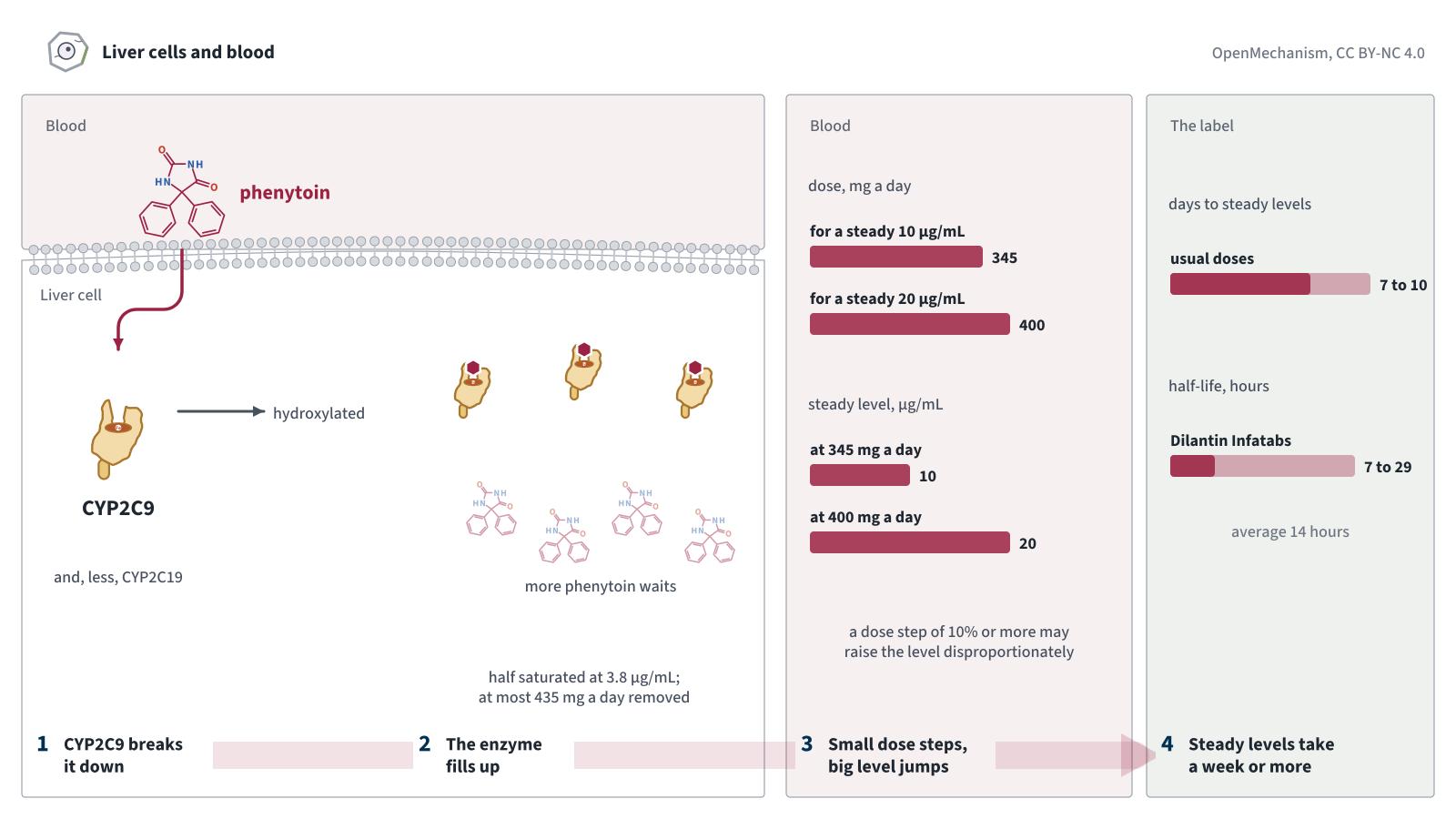
The liver enzyme CYP2C9, and to a lesser extent CYP2C19, breaks phenytoin down. This enzyme system becomes saturated at high blood levels, so small dose increases can lengthen phenytoin's half-life and raise its level a great deal. In one study, a steady level of 10 μg/mL took a mean of 345 mg of phenytoin sodium a day, and twice that level took 400 mg.
- Kind
- In the body
- Medicines
- Phenytoin
- Sources
- 3
For teachers: download this drawing.
Step by step
CYP2C9 breaks it down. Phenytoin is hydroxylated in the liver, and it is broken down mainly by the enzyme and to a lesser extent by .1
The enzyme fills up. This enzyme system becomes saturated at high blood levels. In 15 patients given a test dose, the mean saturated rate of removal was 435 mg of phenytoin a day, and the system was half saturated at a blood level of 3.8 μg/mL.1,2
What the source says
“an enzyme system which is saturable at high serum levels”
Source 1“Fifteen patients were each given an oral test dose of 600 mg phenytoin sodium”
Source 2“The mean saturated rate of elimination of phenytoin was 435 mg/day and the serum concentration (K(m)) corresponding with 50% saturation was 3.8 μg/ml.”
Source 2Small dose steps, big level jumps. Once levels are in the upper range, small dose increases may lengthen the and raise levels very substantially: a dose increase of 10% or more may raise the steady level disproportionately, with resulting poisoning. In the same study, the mean dose needed for a steady level of 10 μg/mL was 345 mg of phenytoin sodium a day, and for 20 μg/mL, 400 mg.1,2
What the source says
“small incremental doses may increase the half-life and produce very substantial increases in serum levels, when these are in the upper range.”
Source 1“The steady-state level may be disproportionately increased, with resultant intoxication, from an increase in dosage of 10% or more.”
Source 1“The mean calculated dose of phenytoin sodium required for a steady state serum concentration of 10-20 μg/ml was 345-400 mg/day.”
Source 2Steady levels take a week or more. After starting usual doses, steady levels take at least 7 to 10 days (5 to 7 half-lives) to reach. With Dilantin Infatabs the half-life averaged 14 hours, ranging from 7 to 29 hours.1
What the source says
“Steady-state therapeutic levels are achieved at least 7 to 10 days (5 to 7 half-lives) after initiation of therapy with recommended doses of 300 mg/day.”
Source 1“Clinical studies using Dilantin Infatabs have shown an average plasma half-life of 14 hours with a range of 7 to 29 hours.”
Source 1
See also
Medicine pages: phenytoin.
Other pages on what the body does with a medicine (brain & nerves): carbamazepine and the HLA-B*15:02 variant; codeine, tramadol and the CYP2D6 gene; why carbamazepine speeds up its own breakdown; and all 16 pages on what the body does with a medicine.
Conditions: epilepsy.
Interactions: isoniazid and phenytoin.
Sources
- 1Dilantin Infatabs (phenytoin): FDA label12.3 Pharmacokinetics. Saved copy
- 2Phenytoin dose adjustment in epileptic patientsMawer GE et al. Br J Clin Pharmacol 1974 (abstract). Saved copy
- 3Human CYP2C9 with S-warfarinPDB 1OG5; Williams, P.A. et al. Nature 2003;424:464. The CYP2C9 outline in the drawing is traced from this structure. Saved copy
Notes and limits
- The study's numbers are means for 15 patients, found by fitting the Michaelis-Menten equation to their blood levels over 48 hours after one test dose.2
Notes that apply to every page are on How to read a page.
Spotted a mistake? Report an error (hello@openmechanism.com). Since launch, every published error we fix is listed on the corrections page.
Cite this page
Tran D. Why phenytoin levels can jump with small dose changes [Internet]. OpenMechanism; 2026 [updated 2026 Oct 20; cited 2026 Oct 20]. Available from: https://openmechanism.com/explained/phenytoin-saturable-breakdown