Carbamazepine and the HLA-B*15:02 variant
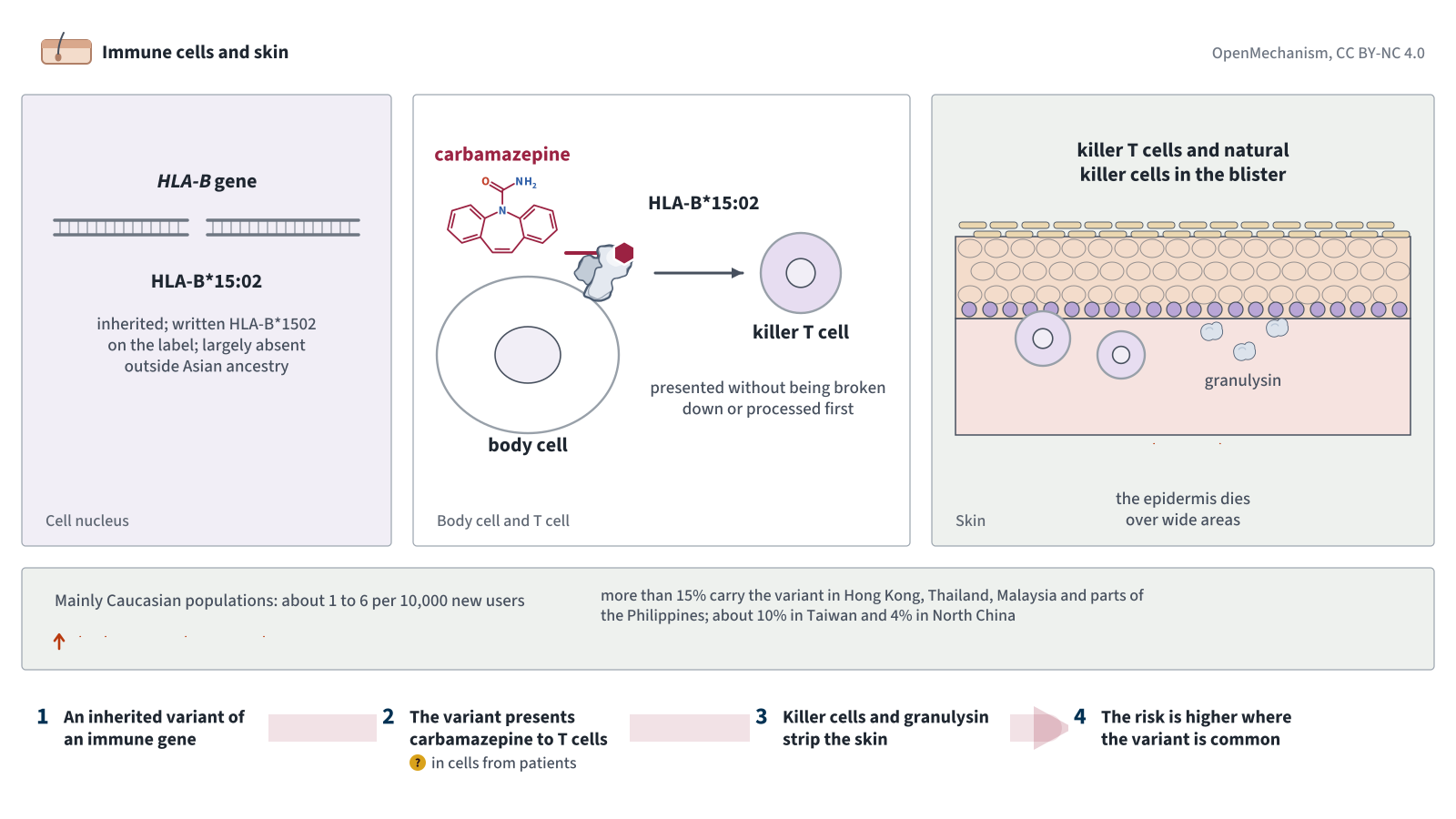
Carbamazepine can cause severe skin reactions: and . In patients of Chinese ancestry these are strongly associated with an inherited variant of the HLA-B gene, written HLA-B*1502 on the label, which is largely absent outside Asian ancestry. In cells from such patients the variant presented carbamazepine to killer T cells.
- Kind
- In the body
- Sources
- 5
Step 2: in cells from patients
The Tegretol label says only that the association exists: Retrospective case-control studies have found that in patients of Chinese ancestry there is a strong association between the risk of developing SJS/TEN with carbamazepine treatment and the presence of an inherited variant of the HLA-B gene, HLA-B*1502.
Clinical study: In Han Chinese patients, a genetic study compared the variant in people who had had this reaction on carbamazepine with others; it measured how often the variant was present, not how the variant presents the medicine to T cells: we show that there is a strong association in Han Chinese between a genetic marker, the human leukocyte antigen HLA-B*1502, and Stevens-Johnson syndrome induced by carbamazepine
Chung WH et al., Nature 2004 (PMID 15057820)
This study was picked with a literature search and is not yet checked by our reviewer.
For teachers: download this drawing.
Step by step
An inherited variant of an immune gene. *1502 is an inherited variant of the HLA-B gene; in patients of Chinese ancestry, case-control studies found a strong association between carrying it and the risk of these skin reactions on carbamazepine, and it is largely absent in people who are not of Asian origin.1
What the source says
“Retrospective case-control studies have found that in patients of Chinese ancestry there is a strong association between the risk of developing SJS/TEN with carbamazepine treatment and the presence of an inherited variant of the HLA-B gene, HLA-B*1502.”
Source 1“HLA-B*1502 is largely absent in individuals not of Asian origin (e.g., Caucasians, African-Americans, Hispanics, and Native Americans).”
Source 1The variant presents carbamazepine to T cells. In killer grown from patients who had had these reactions, the HLA-B*1502 molecule, already loaded with one of the cell's own peptides, presented carbamazepine to those T cells without the medicine first being broken down or processed inside the cell.2
Killer cells and granulysin strip the skin. In blister fluid from these reactions the cells are mostly killer T cells and natural killer cells, and the molecule they carry most, , was shown to be responsible for the widespread death of skin cells that strips the epidermis.3
What the source says
“blister cells from skin lesions of SJS-TEN primarily consist of cytotoxic T lymphocytes (CTLs) and natural killer (NK) cells, and both blister fluids and cells were cytotoxic”
Source 3“Our findings demonstrate that secretory granulysin is a key molecule responsible for the disseminated keratinocyte death in SJS-TEN”
Source 3“Stevens-Johnson syndrome (SJS) and toxic epidermal necrolysis (TEN) are life-threatening adverse drug reactions characterized by massive epidermal necrosis”
Source 3The risk is higher where the variant is common. The label reports these reactions in about 1 to 6 of every 10,000 new users in countries with mainly Caucasian populations and about ten times that in some Asian countries, where more than 15% of people carry the variant in several places.1
What the source says
“Serious and sometimes fatal dermatologic reactions, including toxic epidermal necrolysis (TEN) and Stevens-Johnson syndrome (SJS), have been reported with Tegretol treatment.”
Source 1“The risk of these events is estimated to be about 1 to 6 per 10,000 new users in countries with mainly Caucasian populations.”
Source 1“However, the risk in some Asian countries is estimated to be about 10 times higher.”
Source 1“Greater than 15% of the population is reported positive in Hong Kong, Thailand, Malaysia, and parts of the Philippines, compared to about 10% in Taiwan and 4% in North China.”
Source 1
See also
Related medicines: carbamazepine.
Other pages on what the body does with a medicine (brain & nerves): codeine, tramadol and the CYP2D6 gene; why carbamazepine speeds up its own breakdown; why phenytoin levels can jump with small dose changes; and all 16 pages on what the body does with a medicine.
Interactions: valproate and lamotrigine.
Conditions: bipolar disorder.
Sources
- 1Tegretol (carbamazepine): FDA labelBoxed Warning; Warnings: Serious Dermatologic Reactions; SJS/TEN and HLA-B*1502 Allele. Saved copy
- 2Direct interaction between HLA-B and carbamazepine activates T cells in patients with Stevens-Johnson syndromeWei CY, Chung WH, Huang HW, et al. J Allergy Clin Immunol 2012 (abstract). Saved copy
- 3Granulysin is a key mediator for disseminated keratinocyte death in Stevens-Johnson syndrome and toxic epidermal necrolysisChung WH, Hung SI, Yang JY, et al. Nat Med 2008 (abstract). Saved copy
- 4Medical genetics: a marker for Stevens-Johnson syndromeChung WH et al. Nature 2004 (abstract). Saved copy
- 5HLA-B*15:02 with beta-2-microglobulin and a peptide in its groovePDB 6VB0; Schutte, R.J. et al. To Be Published. The HLA-B*15:02 outline in the drawing is traced from this structure. Saved copy
Notes and limits
- The variant does not decide who will have a reaction.1
- It says nothing about the milder reactions.1
- A second HLA variant, HLA-A*3101, carries its own moderate association with hypersensitivity reactions, in other ancestries.1
- The reactions in the label's association studies and in the laboratory work were studied as a group; the granulysin work is from these reactions in general, not from carbamazepine alone.3
- The label's genotype screening and treatment instructions are left out: this page explains the mechanism, not what to do.
Notes that apply to every page are on How to read a page.
Spotted a mistake? Report an error (hello@openmechanism.com). Since launch, every published error we fix is listed on the corrections page.
Cite this page
Tran D. Carbamazepine and the HLA-B*15:02 variant [Internet]. OpenMechanism; 2026 [updated 2026 Oct 20; cited 2026 Oct 20]. Available from: https://openmechanism.com/explained/carbamazepine-and-hla-b-1502