Naloxone
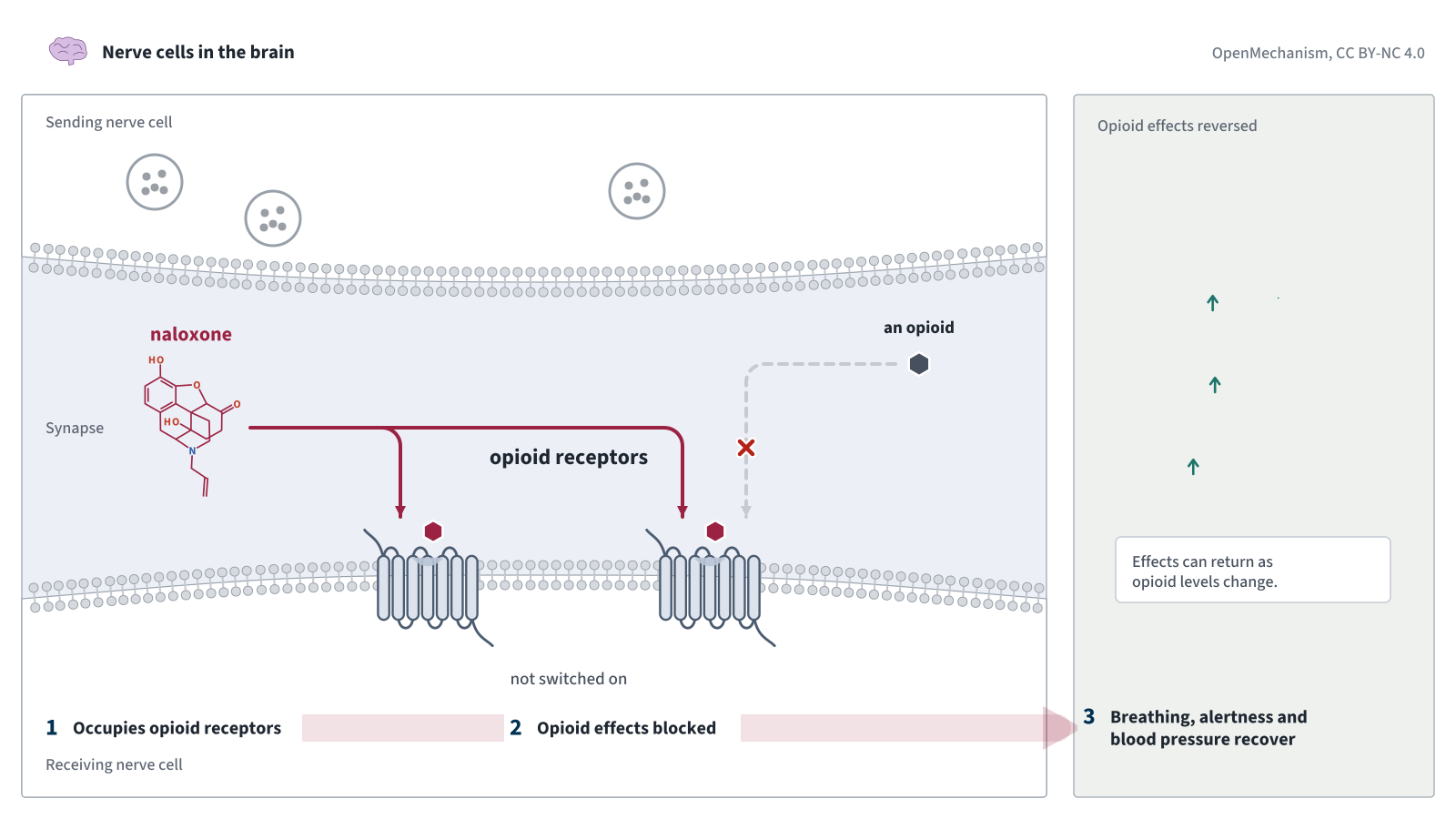
Naloxone occupies opioid receptors without activating them, competing with opioids. The label describes reversal of opioid-caused breathing depression, sedation and low blood pressure; effects can return as opioid levels change.
- Acts on
- Opioid receptors
- Where
- Opioid receptors in the central nervous system
- Medicine type
- Small molecule
- Used for
- Antidotes & reversal
- Drug class
- Opioid antagonists
Also called Narcan.
How it works
Occupies opioid receptors. Naloxone occupies opioid receptor sites that can otherwise bind opioid .1
Opioid effects blocked. Competition antagonizes opioid-mediated signaling rather than activating the opioid response.1
Breathing, alertness and blood pressure recover. The label describes reversal of opioid-associated respiratory depression, sedation and hypotension.1
For teachers: download this drawing or build a slide deck.
More detail
From the nose to the opioid receptors
Given as a nasal spray. NARCAN supplies naloxone by the intranasal route.1
Reaches the blood. Nasal naloxone produces measurable plasma exposure in healthy adults.1
Competes with opioids at their receptors. Naloxone competes with opioids at their receptor sites.1
Can reverse slowed breathing, sedation and low blood pressure. Opioid antagonism can reverse respiratory depression, sedation and hypotension.1
Wearing off, and symptoms that can return
Blood levels fall. Plasma naloxone concentrations decline after nasal administration; measured kinetics depend on route and study context.1
Some opioids outlast it. Some opioids outlast naloxone, allowing respiratory or depression to recur after initial improvement.1
What the source says
“The duration of action is dependent upon the dose and route of administration of naloxone hydrochloride.”
Source 1
Partial opioid agonists
Reversal may be incomplete. Reversal of partial or mixed opioid agonists may be incomplete.1
Withdrawal in people dependent on opioids
Can bring on sudden withdrawal. Opioid antagonism can precipitate acute withdrawal in opioid-dependent people.1
See also
Condition pages: opioid overdose and opioid use disorder.
Explained: why morphine slows the gut and breathing; and why naloxone can bring on opioid withdrawal.
Sources
- 1Narcan (naloxone hydrochloride): FDA label12.1 Mechanism of Action; 2.1 Administration; 12.3 Pharmacokinetics, Table 1 and Elimination; 5.1 Recurrent Depression; 5.2 Limited Efficacy; 5.3 Severe Withdrawal; 5.1 to 5.3 Warnings and Precautions
- 2ChEMBL CHEMBL80Target and action classification: Opioid receptors; mu/kappa/delta antagonist
Spotted a mistake? Report an error (hello@openmechanism.com). Since launch, every published error we fix is listed on the corrections page.
Notes and limits
- A schematic teaching drawing: not to scale, not exact structures, binding poses or a complete pathway, and not a guide to dosing, treatment or how a person will respond.
- The steps are in the order that explains them; one step is said to cause the next only where the source says so.
- NARCAN intranasal product; route-specific healthy-adult PK observations.
- Label does not establish a subtype-exclusive receptor map or microscopic CNS distribution; neither is added.
- Reversal is a physiological label endpoint, not a simulated breathing rate or a clinical response guarantee.
All recorded limits are on the evidence page, and notes that apply to every page are on How to read a page. Version 1.1.0, not yet medically reviewed.
Cite this page
Tran D. Naloxone [Internet]. OpenMechanism; 2026 [updated 2026 Oct 21; cited 2026 Oct 21]. Available from: https://openmechanism.com/medicines/naloxone