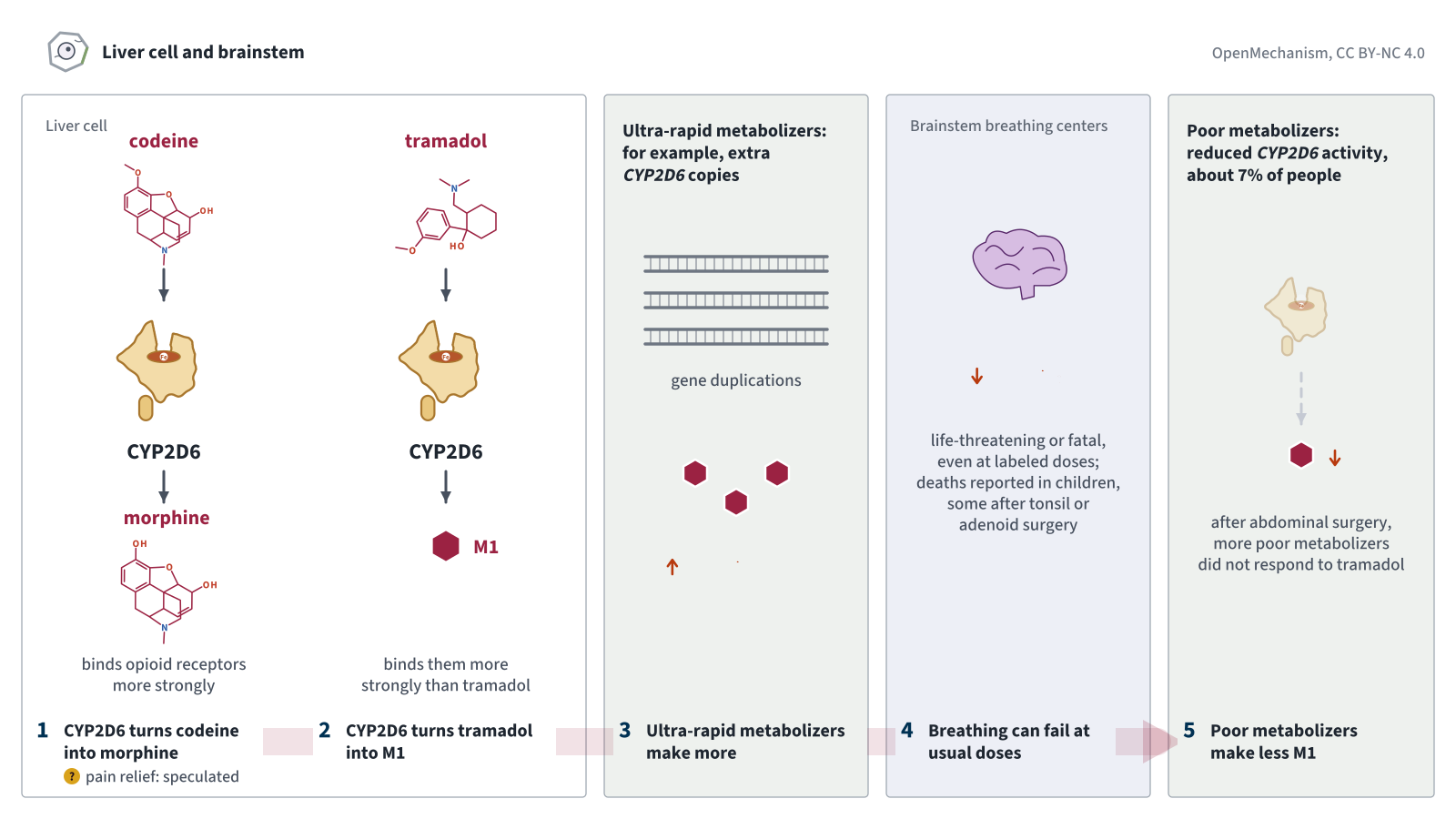
Codeine and tramadol bind mu-opioid receptors weakly themselves. The liver enzyme CYP2D6 turns codeine into morphine and tramadol into M1, which bind more strongly. People whose CYP2D6 works unusually fast make more of them, and the labels report fatal breathing problems; people whose CYP2D6 works poorly make less.
Schematic, not to scale. CYP2D6 outline from the structure with quinidine. License CC BY-NC 4.0.
?Step 1: pain relief: speculated
The codeine label says: The analgesic properties of codeine have been speculated to come from its conversion to morphine, although the exact mechanism of analgesic action remains unknown.
Clinical study: In Poulsen and colleagues' 1996 randomized, double-blind, three-way crossover study of experimental pain in 14 people whose CYP2D6 works normally (extensive metabolizers, EMs) and 14 whose CYP2D6 works poorly (poor metabolizers, PMs), comparing a single dose of codeine (75 or 100 mg) by mouth with morphine (20 or 30 mg) and placebo, a test of the step itself in people: After codeine, neither morphine nor morphine-6-glucuronide could be detected in 13 of the 14 PMs, whereas at least one of the compounds could be detected in all EMs. … it supports the theory that the analgesic effect of codeine depends on its O-demethylationPoulsen L et al., Eur J Clin Pharmacol 1996 (PMID 9010701)
CYP2D6 turns codeine into morphine. Codeine binds the mu-opioid receptor much more weakly than morphine, and is the main enzyme that turns a small part of a codeine dose into morphine; the label says codeine's pain relief has been speculated to come from that conversion, although the exact mechanism remains unknown.1
What the source says
“Codeine sulfate is an opioid agonist relatively selective for the mu-opioid receptor, but with a much weaker affinity than morphine.”
“Cytochrome P450 2D6 is the major enzyme responsible for conversion of codeine to morphine and P450 3A4 is the major enzyme mediating conversion of codeine to norcodeine.”
“The analgesic properties of codeine have been speculated to come from its conversion to morphine, although the exact mechanism of analgesic action remains unknown.”
CYP2D6 turns tramadol into M1. Tramadol's opioid activity comes partly from the medicine itself, which binds mu-opioid receptors with low , and partly from its metabolite M1, which binds them with higher affinity; CYP2D6 makes M1.2
What the source says
“Opioid activity is due to both low affinity binding of the parent compound and higher affinity binding of the O -demethylated metabolite M1 to μ-opioid receptors.”
“In vitro drug interaction studies in human liver microsomes indicate that inhibitors of CYP2D6 such as fluoxetine and its metabolite norfluoxetine, amitriptyline and quinidine inhibit the metabolism of tramadol to various degrees”
Ultra-rapid metabolizers make more. Some people carry a CYP2D6 genotype, such as extra copies of the gene, that makes the conversion faster and more complete, so the level of morphine or M1 is higher than expected.1,2
What the source says
“Some individuals may be ultra-rapid metabolizers because of a specific CYP2D6 genotype (e.g., gene duplications denoted as *1/*1xN or *1/*2xN).”
Breathing can fail at usual doses. Both labels say each medicine slows breathing by acting directly on the brainstem's breathing centers, and that ultra-rapid metabolizers may have life-threatening or fatal slowing of breathing even at the doses on the label. Both also report life-threatening slowing of breathing and deaths in children: after codeine, many of the children had evidence of ultra-rapid metabolism; after tramadol, at least one did.1,2
What the source says
“Codeine produces respiratory depression by direct action on brain stem respiratory centers.”
“Even at labeled dosage regimens, individuals who are ultra-rapid metabolizers may have life-threatening or fatal respiratory depression or experience signs of overdose (such as extreme sleepiness, confusion, or shallow breathing)”
“Even at labeled dosage regimens, individuals who are ultra-rapid metabolizers may have life-threatening or fatal respiratory depression or experience signs of overdose”
“Life-threatening respiratory depression and death have occurred in children who received codeine. Most of the reported cases occurred following tonsillectomy and/or adenoidectomy, and many of the children had evidence of being an ultra-rapid metabolizer of codeine due to a CYP2D6 polymorphism”
“Life-threatening respiratory depression and death have occurred in children who received tramadol. Some of the reported cases followed tonsillectomy and/or adenoidectomy; in at least one case, the child had evidence of being an ultra-rapid metabolizer of tramadol due to a CYP2D6 polymorphism.”
Poor metabolizers make less M1. About 7% of people have reduced CYP2D6 activity: in healthy volunteers their tramadol levels were about 20% higher and their M1 levels 40% lower than in people whose CYP2D6 works normally, and in a 2003 prospective study of 300 people recovering from abdominal surgery, who after a loading dose gave themselves doses of a mix of tramadol, dipyrone and metoclopramide by patient-controlled analgesia, more of the 30 whose CYP2D6 does not work did not respond (46.7%, against 21.6% of 241 extensive metabolizers).2,3
What the source says
“Approximately 7% of the population has reduced activity of the CYP2D6 isoenzyme of cytochrome P450 metabolizing enzyme system.”
“Based on a population PK analysis of Phase 1 studies with IR tablets in healthy subjects, concentrations of tramadol were approximately 20% higher in "poor metabolizers" versus "extensive metabolizers," while M1 concentrations were 40% lower.”
“A prospective study design was used and 300 patients recovering from abdominal surgery were enrolled. After titration of an individual loading dose, patients could self-administer 1 ml bolus doses of the drug combination tramadol 20 mg/ml, dipyrone 200 mg/ml and metoclopramide 0.4 mg/ml via patient-controlled analgesia (PCA).”
“Demographic and surgery related data were comparable between EM (n=241) and PM (n=30). The percentage of non-responders was significantly higher in the PM group (46.7%) compared with the EM group (21.6%; p=0.005).”
Human CYP2D6 with quinidinePDB 4WNU; Wang, A. et al. J.Biol.Chem. 2015;290:5092-5104. The CYP2D6 outline in the drawing is traced from this structure. Saved copy
Notes and limits
Only a small part of a codeine dose becomes morphine at all; most of it is conjugated or turned into norcodeine.1
CYP2D6 is not the only pathway for tramadol, and how much of its pain relief comes from the medicine and how much from M1 depends on the levels of each.2
Medicines that block CYP2D6, or block or induce CYP3A4, can shift the same balance, so the gene is only one of the things that change the levels.1,2
The labels' contraindications, dosing and breastfeeding instructions are left out: this page explains the mechanism, not what to do.
text 4140efd1859f…; drawings 0c6b62ca6d30…; notes 7a4f97bf42cc…
AI source check
Claude Opus 5.5 (AI source check), 3 November 2026: 29 statements compared with their sources, 6 flagged for the reviewer. An automated check, not a medical review.
Next review due
4 May 2028
Cite this page
Tran D. Codeine, tramadol and the CYP2D6 gene [Internet]. OpenMechanism; 2026 [updated 2026 Nov 3; cited 2026 Nov 3]. Available from: https://openmechanism.com/explained/codeine-tramadol-and-cyp2d6