Osteoporosis
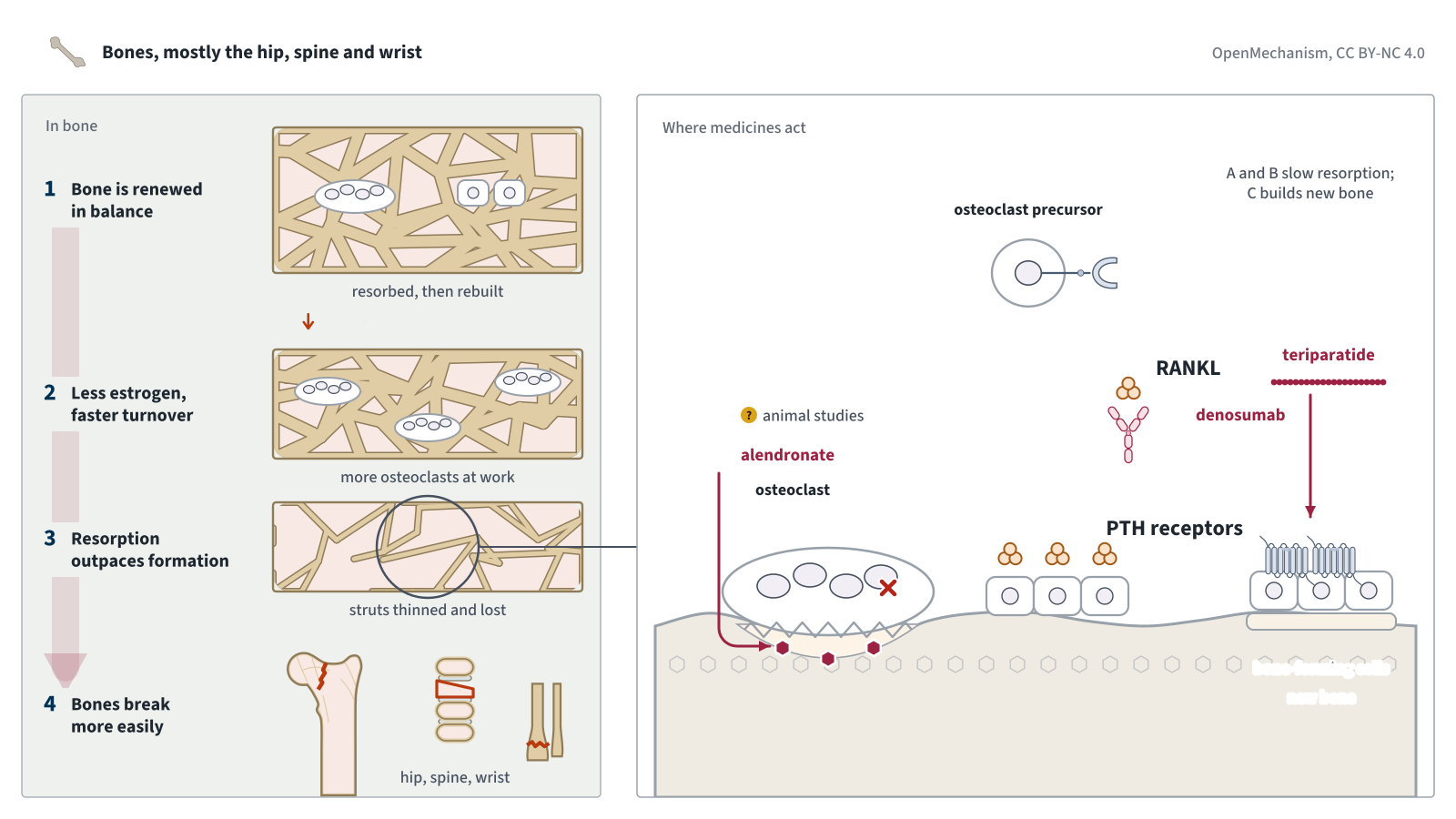
Osteoporosis is low bone mass with a weakened inner structure, so bones break easily, most often at the hip, spine and wrist; on average up to half of women over 50 are at risk of fractures. After menopause, less estrogen speeds bone turnover and resorption outpaces formation. Alendronate and denosumab slow resorption; teriparatide builds new bone.
- Where
- Bones, mostly the hip, spine and wrist
- Body system
- Muscles, bones & joints
- Medicines
- 3 medicines
Animal studies
The Fosamax label says: Animal studies have indicated the following mode of action.
Source 3: Fosamax (alendronate sodium): FDA label, 1 Indications and Usage; 12.1 Mechanism of Action
Clinical study: In Liberman and colleagues' 1995 placebo-controlled trial in 994 women with postmenopausal osteoporosis, who took alendronate (5 or 10 mg a day for three years, or 20 mg for two years then 5 mg for one year) or placebo, all with 500 mg of calcium a day; its abstract reports bone mineral density, fractures and height loss, not how alendronate acts on osteoclasts: The women receiving alendronate had significant, progressive increases in bone mineral density at all skeletal sites, whereas those receiving placebo had decreases in bone mineral density.
Liberman UA et al., N Engl J Med 1995 (PMID 7477143)
This study was picked with a literature search and is not yet checked by our reviewer.
For teachers: download this drawing.
Key terms in this drawing
- PTH
- Parathyroid hormone. A hormone from the parathyroid glands that raises blood calcium.
What goes wrong
Bone is renewed in balance. Throughout life, bone is remodeled: osteoclasts resorb old and damaged bone, and osteoblasts form new bone in its place, closely matched.1
What the source says
“The bone remodelling cycle replaces old and damaged bone and is a highly regulated, lifelong process essential for preserving bone integrity and maintaining mineral homeostasis.”
Source 1“During the bone remodelling cycle, osteoclastic resorption is tightly coupled to osteoblastic bone formation.”
Source 1Less estrogen, faster turnover. After menopause, the loss of estrogen speeds up bone turnover through effects on every kind of bone cell; this postmenopausal form is the most common type of osteoporosis.2
Resorption outpaces formation. When resorption and formation fall out of balance, bone mass falls and its fine structure breaks down: the struts of spongy bone lose their connections, and compact bone grows thinner and more porous.1,2
What the source says
“Disruption of the bone remodelling cycle and any resulting imbalance between bone resorption and formation leads to metabolic bone disease, most commonly osteoporosis.”
Source 1“Osteoporosis is a metabolic bone disorder that is characterized by low bone mass and micro-architectural deterioration of bone tissue.”
Source 2“The imbalance in bone formation and resorption has effects on trabecular bone (loss of connectivity) and cortical bone (cortical thinning and porosity).”
Source 2Bones break more easily. The fractures it causes most often are of the hip (the top of the thigh bone), the spine and the wrist.2
What the source says
“Fractures of the proximal femur, the vertebrae and the distal radius are the most frequent osteoporotic fractures”
Source 2
Where medicines act
Where bone is resorbed
- A
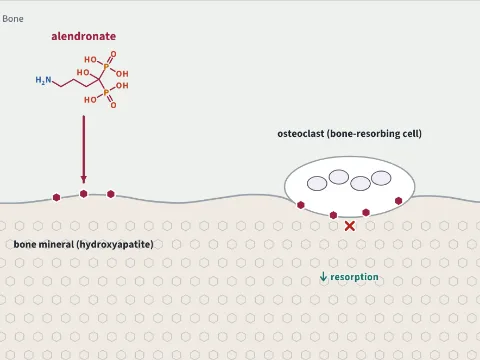
Alendronate targets Osteoclasts
Gathers in the bone under resorbing osteoclasts and stops their activity, in animal studies; it does not stop them forming or attaching.3
Used forOsteoporosis after menopause: treatment and preventionOsteoporosis in men: to increase bone massOsteoporosis from glucocorticoids: treatment, with low bone density
What the label says
“Animal studies have indicated the following mode of action.”
Source 3“At the cellular level, alendronate shows preferential localization to sites of bone resorption, specifically under osteoclasts.”
Source 3“Alendronate does not interfere with osteoclast recruitment or attachment, but it does inhibit osteoclast activity.”
Source 3“In postmenopausal women, FOSAMAX increases bone mass and reduces the incidence of fractures, including those of the hip and spine (vertebral compression fractures).”
Source 3“FOSAMAX is indicated for the prevention of postmenopausal osteoporosis”
Source 3“FOSAMAX is indicated for treatment to increase bone mass in men with osteoporosis”
Source 3“FOSAMAX is indicated for the treatment of glucocorticoid-induced osteoporosis in men and women receiving glucocorticoids in a daily dosage equivalent to 7.5 mg or greater of prednisone and who have low bone mineral density”
Source 3
Where osteoclasts form
- B
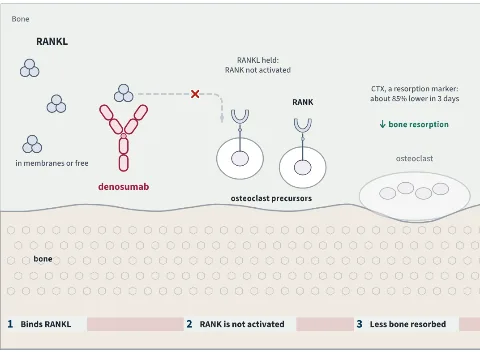
Denosumab targets RANKL
Binds RANKL, the signal osteoclasts need, so fewer osteoclasts form, work and survive.4
Used forOsteoporosis after menopause: at high risk for fractureOsteoporosis in men: to increase bone mass, at high risk for fractureOsteoporosis from glucocorticoids: at high risk of fracture
What the label says
“Denosumab is a human IgG2 monoclonal antibody with affinity and specificity for human RANKL”
Source 4“Prolia prevents RANKL from activating its receptor, RANK, on the surface of osteoclasts and their precursors.”
Source 4“Prevention of the RANKL/RANK interaction inhibits osteoclast formation, function, and survival, thereby decreasing bone resorption and increasing bone mass and strength in both cortical and trabecular bone.”
Source 4“Prolia is indicated for the treatment of postmenopausal women with osteoporosis at high risk for fracture, defined as a history of osteoporotic fracture, or multiple risk factors for fracture; or patients who have failed or are intolerant to other available osteoporosis therapy.”
Source 4“Prolia is indicated for treatment to increase bone mass in men with osteoporosis at high risk for fracture”
Source 4“Prolia is indicated for the treatment of glucocorticoid-induced osteoporosis in men and women at high risk of fracture”
Source 4
Where bone is formed
- C
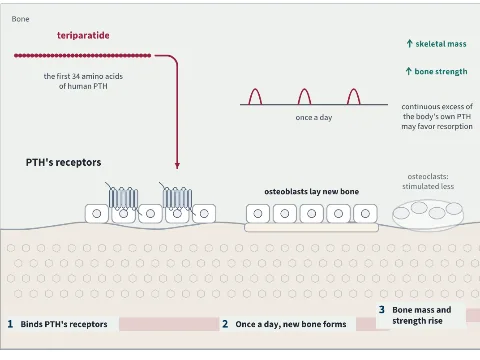
Teriparatide targets PTH receptors
Given once a day, it stimulates osteoblasts more than osteoclasts, so new bone forms.5
Used forOsteoporosis after menopause: at high risk for fractureOsteoporosis in men: to increase bone mass, at high risk for fractureOsteoporosis from glucocorticoids: at high risk for fracture
What the label says
“It has an identical sequence to the 34 N-terminal amino acids (the biologically active region) of the 84-amino acid human parathyroid hormone.”
Source 5“Once-daily administration of teriparatide stimulates new bone formation on trabecular and cortical (periosteal and/or endosteal) bone surfaces by preferential stimulation of osteoblastic activity over osteoclastic activity.”
Source 5“For the treatment of postmenopausal women with osteoporosis at high risk for fracture (defined herein as having a history of osteoporotic fracture or multiple risk factors for fracture) or who have failed or are intolerant to other available osteoporosis therapy.”
Source 5“To increase bone mass in men with primary or hypogonadal osteoporosis at high risk for fracture or who have failed or are intolerant to other available osteoporosis therapy.”
Source 5“For the treatment of men and women with osteoporosis associated with sustained systemic glucocorticoid therapy (daily dosage equivalent to 5 mg or greater of prednisone) at high risk for fracture or who have failed or are intolerant to other available osteoporosis therapy.”
Source 5
See also
Body system: muscles, bones & joints.
Zoom in: bone remodeling.
Also used for it: estradiol (for preventing osteoporosis after menopause, in women at significant risk for whom medicines other than estrogen are not appropriate: “When prescribing solely for the prevention of postmenopausal osteoporosis, therapy should only be considered for women at significant risk of osteoporosis and for whom non-estrogen medications are not considered to be appropriate.”8).
Other conditions: growth hormone deficiency, absent periods (secondary amenorrhea), breast cancer and prostate cancer.
Side effects: why steroid medicines can weaken bones, why alendronate can irritate the esophagus and why antipsychotics can raise prolactin.
Sources
- 1The bone remodelling cycleKenkre JS, Bassett JHD. Ann Clin Biochem 2018 (abstract). Saved copy
- 2Postmenopausal osteoporosisEastell R et al. Nat Rev Dis Primers 2016 (abstract). Saved copy
- 3Fosamax (alendronate sodium): FDA label1 Indications and Usage; 12.1 Mechanism of Action. Saved copy
- 4Prolia (denosumab): FDA label1 Indications and Usage; 12.1 Mechanism of Action. Saved copy
- 5Forteo (teriparatide): FDA label1 Indications and Usage; 12.1 Mechanism of Action. Saved copy
- 6OsteoporosisCompston JE et al. Lancet 2019 (abstract). Saved copy
- 7Vertebral fractures after discontinuation of denosumab: a post hoc analysis of the randomized placebo-controlled FREEDOM trial and its extensionCummings SR et al. J Bone Miner Res 2018 (abstract). Saved copy
- 8Estradiol tablets: FDA labelIndications & Usage. Saved copy
- 9Effect of oral alendronate on bone mineral density and the incidence of fractures in postmenopausal osteoporosis. The Alendronate Phase III Osteoporosis Treatment Study GroupLiberman UA et al. N Engl J Med 1995 (abstract). Saved copy
Notes and limits
- Osteoporosis is long-term, and its treatment can be lifelong.6
- Some medicines lower fracture risk by slowing bone resorption, such as alendronate and denosumab; others, such as teriparatide, by stimulating bone formation.2
- When denosumab is stopped, bone turnover rises above where it started within 6 months, and spine fractures become as common as without treatment.7
Notes that apply to every page are on How to read a page.
Spotted a mistake? Report an error (hello@openmechanism.com). Since launch, every published error we fix is listed on the corrections page.
Cite this page
Tran D. Osteoporosis [Internet]. OpenMechanism; 2026 [updated 2026 Nov 14; cited 2026 Nov 14]. Available from: https://openmechanism.com/conditions/osteoporosis