Acetylcysteine
In the liver, part of acetaminophen is turned into a reactive metabolite, NAPQI, which glutathione normally binds; doses of 150 mg/kg or more have been associated with liver injury. Acetylcysteine probably protects the liver by keeping up or restoring glutathione, or by binding the reactive metabolite itself. It has been shown to reduce liver injury after an acetaminophen overdose, and is given to prevent or lessen it.
- Acts on
- Glutathione and acetaminophen's reactive metabolite (NAPQI)
- Where
- Liver cells
- Medicine type
- Small molecule
- Used for
- Antidotes & reversal
Also called Acetadote and N-acetyl-l-cysteine.
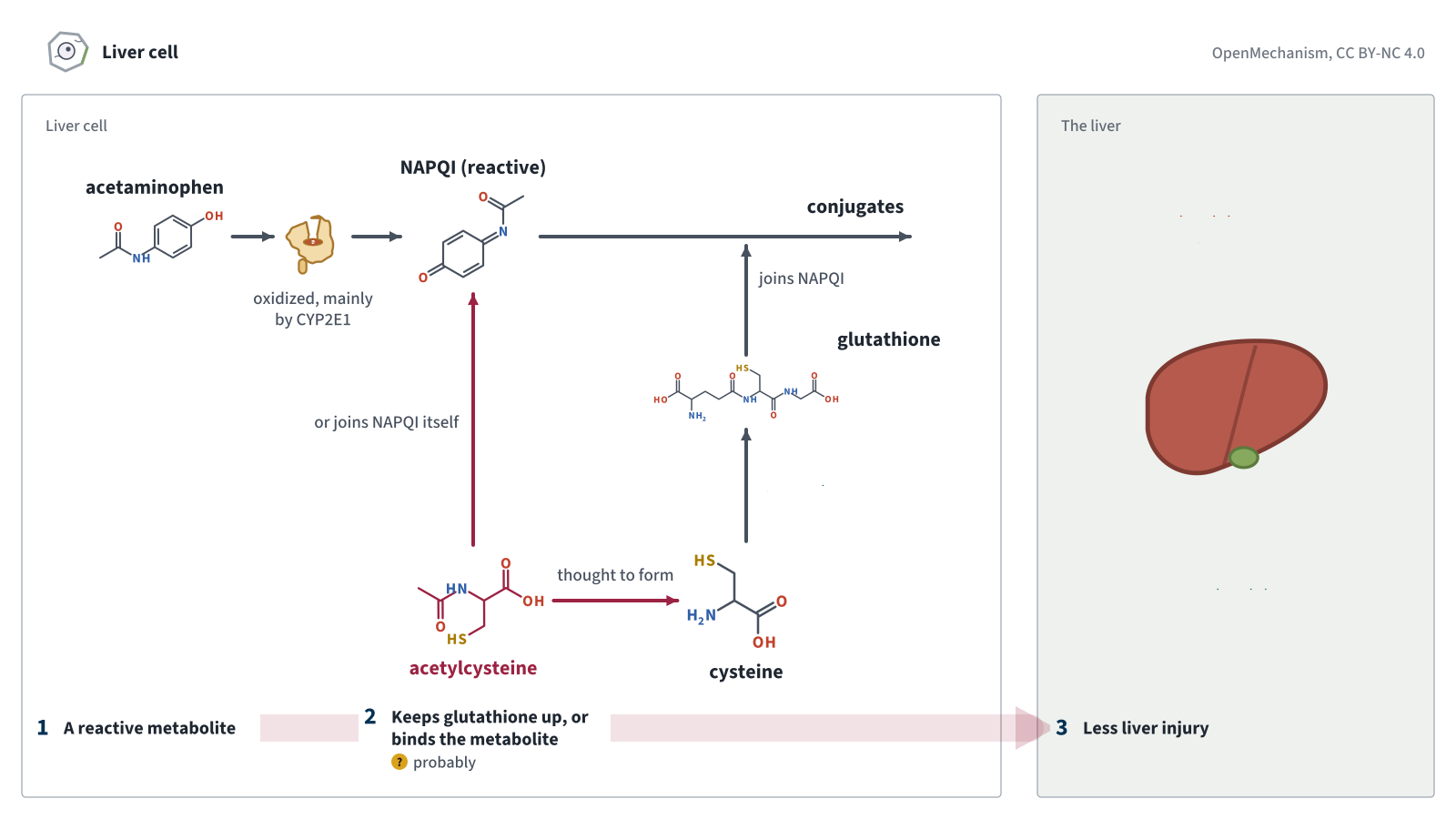
Step 2: probably
The Acetadote label says: Acetylcysteine probably protects the liver by maintaining or restoring the glutathione levels, or by acting as an alternate substrate for conjugation with, and thus detoxification of, the reactive metabolite of acetaminophen. … Acetylcysteine (i.e., N -acetylcysteine) is postulated to form cysteine and disulfides (N,N-diacetylcysteine and N -acetylcysteine). Cysteine is further metabolized to form glutathione and other metabolites.
Clinical study: In 100 people with severe paracetamol (acetaminophen) poisoning treated with intravenous acetylcysteine, compared with earlier patients given supportive care alone; the study measured liver damage, not how acetylcysteine works: There was virtually complete protection against liver damage in 40 patients treated within eight hours after ingestion (mean maximum serum alanine transaminase activity 27 IU/1). … Only one out of 62 patients treated within 10 hours developed severe liver damage compared with 33 out of 57 patients (58%) studied retrospectively who received supportive treatment alone.
Prescott LF et al., Br Med J 1979 (PMID 519312)
This study was picked with a literature search and is not yet checked by our reviewer.
How it works
A reactive metabolite. In the liver, acetaminophen is broken down in three main ways: joined to glucuronide, joined to sulfate, or oxidized, mainly by the enzyme CYP2E1, into a reactive metabolite, NAPQI. At usual doses, NAPQI is quickly joined to glutathione and then made into cysteine and mercapturic acid conjugates. Acetaminophen doses of 150 mg/kg or more have been associated with liver injury.1,2
Keeps glutathione up, or binds the metabolite. Acetylcysteine probably protects the liver by maintaining or restoring glutathione (in the body it is thought to form cysteine, from which glutathione is made), or by joining the reactive metabolite itself, in glutathione's place, which detoxifies it.2
Less liver injury. Acetylcysteine has been shown to reduce the extent of liver injury after an acetaminophen overdose. It is used to prevent or lessen liver injury after a potentially harmful amount of acetaminophen.2
For teachers: download this drawing.
See also
Condition pages: acetaminophen overdose.
More medicines for antidotes & reversal: atropine, digoxin immune fab, dimercaprol, flumazenil, fomepizole, glucarpidase, hydroxocobalamin, idarucizumab and 7 more.
Explained: why too much acetaminophen harms the liver.
Related drawings: acetaminophen (whose overdose acetylcysteine treats).
Sources
- 1Acetaminophen injection: FDA label12.3 Pharmacokinetics (Metabolism)
- 2Acetadote (acetylcysteine) injection: FDA label1 Indications and Usage; 12.1 Mechanism of Action; 12.3 Pharmacokinetics
- 3ChEMBL CHEMBL600Target and action classification: Glutathione precursor; Mycolytic
- 4Intravenous N-acetylcystine: the treatment of choice for paracetamol poisoningPrescott LF et al. Br Med J 1979 (abstract)
Also used for the drawing
The CYP2E1 outline is traced from the crystal structure below.
- 5Human CYP2E1 with an inhibitor (indazole)PDB 3E6I; Porubsky, P.R. et al. J.Biol.Chem. 2008; 283:33698-33707
Spotted a mistake? Report an error (hello@openmechanism.com). Since launch, every published error we fix is listed on the corrections page.
Notes and limits
- A schematic teaching drawing: not to scale, not exact structures, binding poses or a complete pathway, and not a guide to dosing, treatment or how a person will respond.
- The Acetadote label says acetylcysteine probably protects the liver by maintaining or restoring glutathione, or by acting as an alternate substrate for conjugation with the reactive metabolite; that it forms cysteine is postulated.
All recorded limits are on the evidence page, and notes that apply to every page are on How to read a page. Version 1.0.0, not yet medically reviewed.
Cite this page
Tran D. Acetylcysteine [Internet]. OpenMechanism; 2026 [updated 2026 Oct 17; cited 2026 Oct 17]. Available from: https://openmechanism.com/medicines/acetylcysteine