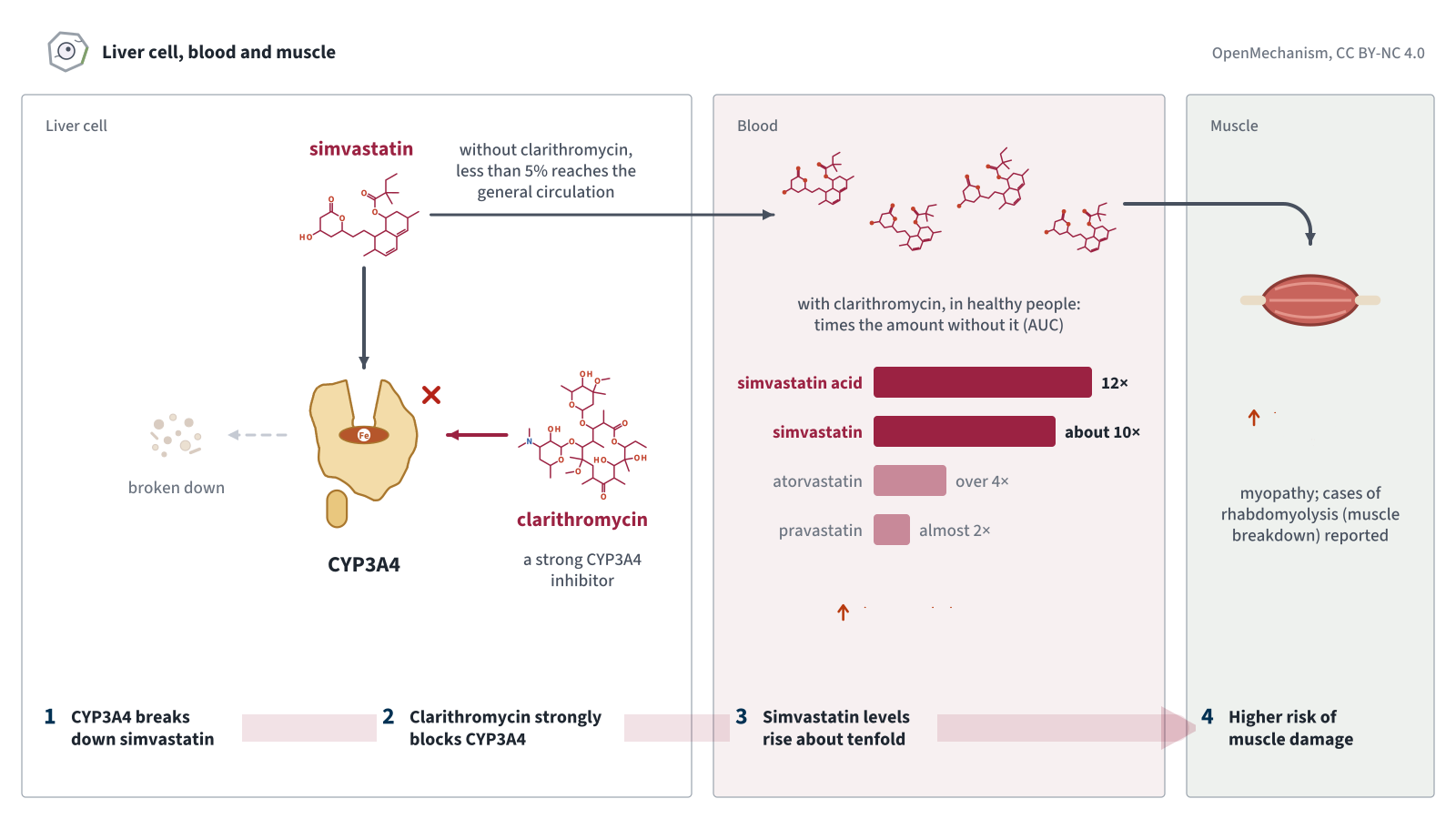
Simvastatin is broken down extensively by the enzyme CYP3A4, and less than 5% of each dose gets past the liver. Clarithromycin, an antibiotic, strongly blocks CYP3A4. In healthy people it raised simvastatin levels in the blood about tenfold, more than atorvastatin's or pravastatin's, and the labels say higher levels raise the risk of muscle damage. Both labels list taking the two together as contraindicated.
CYP3A4 breaks down simvastatin. Simvastatin is broken down extensively by the enzyme , and the liver takes out so much of each dose on its first pass that less than 5% reaches the general circulation.1,2
Simvastatin levels rise about tenfold. So more simvastatin reaches the blood. In healthy people, clarithromycin raised the total amount of simvastatin in the blood over time (its ) about 10-fold, and of simvastatin acid, its active form, 12-fold: more than for atorvastatin (over 4-fold) or pravastatin (almost 2-fold). The clarithromycin label also reports in people taking it with atorvastatin.1,2,3
What the source says
“concomitant treatment with clarithromycin increases their plasma concentration”
“Studies compared the multiple-dose pharmacokinetic interaction profiles of pravastatin, simvastatin, and atorvastatin when coadministered with 4 inhibitors of cytochrome P450-3A4 isoenzymes in healthy subjects.”
“Clarithromycin significantly (p <0.001) increased the AUC (and C(max)) of all 3 statins, most markedly simvastatin ( approximately 10-fold increase in AUC) and simvastatin acid (12-fold), followed by atorvastatin (greater than fourfold) and then pravastatin (almost twofold).”
Higher risk of muscle damage. Higher levels of simvastatin and simvastatin acid in the blood raise the risk of (muscle pain, tenderness or weakness with a raised , CK). The clarithromycin label says taking the two together increases the risk of myopathy, including rhabdomyolysis (muscle breakdown), and that cases of rhabdomyolysis have been reported.1,2
What the source says
“The risk of myopathy is increased by elevated plasma levels of simvastatin and simvastatin acid.”
“myopathy, defined as unexplained muscle weakness, pain, or tenderness accompanied by creatinine kinase (CK) increases greater than ten times the upper limit of normal (10xULN)”
Zocor (simvastatin): FDA label5.1 Myopathy and Rhabdomyolysis; 7.1 Drug Interactions that Increase the Risk of Myopathy and Rhabdomyolysis; 12.1 Mechanism of Action; 12.3 Pharmacokinetics. Saved copy
Human CYP3A4 with ritonavirPDB 3NXU; Sevrioukova, I.F., Poulos, T.L. Proc.Natl.Acad.Sci.USA 2010;107:18422-18427. The CYP3A4 outline in the drawing is traced from this structure. Saved copy
Notes and limits
Both labels list taking the two together as contraindicated. Their doses and management advice are left out: this page explains the mechanism, not what to do.1,2
The studies in step 3 measured blood levels in healthy people, not muscle damage.
The Zocor label names other strong CYP3A4 blockers too, such as itraconazole and some HIV medicines.1
How statins can harm muscle is on its own page, Why statins can cause muscle problems.
Claude Opus 5.5 (AI source check), 29 October 2026: 25 statements compared with their sources, 3 flagged for the reviewer. An automated check, not a medical review.
Conflict of interest
Atorvastatin: Pfizer, the reviewer's former employer, used to market this medicine as Lipitor. The label this site cites is from Viatris. Details
Key terms
Definitions reworded since this review: CYP3A4, myopathy and rhabdomyolysis. Definitions are shared across pages, so a later rewording does not take the review line off (what a review covers).
Next review due
29 April 2028
Cite this page
Tran D. Simvastatin and clarithromycin [Internet]. OpenMechanism; 2026 [updated 2026 Oct 29; cited 2026 Oct 29]. Available from: https://openmechanism.com/explained/simvastatin-and-clarithromycin