Why eculizumab raises the risk of meningococcal infections
Eculizumab blocks the complement protein C5, so complement's final, bacteria-killing steps cannot happen. That leaves people open to Neisseria meningitidis: serious meningococcal infections become about 1,000 to 2,000 times more common, and can be fatal, even in people who have been vaccinated.
- Kind
- Side effect
- Medicines
- Eculizumab
- Sources
- 6
Step 2: in the lab
The Konar 2017 study, in blood from vaccinated adults in the lab, says: In the presence of eculizumab, there was a >22-fold increase in geometric mean CFUs per milliliter
Clinical study: A report of the 16 meningococcal cases in people taking eculizumab in the United States from 2008 to 2016; it counted cases and vaccine doses, and did not test how complement killing failed: Sixteen cases of meningococcal disease were identified in eculizumab recipients in the United States during 2008-2016; among these, 11 were caused by nongroupable Neisseria meningitidis. … Fourteen patients had documentation of receipt of at least 1 dose of meningococcal vaccine before disease onset.
McNamara LA et al., MMWR Morb Mortal Wkly Rep 2017 (PMID 28704351)
This study was picked with a literature search and is not yet checked by our reviewer.
For teachers: download this drawing.
Step by step
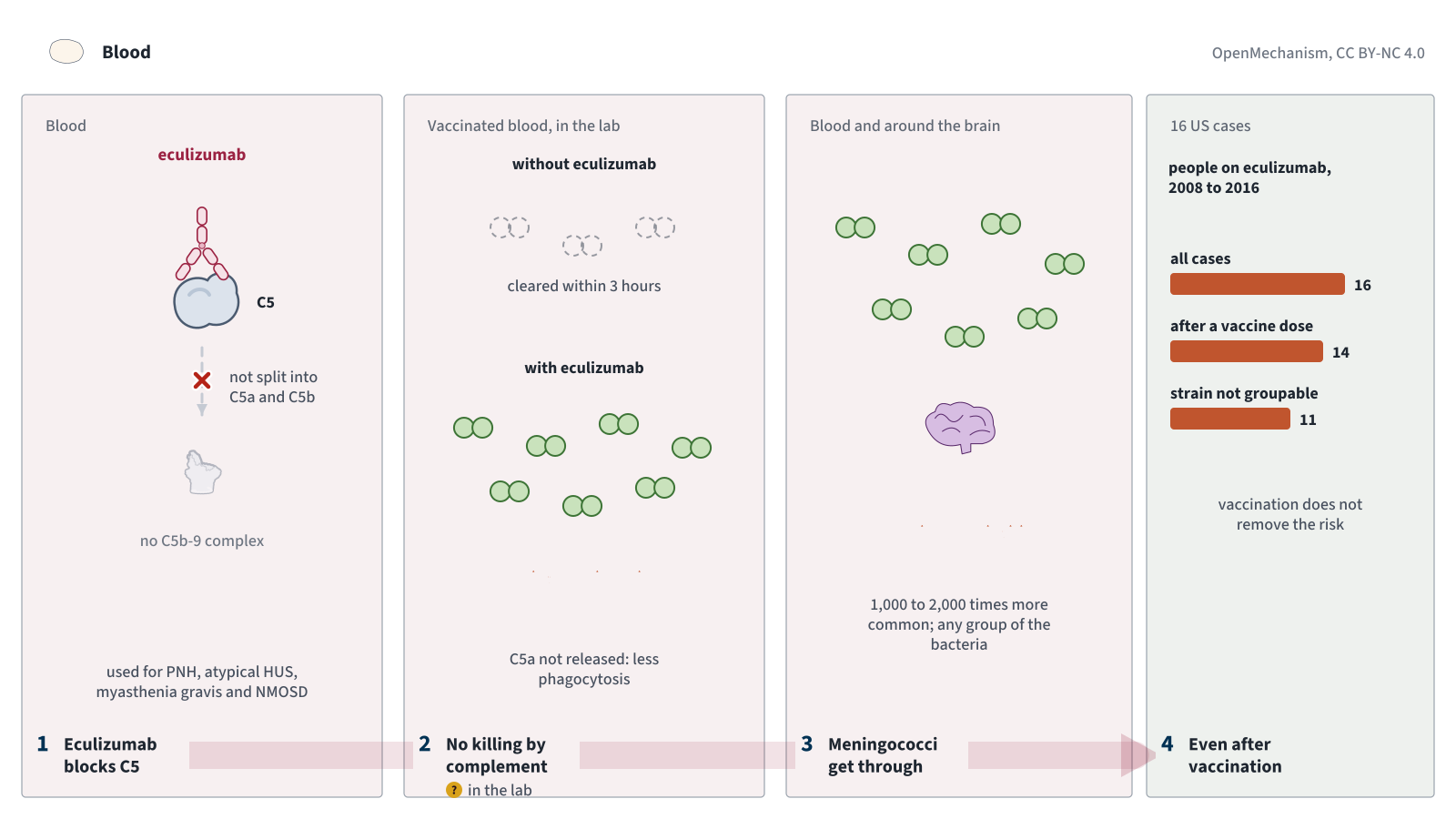
Eculizumab blocks C5. Eculizumab, used for , atypical hemolytic uremic syndrome, generalized myasthenia gravis and , is an antibody that binds the protein , so C5 cannot be split into and and the , C5b-9, is not made.1
What the source says
“SOLIRIS is a complement inhibitor indicated for: the treatment of patients with paroxysmal nocturnal hemoglobinuria (PNH) to reduce hemolysis.”
Source 1“the treatment of patients with atypical hemolytic uremic syndrome (aHUS) to inhibit complement-mediated thrombotic microangiopathy.”
Source 1“the treatment of generalized myasthenia gravis (gMG) in adult and pediatric patients six years of age and older who are anti-acetylcholine receptor (AChR) antibody positive.”
Source 1“the treatment of neuromyelitis optica spectrum disorder (NMOSD) in adult patients who are anti-aquaporin-4 (AQP4) antibody positive.”
Source 1“Eculizumab, the active ingredient in SOLIRIS, is a monoclonal antibody that specifically binds to the complement protein C5 with high affinity, thereby inhibiting its cleavage to C5a and C5b and preventing the generation of the terminal complement complex C5b-9.”
Source 1No killing by complement. Complement's final steps assemble and insert the membrane attack complex, and the terminal pathway is needed for blood serum to kill bacteria. In the lab, blood from 12 vaccinated adults cleared meningococci within 3 hours; with eculizumab added, the bacteria multiplied more than 22-fold, and the study traced the lost killing to C5a, a piece of C5 needed to step up phagocytosis, not being released.2,3
What the source says
“Four aspects of the complement cascade are critical to its function and regulation: (i) activation of the classical pathway, (ii) activation of the alternative pathway, (iii) C3 convertase formation and C3 deposition, and (iv) membrane attack complex assembly and insertion.”
Source 2“Eculizumab, a humanized anti-complement C5 monoclonal antibody (mAb) for treatment of paroxysmal nocturnal hemoglobinuria (PNH) and atypical hemolytic uremic syndrome, blocks the terminal complement pathway required for serum bactericidal activity (SBA).”
Source 3“In the absence of inhibitors, colony formation units (CFUs) per milliliter in blood from all 12 immunized subjects decreased from ∼4000 at time 0 to sterile cultures at 3 hours.”
Source 3“In the presence of eculizumab, there was a >22-fold increase in geometric mean CFUs per milliliter”
Source 3“The lack of meningococci killing by blood containing eculizumab resulted from inhibition of release of C5a, a C5 split product needed for upregulation of phagocytosis.”
Source 3Meningococci get through. Complement appears to matter most against encapsulated bacteria, above all Neisseria meningitidis, and people lacking parts of its alternative or terminal pathways are highly prone to invasive, often recurrent meningococcal infections. Eculizumab makes serious meningococcal sepsis or meningitis, from any group of the bacteria, more likely: such disease is 1,000 to 2,000 times more common in people taking it.1,2,4,5
What the source says
“Although complement undoubtedly plays a role in host defense against many microbial pathogens, it appears most important in protection against encapsulated bacteria, especially Neisseria meningitidis”
Source 2“Individuals deficient in components of the alternative and terminal complement pathways are highly predisposed to invasive, often recurrent meningococcal infections.”
Source 4“SOLIRIS, a complement inhibitor, increases a patient's susceptibility to serious, life-threatening, or fatal infections caused by meningococcal bacteria (septicemia and/or meningitis) in any serogroup, including non-groupable strains.”
Source 1“Use of eculizumab (Soliris, Alexion Pharmaceuticals), a terminal complement inhibitor, is associated with a 1,000-fold to 2,000-fold increased incidence of meningococcal disease”
Source 5Even after vaccination. Vaccination does not remove the risk: infections, some fatal, have struck both vaccinated and unvaccinated people. Of 16 cases in people taking eculizumab in the United States from 2008 to 2016, 14 had had at least one dose of meningococcal vaccine, and 11 were caused by strains that could not be grouped.1,5
What the source says
“Life-threatening and fatal meningococcal infections have occurred in both vaccinated and unvaccinated patients treated with complement inhibitors.”
Source 1“Vaccination does not eliminate the risk of serious meningococcal infections, despite development of antibodies following vaccination.”
Source 1“Sixteen cases of meningococcal disease were identified in eculizumab recipients in the United States during 2008-2016; among these, 11 were caused by nongroupable Neisseria meningitidis.”
Source 5“Fourteen patients had documentation of receipt of at least 1 dose of meningococcal vaccine before disease onset.”
Source 5
See also
Medicine pages: eculizumab.
Other side effects (immune system): why natalizumab raises the risk of PML, a brain infection; why TNF blockers such as adalimumab raise the risk of tuberculosis; and all 65 side effects.
Conditions: paroxysmal nocturnal hemoglobinuria, atypical hemolytic uremic syndrome (aHUS), myasthenia gravis and neuromyelitis optica (NMOSD).
Sources
- 1Soliris (eculizumab): FDA labelBoxed Warning; 1 Indications and Usage; 5.1 Serious Meningococcal Infections; 12.1 Mechanism of Action. Saved copy
- 2Infectious diseases associated with complement deficienciesFigueroa JE, Densen P. Clin Microbiol Rev 1991 (abstract). Saved copy
- 3Eculizumab treatment and impaired opsonophagocytic killing of meningococci by whole blood from immunized adultsKonar M, Granoff DM. Blood 2017 (abstract). Saved copy
- 4Meningococcal disease and the complement systemLewis LA, Ram S. Virulence 2014 (abstract). Saved copy
- 5High Risk for Invasive Meningococcal Disease Among Patients Receiving Eculizumab (Soliris) Despite Receipt of Meningococcal VaccineMcNamara LA et al. MMWR Morb Mortal Wkly Rep 2017 (abstract). Saved copy
- 6The complement membrane attack complex (C5b-9) in its open form (cryo-EM)PDB 6H03; Menny, A. et al. Nat Commun 2018;9:5316. The attack complex outline in the drawing is traced from this structure. Saved copy
Notes and limits
- These infections may become life-threatening or fatal quickly if they are not recognized and treated early.1
- The risk comes with complement inhibitors in general, not with eculizumab alone.1
Notes that apply to every page are on How to read a page.
Spotted a mistake? Report an error (hello@openmechanism.com). Since launch, every published error we fix is listed on the corrections page.
Cite this page
Tran D. Why eculizumab raises the risk of meningococcal infections [Internet]. OpenMechanism; 2026 [updated 2026 Oct 21; cited 2026 Oct 21]. Available from: https://openmechanism.com/explained/eculizumab-and-meningococcal-infections