Burosumab
In X-linked hypophosphatemia, too much stops the kidney taking back phosphate and making active vitamin D. Burosumab binds FGF23 and blocks it, so the kidney reabsorbs phosphate again and active vitamin D (1,25-dihydroxyvitamin D) rises.
- Acts on
- Fibroblast growth factor 23 (FGF23)
- Where
- Kidney tubule
- Used for
- Muscles, bones & joints
- Drug class
- Antibody medicines
Also called Crysvita.
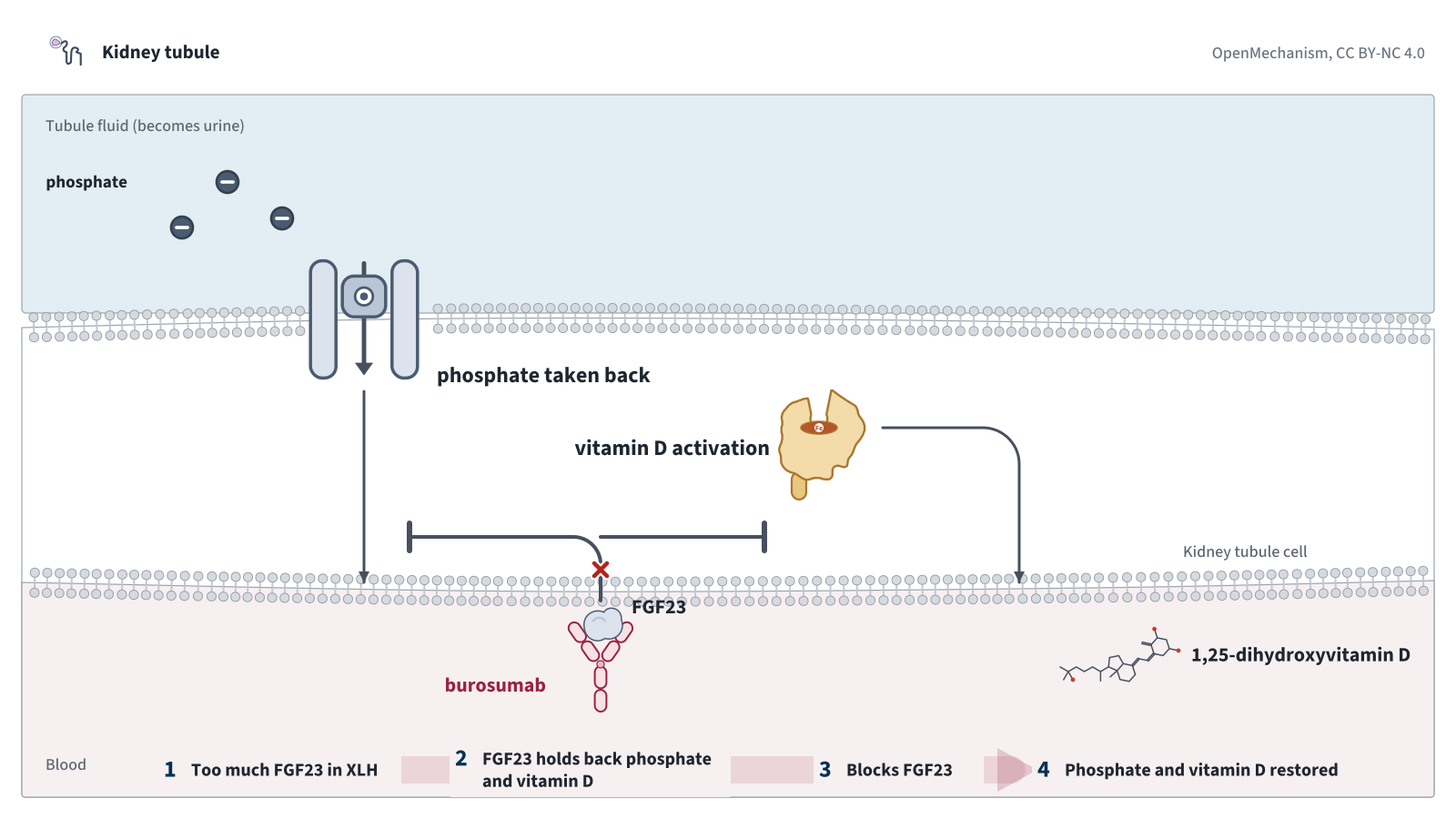
Key terms in this drawing
- FGF23
- Fibroblast growth factor 23. A growth factor that is high in X-linked hypophosphatemia and is thought to cause many of the disease's effects.
How it works
Too much FGF23 in XLH. X-linked hypophosphatemia (XLH) is caused by excess fibroblast growth factor 23 (FGF23).1
FGF23 holds back phosphate and vitamin D. FGF23 suppresses phosphate reabsorption in the kidney tubules and the kidney's production of 1,25-dihydroxyvitamin D.1
Blocks FGF23. Burosumab binds to and inhibits the biological activity of FGF23.1
Phosphate and vitamin D restored. Kidney phosphate reabsorption is restored and the serum concentration of 1,25-dihydroxyvitamin D rises.1
For teachers: download this drawing.
See also
Condition pages: X-linked hypophosphatemia.
Other antibody medicines: adalimumab, bevacizumab, bezlotoxumab, blinatumomab, denosumab, dupilumab, eculizumab, emicizumab and 14 more.
Body system: muscles, bones & joints.
Sources
- 1Crysvita (burosumab-twza) injection: FDA label12.1 Mechanism of Action
- 2ChEMBL CHEMBL3707326Target and action classification: Fibroblast growth factor 23 inhibitor
Also used for the drawing
The 1-alpha-hydroxylase outline is traced from the crystal structure below.
- 3Human CYP2R1, the vitamin D 25-hydroxylase, with vitamin D3PDB 3C6G; Strushkevich, N. et al. J.Mol.Biol. 2008; 380:95-106
Spotted a mistake? Report an error (hello@openmechanism.com). Since launch, every published error we fix is listed on the corrections page.
Notes and limits
- A schematic teaching drawing: not to scale, not exact structures, binding poses or a complete pathway, and not a guide to dosing, treatment or how a person will respond.
All recorded limits are on the evidence page, and notes that apply to every page are on How to read a page. Version 1.0.0, not yet medically reviewed.
Cite this page
Tran D. Burosumab [Internet]. OpenMechanism; 2026 [updated 2026 Oct 10; cited 2026 Oct 10]. Available from: https://openmechanism.com/medicines/burosumab