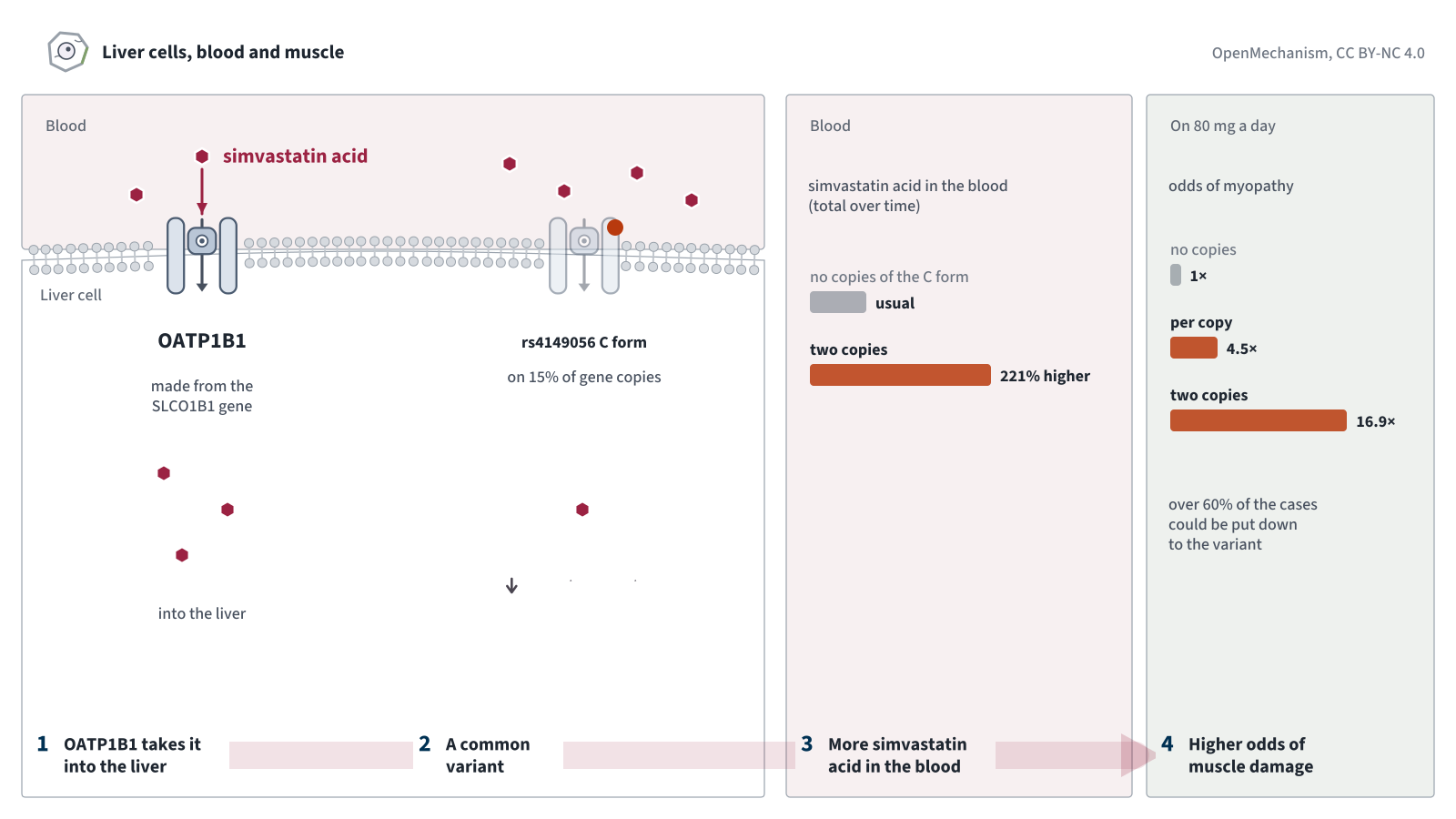
Simvastatin acid, the active form, is taken into liver cells by the transporter OATP1B1, made from the SLCO1B1 gene. In healthy volunteers who took one 40 mg dose, the total amount of simvastatin acid in the blood over time was 221% higher with two copies of a common variant than with none. Among people taking 80 mg a day in a large trial, the odds of muscle damage (myopathy) with two copies were about 17 times those with none.
OATP1B1 takes it into the liver. Simvastatin is a lactone that the body turns into simvastatin acid, the active form. Simvastatin acid is carried by the transporter , made from the SLCO1B1 gene, which has been shown to regulate the liver's uptake of statins.1,2,3
What the source says
“Simvastatin is a lactone that is readily hydrolyzed in vivo to the corresponding β-hydroxyacid.”
A common variant. A common variant of the gene, rs4149056, changes the transporter's building blocks. Its C form was carried on 15% of gene copies in the population studied. A study of the gene's c.521C form writes of “reduced uptake of simvastatin acid by OATP1B1 into the liver” in people who carry it.2,3,4
What the source says
“The noncoding rs4363657 SNP was in nearly complete linkage disequilibrium with the nonsynonymous rs4149056 SNP”
“In addition, reduced uptake of simvastatin acid by OATP1B1 into the liver in patients with the c.521C allele could reduce its cholesterol-lowering efficacy.”
More simvastatin acid in the blood. In 32 healthy volunteers who each took one 40 mg dose (4 of them with two copies), the total amount of simvastatin acid in the blood over time was 221% higher with two copies of the gene's c.521C form than with none, and 120% higher than with one; the variant was not linked to its , and no clear link was seen with the levels of simvastatin itself (the lactone).2,4
What the source says
“Four healthy volunteers with the homozygous SLCO1B1 c.521CC genotype, 12 with the heterozygous c.521TC genotype and 16 with the homozygous c.521TT genotype (controls) were recruited.”
“The AUC0-infinity of simvastatin acid was 120 and 221% higher in participants with the SLCO1B1 c.521CC genotype than in those with the c.521TC and c.521TT (reference) genotypes, respectively (P<0.001).”
Higher odds of muscle damage. In a genome-wide study of 85 people with definite or incipient and 90 without, all taking 80 mg of simvastatin a day in a trial of 12,000 people, the odds of myopathy were 4.5 times higher for each copy of the rs4149056 C form, and 16.9 times higher with two copies than with none (the 95% confidence interval runs from 4.7 to 61.1); more than 60% of the myopathy cases could be put down to the variant. The blood-level study's authors write that raised simvastatin acid levels with the c.521C form “may enhance the risk of systemic adverse effects during simvastatin treatment”.2,3,4
What the source says
“We carried out a genomewide association study using approximately 300,000 markers (and additional fine-mapping) in 85 subjects with definite or incipient myopathy and 90 controls, all of whom were taking 80 mg of simvastatin daily as part of a trial involving 12,000 participants.”
“The odds ratio for myopathy was 4.5 (95% confidence interval [CI], 2.6 to 7.7) per copy of the C allele, and 16.9 (95% CI, 4.7 to 61.1) in CC as compared with TT homozygotes.”
“Raised plasma concentrations of simvastatin acid in patients carrying the SLCO1B1 c.521C variant allele may enhance the risk of systemic adverse effects during simvastatin treatment.”
The study's numbers come from 80 mg a day; the Zocor label says its 80 mg strength is no longer marketed. The link with myopathy was also found in a second trial, of 40 mg a day in 20,000 people; the abstract gives no numbers for it.1,3
Claude Opus 5.5 (AI source check), 29 October 2026: 22 statements compared with their sources, 6 flagged for the reviewer. An automated check, not a medical review.
Key terms
Definitions reworded since this review: myopathy. Definitions are shared across pages, so a later rewording does not take the review line off (what a review covers).
Next review due
29 April 2028
Cite this page
Tran D. Simvastatin and the SLCO1B1 gene [Internet]. OpenMechanism; 2026 [updated 2026 Oct 29; cited 2026 Oct 29]. Available from: https://openmechanism.com/explained/simvastatin-and-slco1b1