Amiodarone
Amiodarone blocks potassium channels in heart muscle, which lengthens the action potential; it also blocks sodium and calcium channels and damps the sympathetic drive. Conduction slows through the sinus and nodes and every heart tissue takes longer to recover. Its effects on abnormal rhythms build up over days to weeks.
- Acts on
- Myocardial potassium, sodium and calcium channels; a noncompetitive antisympathetic action
- Where
- Heart muscle and the conduction system
- Medicine type
- Small molecule
- Used for
- Heart & circulation
- Drug class
- Antiarrhythmics (class I and III)
Also called Pacerone.
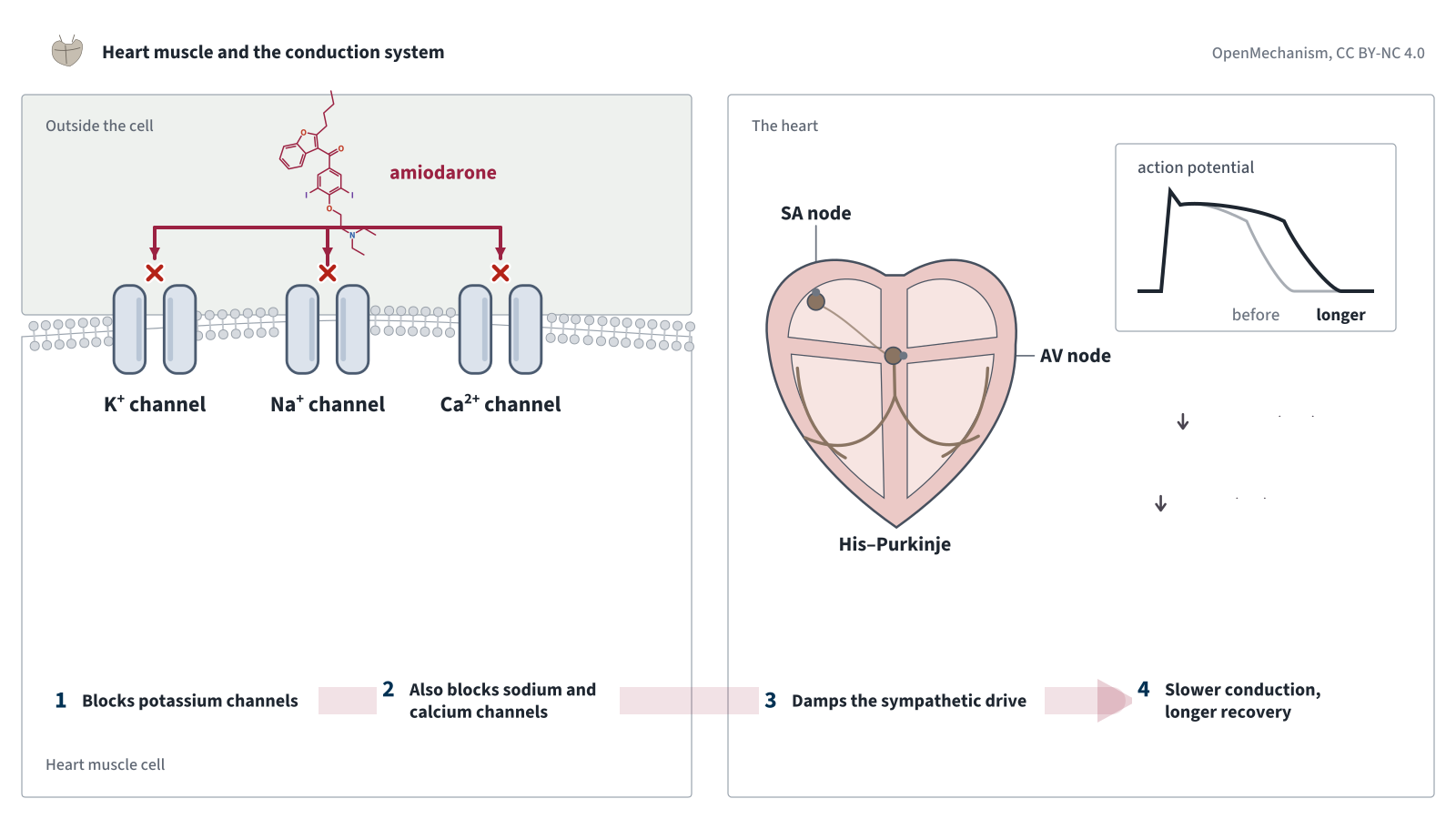
Key terms in this drawing
- AV node
- Atrioventricular node. The part of the heart's wiring that passes each beat's electrical impulse from the upper chambers (atria) to the lower chambers (ventricles).
- SA node
- Sinoatrial node. The place in the heart where each heartbeat's electrical impulse starts.
How it works
Blocks potassium channels. Amiodarone blocks myocardial potassium channels. One of its main effects, with prolonged use, is to lengthen the cardiac action potential, a class III effect.1
Also blocks sodium and calcium channels. Like class I drugs it blocks sodium channels at rapid pacing frequencies; it also blocks calcium channels, and its slowing effect in nodal tissue is similar to that of class IV drugs.1
Damps the sympathetic drive. Like class II drugs, it has a noncompetitive antisympathetic action.1
Slower conduction, longer recovery. Together these slow the sinus node and conduction through the AV node and prolong refractoriness; the action potential and refractory period are prolonged in all cardiac tissues. Effects on abnormal rhythms appear after 2 to 3 days and usually take 1 to 3 weeks.1
For teachers: download this drawing.
See also
Condition pages: ventricular arrhythmias.
Other antiarrhythmics (class I and III): flecainide, lidocaine and sotalol.
Explained: why amiodarone can upset the thyroid; amiodarone and warfarin; digoxin and P-glycoprotein blockers; and why some medicines lengthen the QT interval.
Body system: heart, vessels & cholesterol.
Sources
- 1Pacerone (amiodarone hydrochloride) tablets: FDA label12.1 Mechanism of Action; 12.2 Pharmacodynamics
- 2ChEMBL CHEMBL633Target and action classification: HERG blocker
Spotted a mistake? Report an error (hello@openmechanism.com). Since launch, every published error we fix is listed on the corrections page.
Notes and limits
- A schematic teaching drawing: not to scale, not exact structures, binding poses or a complete pathway, and not a guide to dosing, treatment or how a person will respond.
- Amiodarone is considered a class III antiarrhythmic but has properties of all four Vaughan Williams classes.
All recorded limits are on the evidence page, and notes that apply to every page are on How to read a page. Version 1.0.0, not yet medically reviewed.
Cite this page
Tran D. Amiodarone [Internet]. OpenMechanism; 2026 [updated 2026 Oct 10; cited 2026 Oct 10]. Available from: https://openmechanism.com/medicines/amiodarone