Why linezolid can cause lactic acidosis and nerve damage
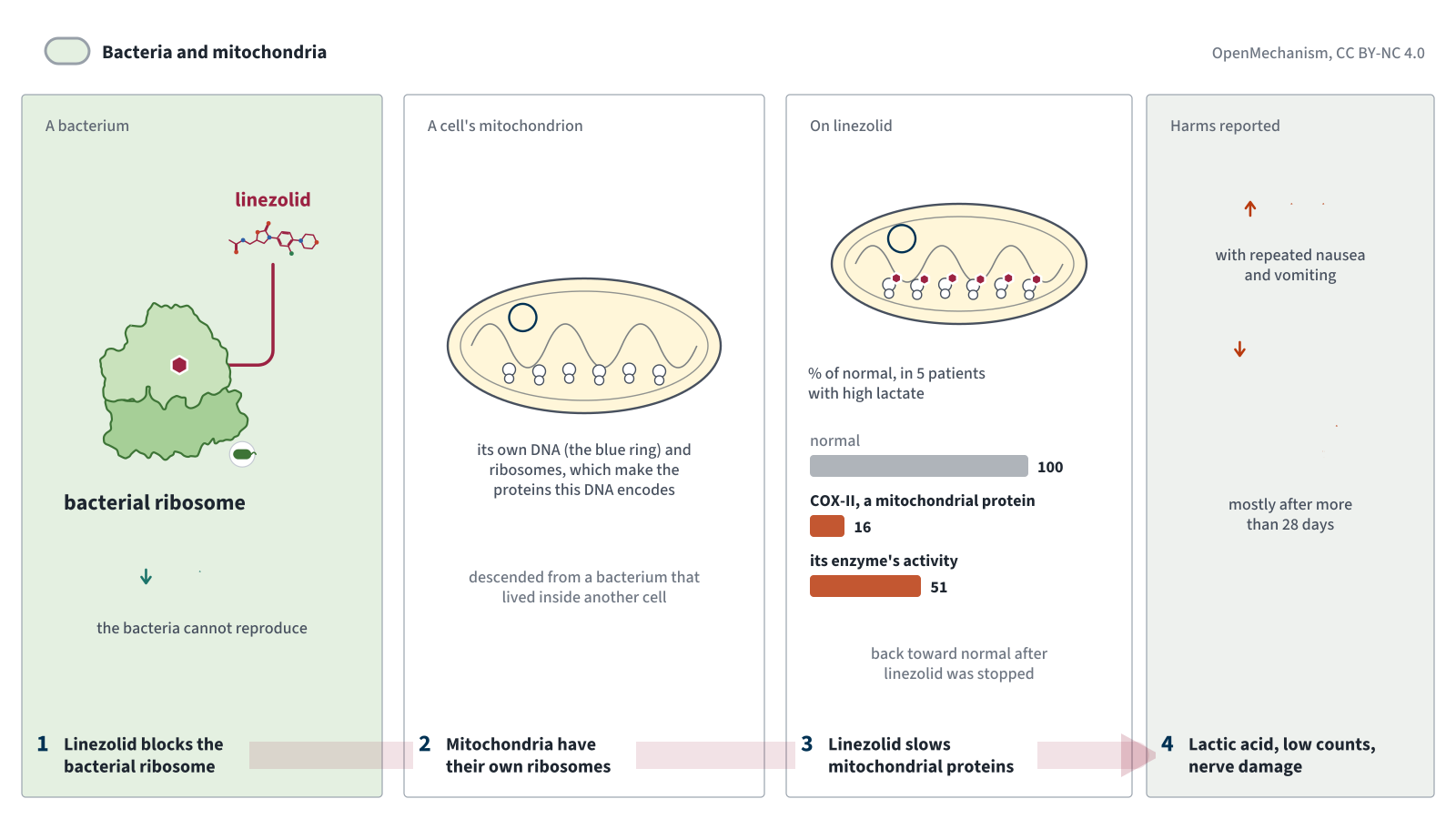
Linezolid blocks the bacterial ribosome. Mitochondria, which descend from a bacterium, have their own ribosomes, and linezolid slows their protein making, so the respiratory chain enzymes they build fall. Lactic acidosis has been reported, and one study's authors tie high lactate to that fall; low blood counts have been reported too, and nerve and optic nerve damage mostly after courses longer than 28 days.
- Kind
- Side effect
- Medicines
- Linezolid
- Sources
- 5
For teachers: download this drawing.
Step by step
Linezolid blocks the bacterial ribosome. Linezolid binds the bacterial ribosome's in its large () part and stops it starting to make proteins, which bacteria need to reproduce.1
What the source says
“Linezolid binds to a site on the bacterial 23S ribosomal RNA of the 50S subunit and prevents the formation of a functional 70S initiation complex, which is essential for bacterial reproduction.”
Source 1Mitochondria have their own ribosomes. Mitochondria descend from a bacterium that lived inside another cell, and they keep a remnant of its genome and the full machinery to read it: their own ribosomes make the proteins that genome encodes.2
What the source says
“As a descendant of a bacterial endosymbiont, mitochondria retain a vestige of their original genome (mtDNA), and its corresponding full gene expression machinery.”
Source 2“Proteins encoded in the mtDNA, all components of the multimeric OXPHOS enzymes, are synthesized in specialized mitochondrial ribosomes (mitoribosomes).”
Source 2Linezolid slows mitochondrial proteins. In a patient and in animals, linezolid slowed the mitochondria's own protein making, and the respiratory chain enzymes they build fell. In 5 patients with high lactate on long courses, one such protein was at 16% of normal and its enzyme's activity at 51%; most of these changes reversed after linezolid was stopped.3,4
What the source says
“These results provide direct evidence that linezolid inhibits mitochondrial protein synthesis with potentially severe clinical consequences.”
Source 3“In the experimental animals, linezolid induced a dose- and time-dependent decrease of the activity of respiratory chain complexes containing mtDNA-encoded subunits and a decreased amount of protein of these complexes, whereas the amount of mtDNA was normal.”
Source 3“Five patients on a long-term schedule of linezolid treatment were studied during the acute phase of hyperlactatemia and after clinical recovery and lactate normalization following linezolid withdrawal.”
Source 4“During linezolid-induced hyperlactatemia, we found extremely reduced protein expression (16% of the remaining content compared to control values [100%], P < 0.001) for the mitochondrially coded, transcribed, and translated COX-II subunit. Accordingly, COX activity was also found to be decreased (51% of the remaining activity, P < 0.05).”
Source 4“Most of the mitochondrial abnormalities returned to control ranges after linezolid withdrawal, lactate normalization, and clinical recovery.”
Source 4Lactic acid, low counts, nerve damage. Lactic acidosis has been reported with linezolid, with repeated nausea and vomiting; the study's authors tie the high lactate to the fall in mitochondrial enzymes. Low blood counts have been reported too, rising toward their earlier levels after stopping where the outcome is known, and nerve and optic nerve damage mainly after more than 28 days.1,4
What the source says
“Lactic acidosis has been reported with the use of ZYVOX.”
Source 1“In reported cases, patients experienced repeated episodes of nausea and vomiting.”
Source 1“Linezolid inhibits mitochondrial protein synthesis, leading to decreased mitochondrial enzymatic activity, which causes linezolid-related hyperlactatemia, which resolves upon discontinuation of linezolid treatment.”
Source 4“Myelosuppression (including anemia, leukopenia, pancytopenia, and thrombocytopenia) has been reported in patients receiving linezolid. In cases where the outcome is known, when linezolid was discontinued, the affected hematologic parameters have risen toward pretreatment levels.”
Source 1“Peripheral and optic neuropathies have been reported in patients treated with ZYVOX, primarily in those patients treated for longer than the maximum recommended duration of 28 days.”
Source 1
See also
Medicine pages: linezolid.
Other side effects (infections): why amphotericin B can harm the kidneys; why antibiotics can cause C. difficile diarrhea; why fast vancomycin infusions cause flushing; why fluoroquinolones such as ciprofloxacin can damage tendons; why gentamicin can damage hearing and balance; why isoniazid can damage nerves; why tetracyclines can stain developing teeth; why trimethoprim can raise potassium; why vancomycin can harm the kidneys; and all 65 side effects.
Conditions: antibiotic-resistant infections and tuberculosis.
Interactions: linezolid and serotonergic medicines.
Sources
- 1Zyvox (linezolid): FDA label5.1 Myelosuppression; 5.2 Peripheral and Optic Neuropathy; 5.7 Lactic Acidosis; 12.4 Microbiology. Saved copy
- 2Mitochondrial ribosomes in cancerKim HJ, Maiti P, Barrientos A. Semin Cancer Biol 2017 (abstract). Saved copy
- 3Linezolid-induced inhibition of mitochondrial protein synthesisDe Vriese AS et al. Clin Infect Dis 2006 (abstract). Saved copy
- 4Reversible inhibition of mitochondrial protein synthesis during linezolid-related hyperlactatemiaGarrabou G et al. Antimicrob Agents Chemother 2007 (abstract). Saved copy
- 5Escherichia coli stalled ribosome with linezolidPDB 7S1G; Tsai, K. et al. Nat.Struct.Mol.Biol. 2022;29:162-171. The ribosome outline in the drawing is traced from this structure. Saved copy
Notes and limits
Notes that apply to every page are on How to read a page.
Spotted a mistake? Report an error (hello@openmechanism.com). Since launch, every published error we fix is listed on the corrections page.
Cite this page
Tran D. Why linezolid can cause lactic acidosis and nerve damage [Internet]. OpenMechanism; 2026 [updated 2026 Nov 13; cited 2026 Nov 13]. Available from: https://openmechanism.com/explained/linezolid-and-mitochondria