Why isoniazid can damage nerves
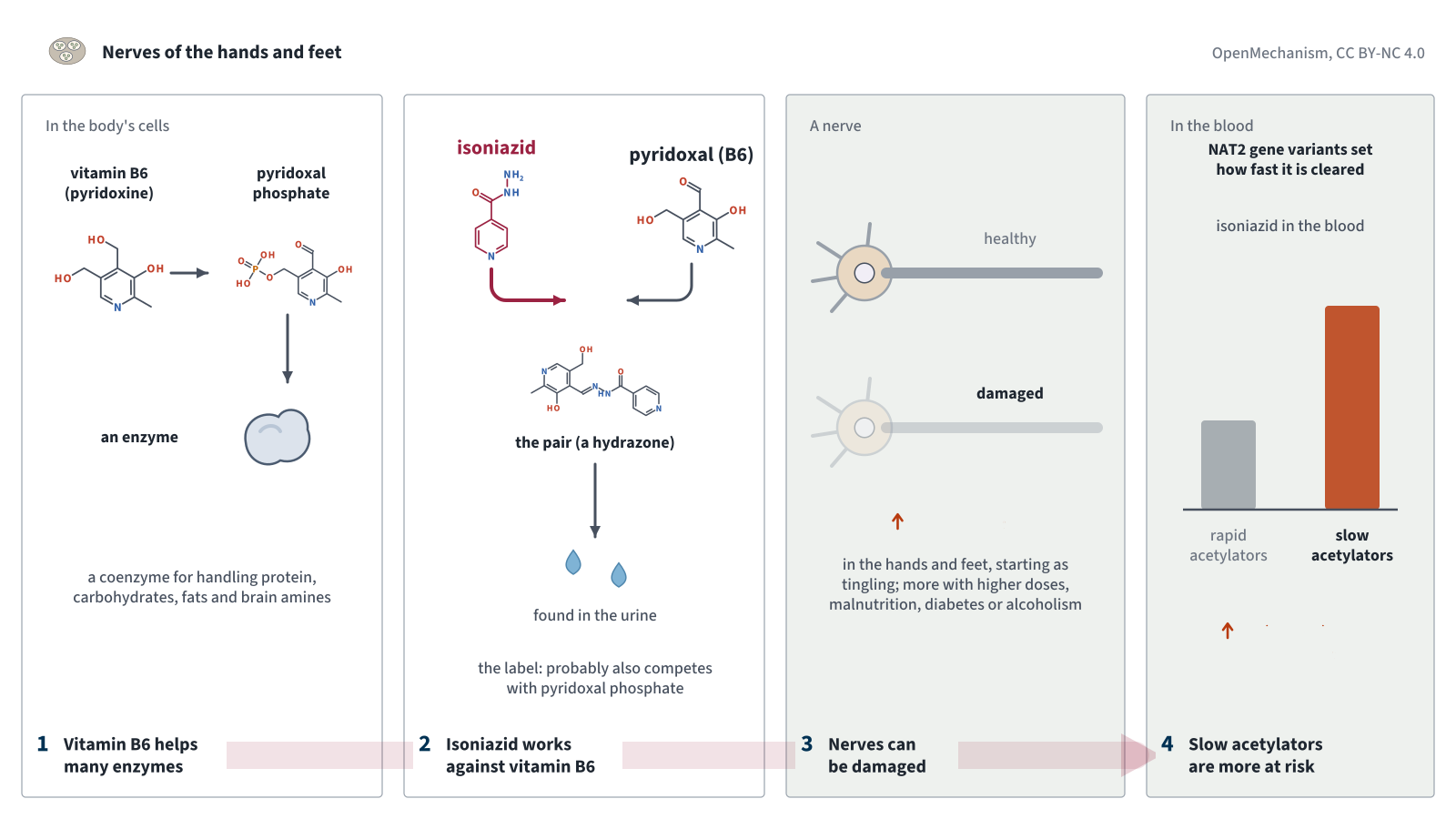
The body turns vitamin B6 into coenzymes, such as pyridoxal phosphate, that many enzymes need. Isoniazid works against them: the label puts it probably down to isoniazid competing with pyridoxal phosphate at an enzyme, and isoniazid also joins with vitamin B6 into a pair passed in the urine. Damage to the nerves of the hands and feet (peripheral neuropathy) is isoniazid's most common toxic effect, and it is more common in slow acetylators, whose genes make them clear isoniazid slowly.
- Kind
- Side effect
- Medicines
- Isoniazid
- Sources
- 6
For teachers: download this drawing.
Step by step
Vitamin B6 helps many enzymes. The body turns vitamin B6 (pyridoxine) into coenzymes, such as pyridoxal phosphate, which play an essential part in handling protein, carbohydrates, fats and other substances, brain amines among them.1,2
What the source says
“In vivo pyridoxine is converted into coenzymes which play an essential role in the metabolism of protein, carbohydrates, fatty acids, and several other substances, including brain amines”
Source 1“Pyridoxine (vitamin B6) deficiency is sometimes observed in adults with high doses of isoniazid and is considered probably due to its competition with pyridoxal phosphate for the enzyme apotryptophanase.”
Source 2Isoniazid works against vitamin B6. Isoniazid appears to block vitamin B6's work. A B6 shortage is sometimes seen in adults on high doses, which the label puts probably down to isoniazid competing with pyridoxal phosphate for an enzyme. Isoniazid also joins with vitamin B6: the pair, pyridoxal isonicotinoyl hydrazone, has been found in the urine of people taking it, and in lab tests isoniazid blocked pyridoxal kinase, an enzyme of vitamin B6 metabolism, apparently through such pairs.1,2,3,4
What the source says
“INH apparently competitively inhibits the action of pyridoxine in these metabolic functions.”
Source 1“Pyridoxine (vitamin B6) deficiency is sometimes observed in adults with high doses of isoniazid and is considered probably due to its competition with pyridoxal phosphate for the enzyme apotryptophanase.”
Source 2“Two metabolites of isoniazid, pyridoxal isonicotinoyl hydrazone (PIH, the isoniazid-vitamin B6 conjugate) and hydrazine, have been detected in the urine of humans treated with isoniazid.”
Source 3“The aim of this study was to investigate the interaction between drugs chosen for their clinical neurotoxicity or chemical structure and vitamin B6 metabolism.”
Source 4“The second group, which included cycloserine, dopamine, isoniazid, and thiamphenicol glycinate, inhibited PLK using PL, but not PM, as substrate.”
Source 4“They were able to react with PL or PLP to form covalent complexes, and kinetic studies suggested that the observed PLK inhibition was due to these formed complexes.”
Source 4Nerves can be damaged. Damage to the nerves of the hands and feet (peripheral neuropathy) is isoniazid's most common toxic effect: it depends on the dose, comes most often in people who are malnourished or prone to nerve damage, such as people with diabetes or alcoholism, and usually starts as tingling in the feet and hands. A 1980 review says extra vitamin B6 is needed in some people to keep it from developing.1,2
What the source says
“Peripheral neuropathy is the most common toxic effect.”
Source 2“It is dose-related, occurs most often in the malnourished and in those predisposed to neuritis (e.g., alcoholics and diabetics) and is usually preceded by paresthesias of the feet and hands.”
Source 2“Vitamin B6 (pyridoxine) supplementation during isoniazid (INH) therapy is necessary in some patients to prevent the development of peripheral neuropathy.”
Source 1Slow acetylators are more at risk. The body breaks isoniazid down mainly by acetylation and dehydrazination. The speed of acetylation is set by genes, and variants of the gene change it. In slow acetylators, isoniazid may reach higher levels in the blood and cause more toxic reactions, and nerve damage is more common.2,5,6
What the source says
“Isoniazid is metabolized primarily by acetylation and dehydrazination.”
Source 2“The rate of acetylation is genetically determined.”
Source 2“N-acetyltransferase 2 (NAT2) polymorphisms influence drug acetylation and possibly the risk for INH-associated DSP.”
Source 5“However, slow acetylation may lead to higher blood levels of the drug and, thus, to an increase in toxic reactions.”
Source 2“The incidence is higher in "slow inactivators".”
Source 2“This result confirmed that patients with the slow acetylator genotype tend to develop neuropathy after administration of isoniazid.”
Source 6
See also
Medicine pages: isoniazid.
Other side effects (infections): why amphotericin B can harm the kidneys; why antibiotics can cause C. difficile diarrhea; why fast vancomycin infusions cause flushing; why fluoroquinolones such as ciprofloxacin can damage tendons; why gentamicin can damage hearing and balance; why linezolid can cause lactic acidosis and nerve damage; why tetracyclines can stain developing teeth; why trimethoprim can raise potassium; why vancomycin can harm the kidneys; and all 65 side effects.
Conditions: tuberculosis.
Interactions: rifampin and other medicines; and isoniazid and phenytoin.
The medicine in the body: codeine, tramadol and the CYP2D6 gene.
Sources
- 1Pyridoxine supplementation during isoniazid therapySnider DE. Tubercle 1980 (abstract). Saved copy
- 2Isoniazid tablets: FDA labelClinical Pharmacology; Adverse Reactions. Saved copy
- 3The isoniazid metabolites hydrazine and pyridoxal isonicotinoyl hydrazone modulate heme biosynthesisBrewer CT et al. Toxicol Sci 2019 (abstract). Saved copy
- 4Mechanisms of the inhibition of human erythrocyte pyridoxal kinase by drugsLainé-Cessac P et al. Biochem Pharmacol 1997 (abstract). Saved copy
- 5Isoniazid exposure and pyridoxine levels in human immunodeficiency virus associated distal sensory neuropathyvan der Watt JJ et al. Int J Tuberc Lung Dis 2015 (abstract). Saved copy
- 6Demonstration of slow acetylator genotype of N-acetyltransferase in isoniazid neuropathyYamamoto M et al. J Neurol Sci 1996 (abstract). Saved copy
Notes and limits
- The label's advice on preventing and checking for nerve damage is left out: this page explains the mechanism, not what to do.
- The label calls its explanation of the B6 shortage probable, and these sources do not spell out how the shortage harms nerves.
- How common slow acetylators are differs between populations.2
- Isoniazid's other effects on the nerves, such as convulsions and inflammation of the optic nerve, are uncommon at usual doses.2
Notes that apply to every page are on How to read a page.
Spotted a mistake? Report an error (hello@openmechanism.com). Since launch, every published error we fix is listed on the corrections page.
Cite this page
Tran D. Why isoniazid can damage nerves [Internet]. OpenMechanism; 2026 [updated 2026 Nov 18; cited 2026 Nov 18]. Available from: https://openmechanism.com/explained/isoniazid-and-vitamin-b6