We’re looking for volunteer reviewers in pharmacy, medicine and pharmacology. How to volunteerWe’re looking for volunteer reviewers.

Urate crystals in a joint

From the foot down to one enzyme: a calm joint, a gout flare, and with allopurinol.

Zoom
Compare

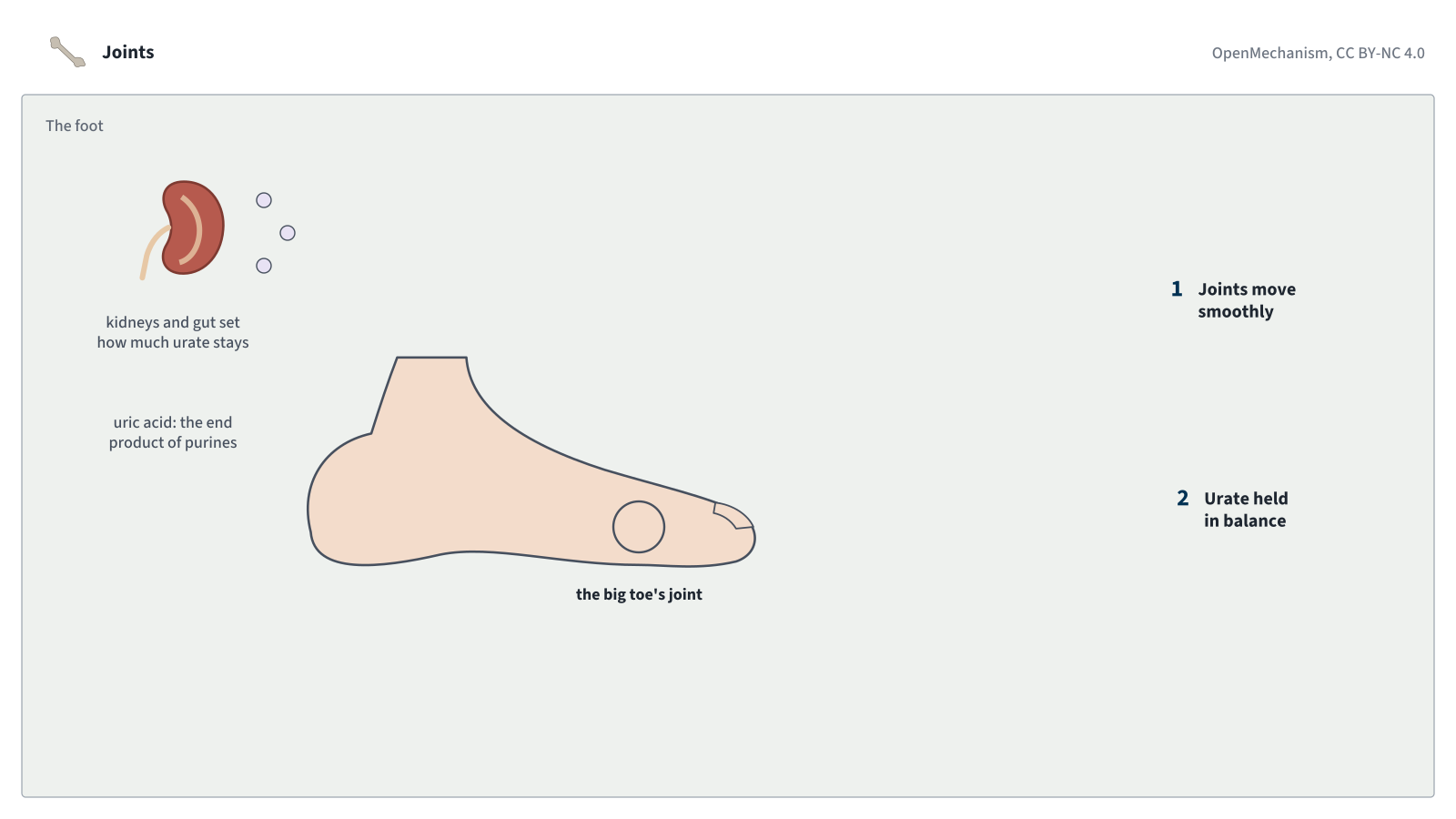
The foot, a calm joint

Drawing: The foot, a calm joint. 1: Joints move smoothly. 2: Urate held in balance.
Schematic, not to scale. License CC BY-NC 4.0.

For teachers: download this drawing.

  1. Joints move smoothly. At a synovial joint, smooth cartilage covers the bone ends and fluid from the joint's lining lubricates them.1

    What the source says

    “Friction between the bones at a synovial joint is prevented by the presence of the articular cartilage, a thin layer of hyaline cartilage that covers the entire articulating surface of each bone.”

    Source 1

    “The cells of this membrane secrete synovial fluid (synovia = “a thick fluid”), a thick, slimy fluid that provides lubrication to further reduce friction between the bones of the joint.”

    Source 1
  2. Urate held in balance. Uric acid is the end product of breaking down purines; transporters in the kidney and gut set how much urate stays in the blood.2,3

    What the source says

    “the end product of purine metabolism in humans”

    Source 2

    “Serum urate is regulated by urate transporters in the kidney and gut, particularly GLUT9 (SLC2A9), URAT1 (SLC22A12), and ABCG2.”

    Source 3

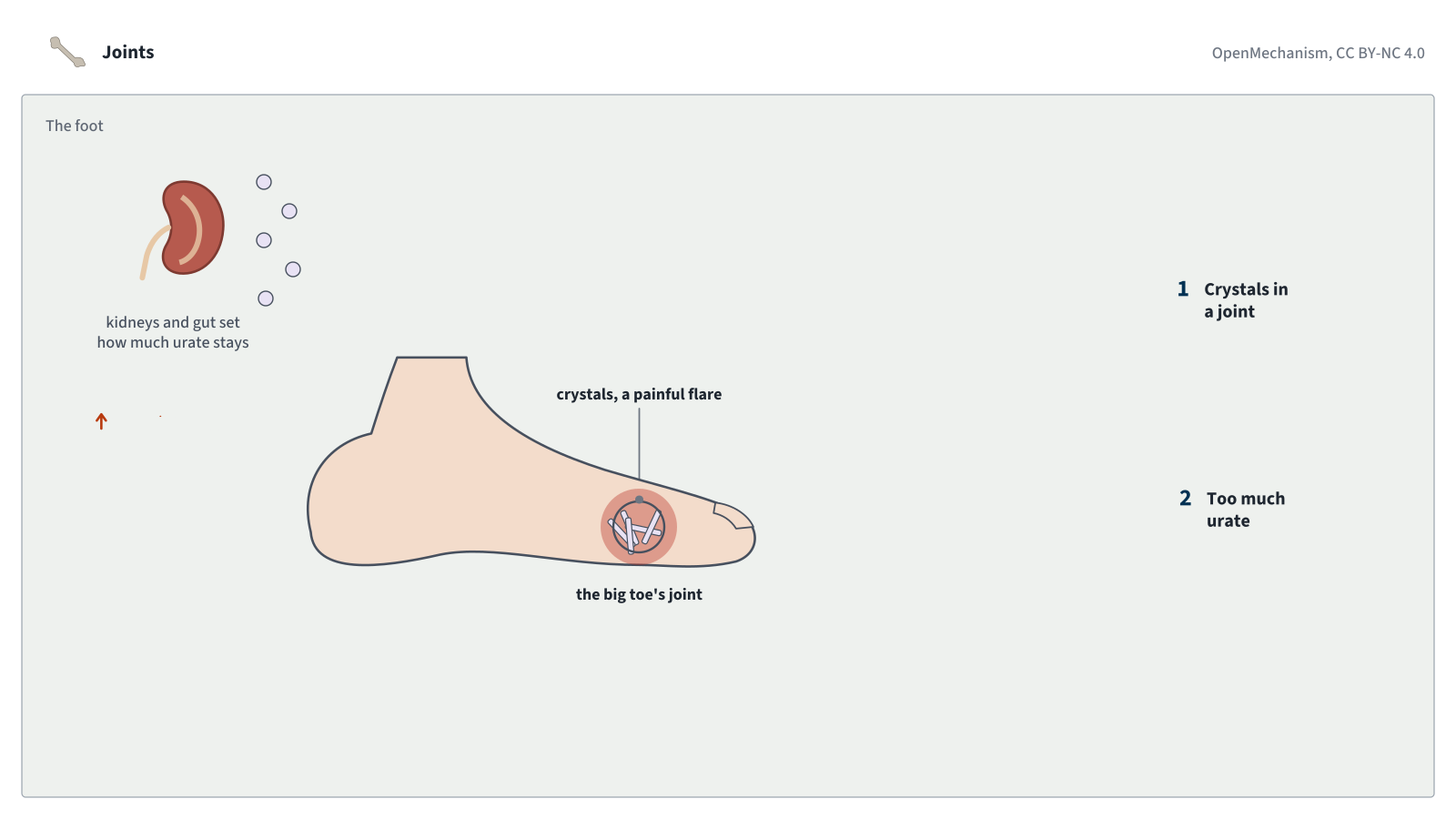
The foot, a gout flare

Drawing: The foot, a gout flare. 1: Crystals in a joint. 2: Too much urate.
Schematic, not to scale. License CC BY-NC 4.0.

For teachers: download this drawing.

  1. Crystals in a joint. Gout is arthritis from crystals of uric acid (monosodium urate) deposited in a joint, most often the big toe's (the first metatarsophalangeal joint).1,4

    What the source says

    “Gout is a form of arthritis that results from the deposition of uric acid crystals within a body joint.”

    Source 1

    “Gout is characterized by painful joint inflammation, most commonly in the first metatarsophalangeal joint, resulting from precipitation of monosodium urate crystals in a joint space.”

    Source 4
  2. Too much urate. It happens when the body makes too much uric acid or the kidneys do not remove enough; high urate in the blood is the most important risk.1,3

    What the source says

    “Gout occurs when the body makes too much uric acid or the kidneys do not properly excrete it.”

    Source 1

    “Increased concentration of serum urate (hyperuricaemia) is the most important risk factor for the development of gout.”

    Source 3

More on the condition: gout.

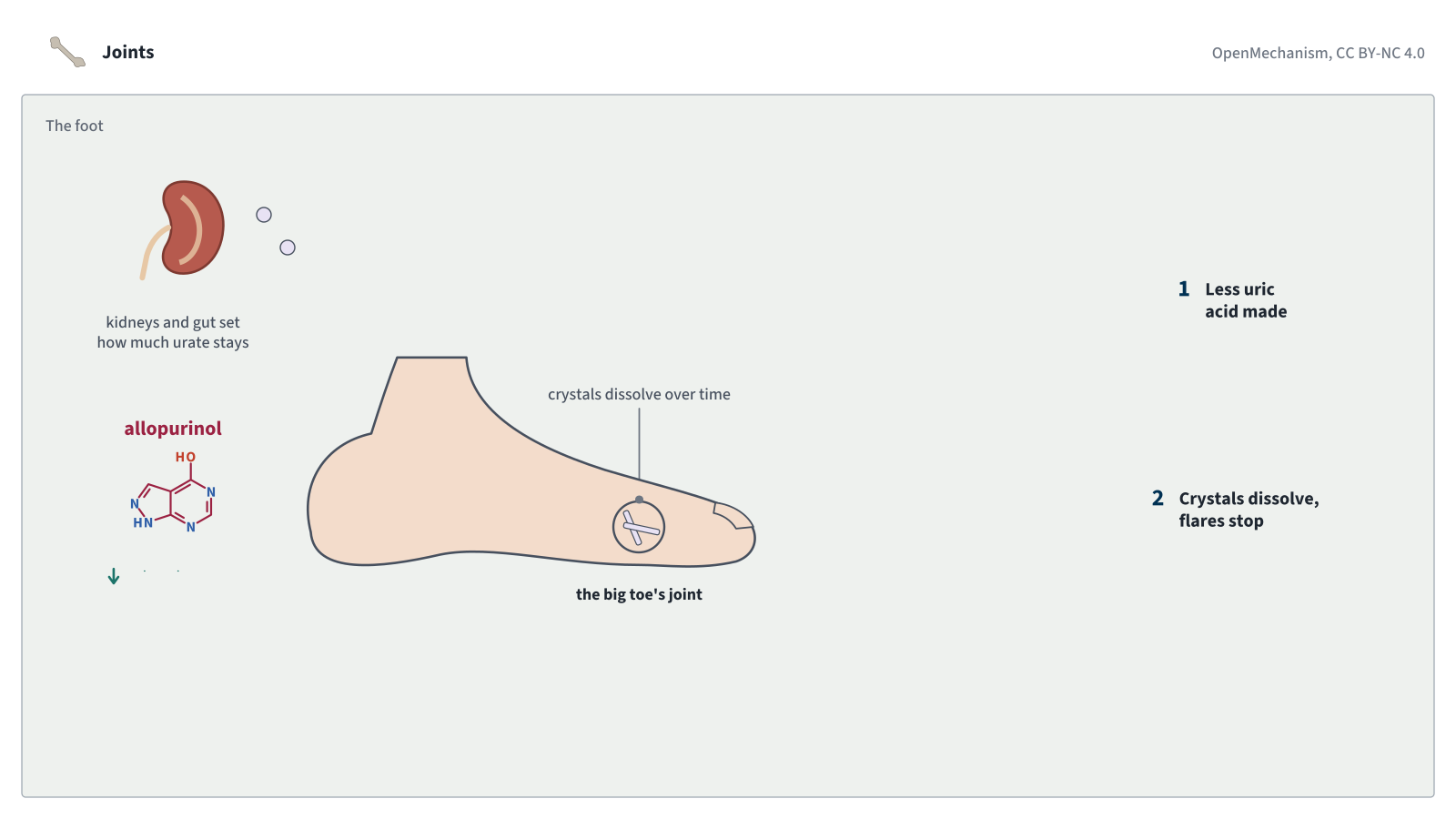
The foot, with allopurinol

Drawing: The foot, with allopurinol. 1: Less uric acid made. 2: Crystals dissolve, flares stop.
Schematic, not to scale. License CC BY-NC 4.0.

For teachers: download this drawing.

  1. Less uric acid made. Allopurinol lowers how much uric acid the body makes.2

    What the source says

    “It reduces the production of uric acid by inhibiting the biochemical reactions immediately preceding its formation.”

    Source 2
  2. Crystals dissolve, flares stop. Taken long term, urate-lowering treatment such as allopurinol dissolves the crystals and prevents flares and tophi (lumps of crystals).3

    What the source says

    “Long-term urate lowering therapy (eg, allopurinol) leads to the dissolution of monosodium urate crystals, ultimately resulting in the prevention of gout flares and tophi and in improved quality of life.”

    Source 3

More on the medicine: allopurinol.

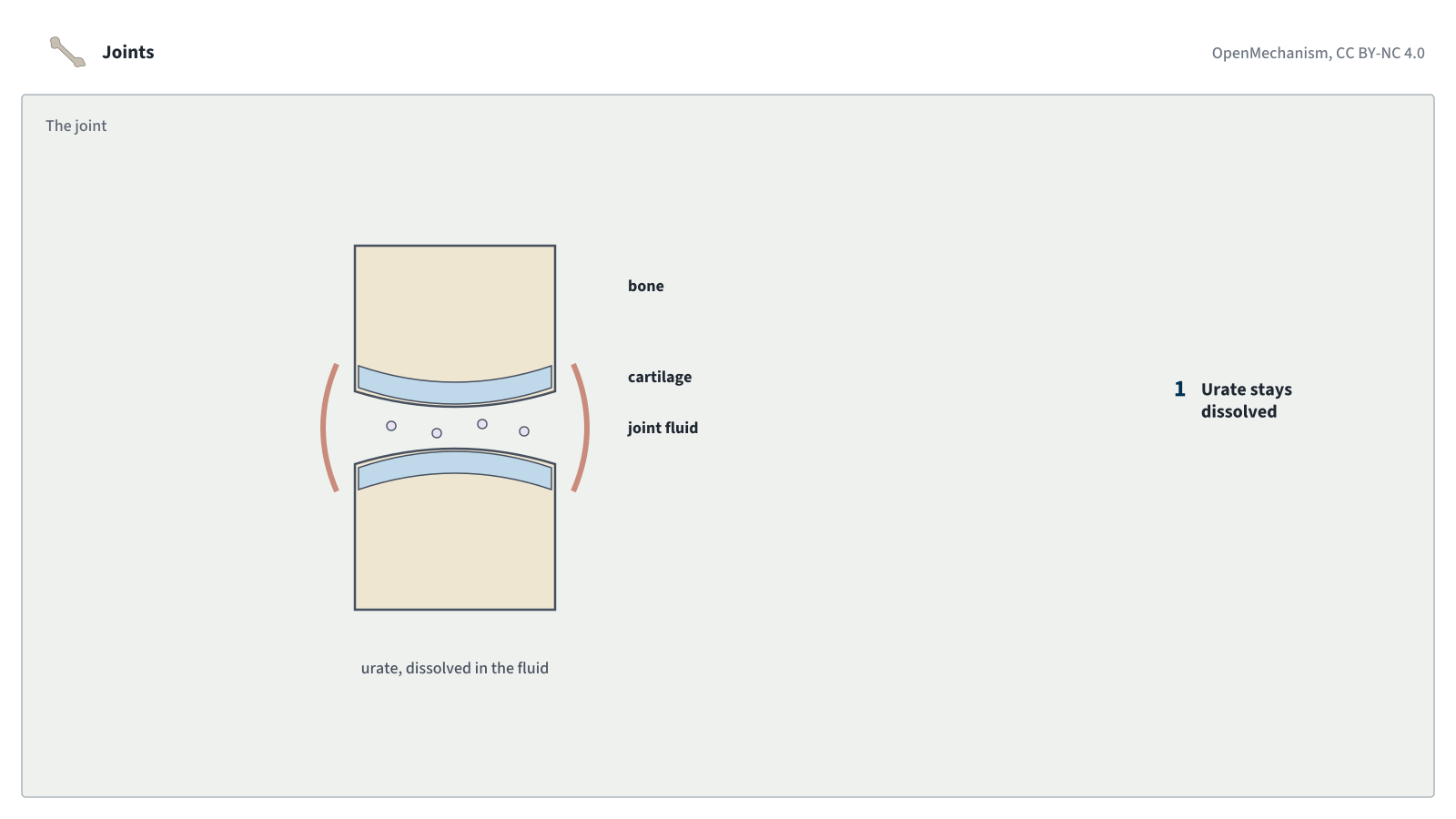
The joint, a calm joint

Drawing: The joint, a calm joint. 1: Urate stays dissolved.
Schematic, not to scale. License CC BY-NC 4.0.

For teachers: download this drawing.

  1. Urate stays dissolved. Urate is dissolved in the blood and joint fluid; crystals may form when its level rises above its limit of solubility, about 6.8 mg/dL.3,5

    What the source says

    “Serum urate is regulated by urate transporters in the kidney and gut”

    Source 3

    “When urate levels exceed the limit of solubility (6.8 mg/dL [400 μmol/L]), MSU crystals may form or grow.”

    Source 5

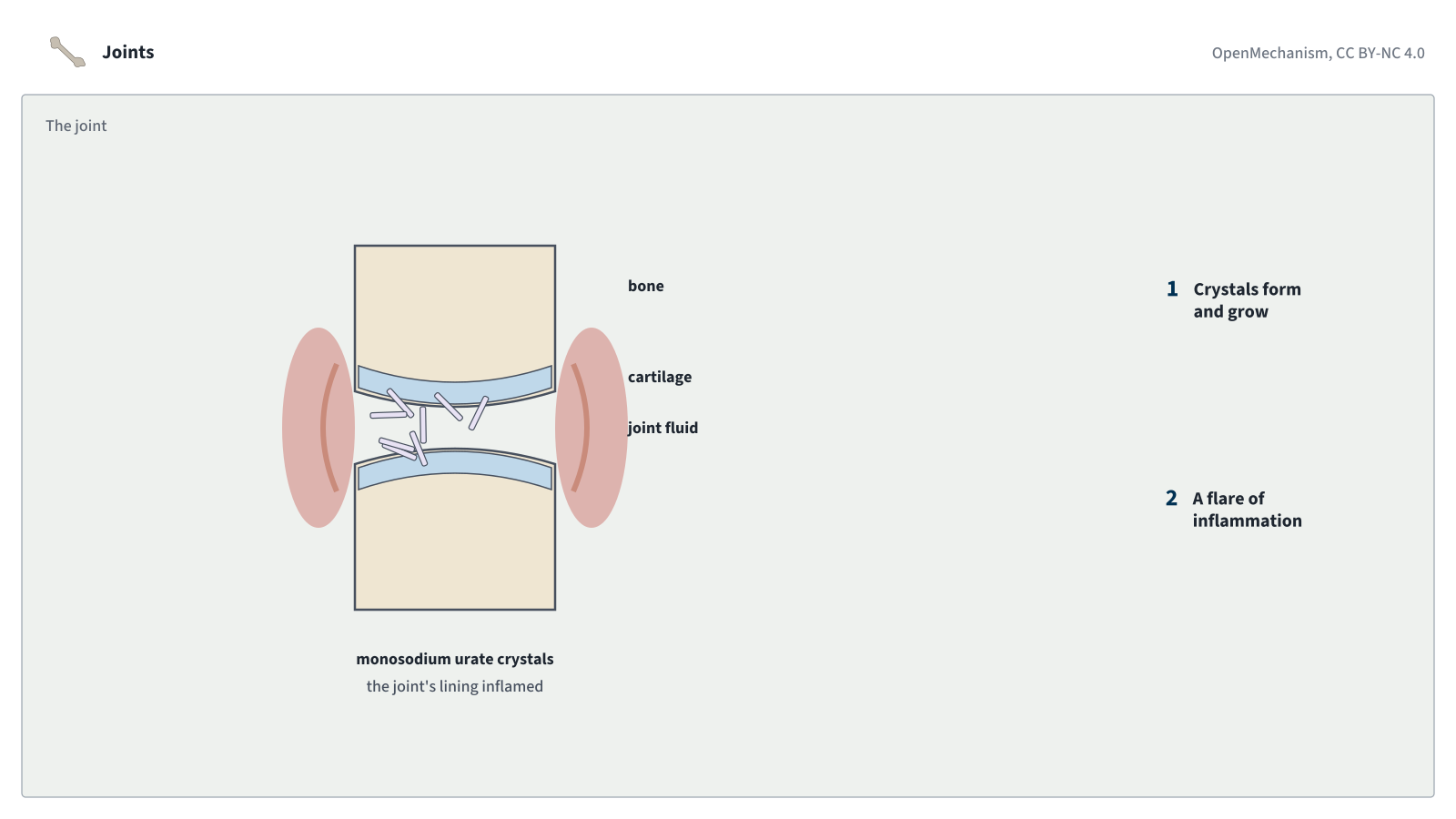
The joint, a gout flare

Drawing: The joint, a gout flare. 1: Crystals form and grow. 2: A flare of inflammation.
Schematic, not to scale. License CC BY-NC 4.0.

For teachers: download this drawing.

  1. Crystals form and grow. Above that limit, monosodium urate crystals may form and grow in the joint; they build up before the first flare and keep spreading while urate stays high.5,6

    What the source says

    “When urate levels exceed the limit of solubility (6.8 mg/dL [400 μmol/L]), MSU crystals may form or grow.”

    Source 5

    “Monosodium urate crystal deposition in gout precedes the first attack and, while hyperuricaemia persists, it grows and expands to other sites.”

    Source 6
  2. A flare of inflammation. A gout flare is the body's inflammatory response to the crystals.5

    What the source says

    “Gout flares are the result of inflammatory responses to MSU crystals.”

    Source 5

More on the condition: gout.

The joint, with allopurinol

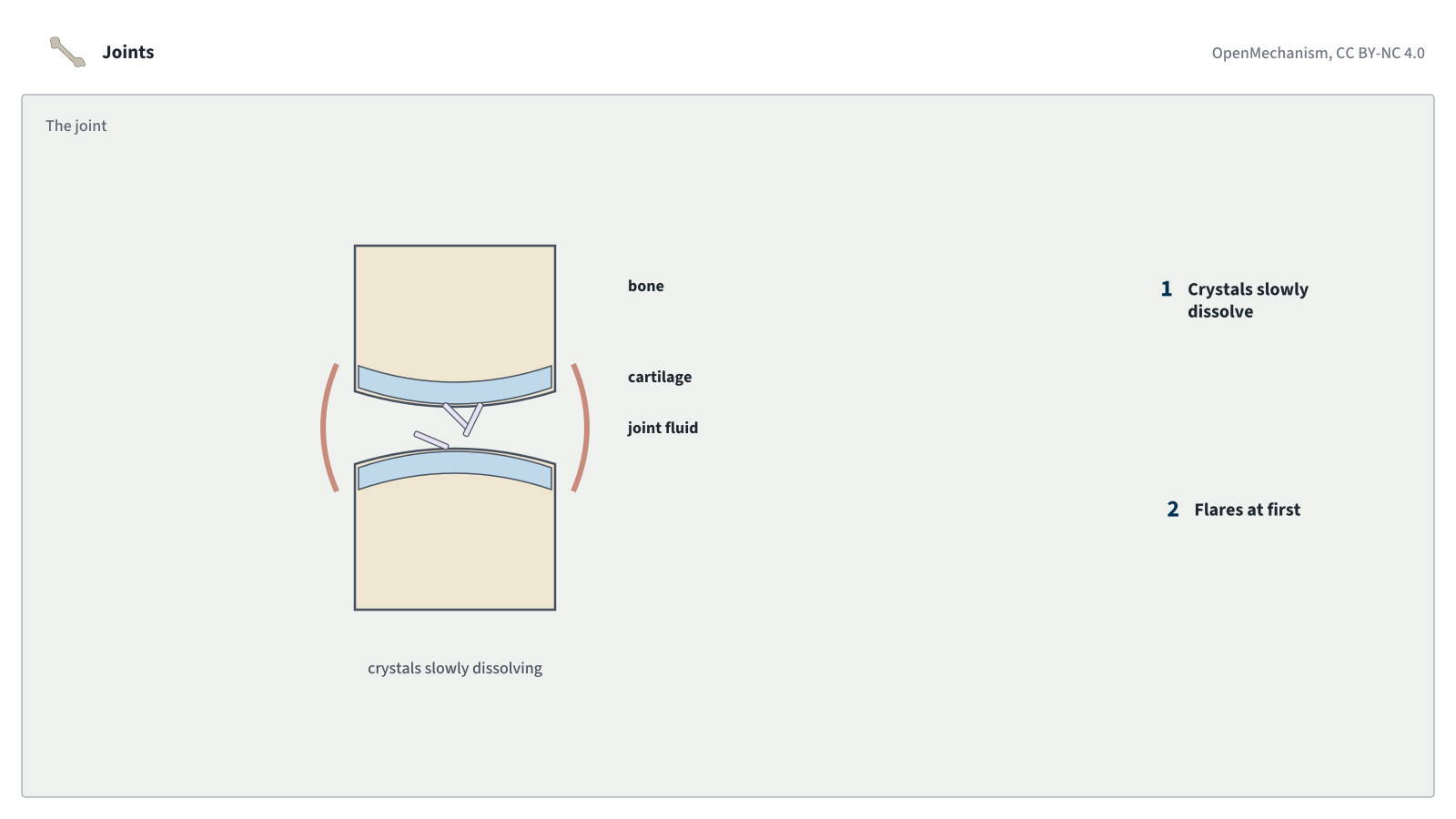
Drawing: The joint, with allopurinol. 1: Crystals slowly dissolve. 2: Flares at first.
Schematic, not to scale. License CC BY-NC 4.0.

For teachers: download this drawing.

  1. Crystals slowly dissolve. Once urate is below its saturation point, about 6.8 mg/dL, the crystals slowly dissolve and finally disappear from the joints, more slowly the longer the gout has lasted.6

    What the source says

    “Fortunately, it is reversible and slowly dissolves when serum uric acid (SUA) is lowered below its saturation point of about 6.8 mg/dl and with certainty below 6 mg/dl.”

    Source 6

    “Crystals finally disappear from joints, taking longer in those patients with longer disease duration, probably because of a larger accumulated load of crystals.”

    Source 6
  2. Flares at first. Flares can come when allopurinol is started, as urate moves out of the deposits, and become shorter and milder after several months.7

    What the source says

    “Gout flares have been reported during initiation of treatment with Allopurinol Tablets, even when normal or subnormal serum uric acid levels have been attained due to the mobilization of urates from tissue deposits.”

    Source 7

    “The flares typically become shorter and less severe after several months of therapy.”

    Source 7

More on the medicine: allopurinol.

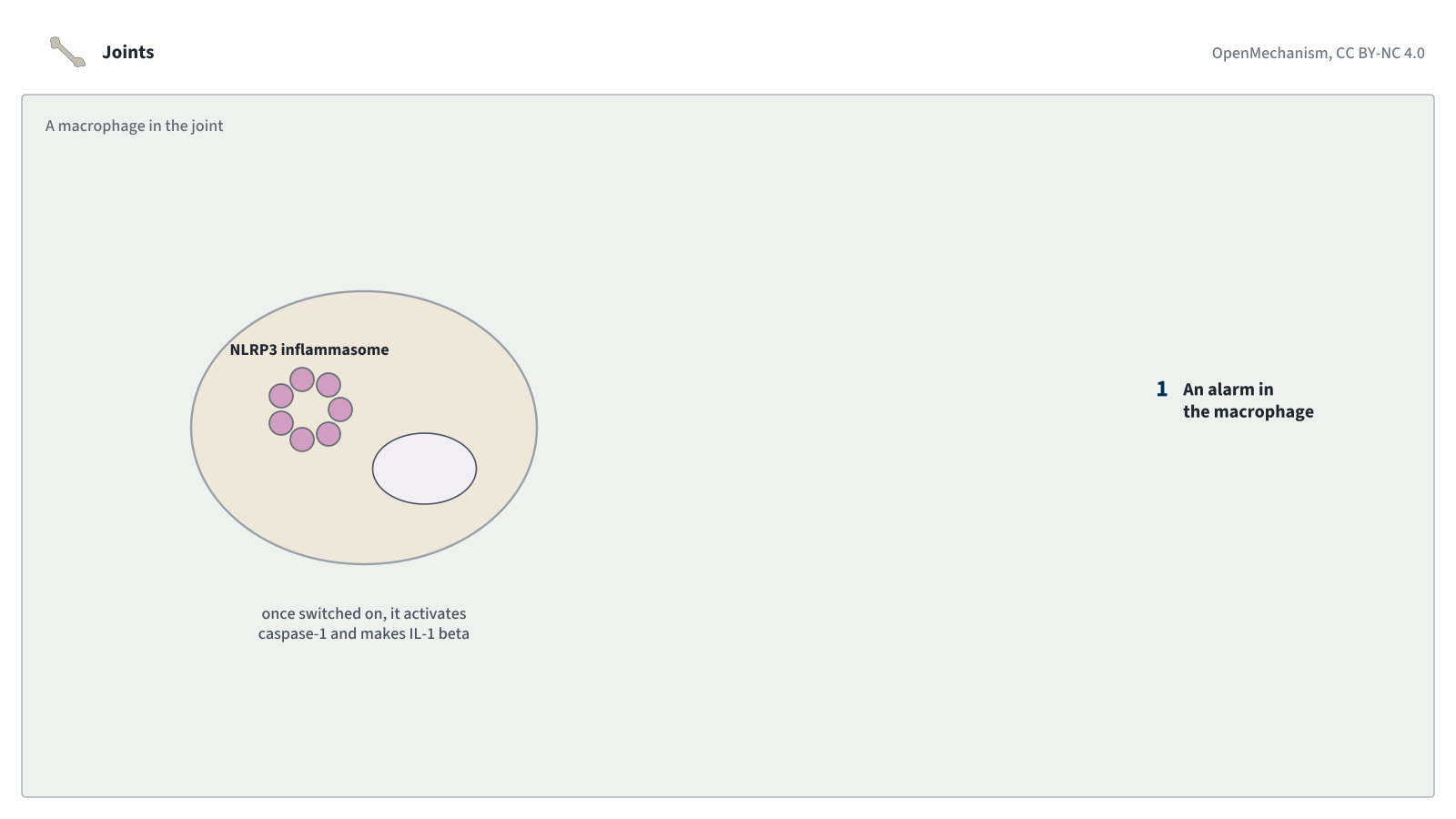
A macrophage in the joint, a calm joint

Drawing: A macrophage in the joint, a calm joint. 1: An alarm in the macrophage.
Schematic, not to scale. License CC BY-NC 4.0.

For teachers: download this drawing.

  1. An alarm in the macrophage. Macrophages carry the inflammasome, an alarm that, once switched on, activates caspase-1 and makes active beta.8

    What the source says

    “Here we show that MSU and CPPD engage the caspase-1-activating NALP3 (also called cryopyrin) inflammasome, resulting in the production of active interleukin (IL)-1beta and IL-18.”

    Source 8

    “Macrophages from mice deficient in various components of the inflammasome such as caspase-1, ASC and NALP3 are defective in crystal-induced IL-1beta activation.”

    Source 8

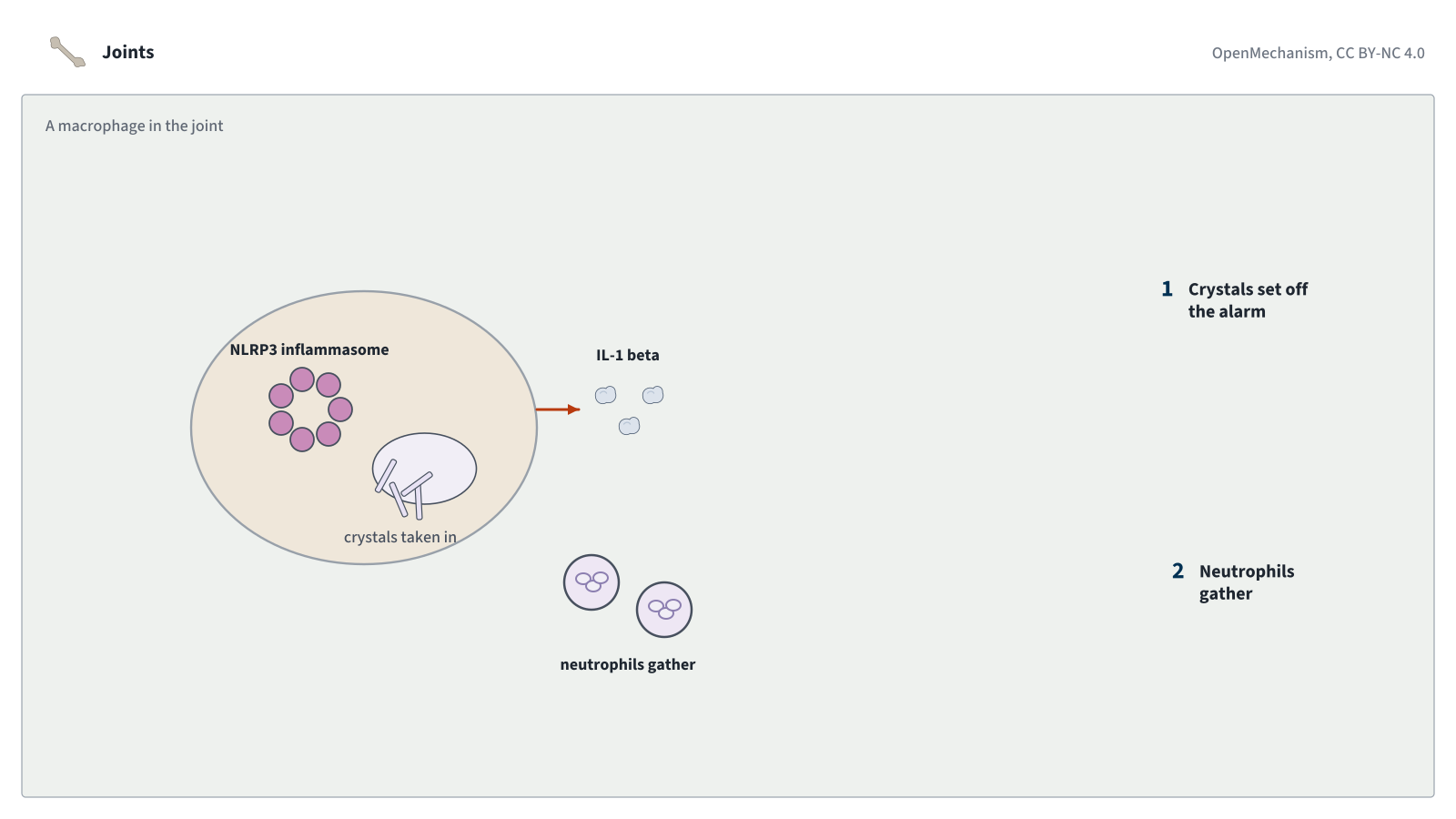
A macrophage in the joint, a gout flare

Drawing: A macrophage in the joint, a gout flare. 1: Crystals set off the alarm. 2: Neutrophils gather.
Schematic, not to scale. License CC BY-NC 4.0.

For teachers: download this drawing.

  1. Crystals set off the alarm. Urate crystals switch on the NLRP3 inflammasome, and the IL-1 beta it releases plays a major part in starting the flare.3,8

    What the source says

    “Here we show that MSU and CPPD engage the caspase-1-activating NALP3 (also called cryopyrin) inflammasome, resulting in the production of active interleukin (IL)-1beta and IL-18.”

    Source 8

    “Activation of the NLRP3 inflammasome by monosodium urate crystals with release of IL-1β plays a major role in the initiation of the gout flare”

    Source 3
  2. Neutrophils gather. Neutrophils gather; clumps of the traps they cast out () later help the flare settle.3,8

    What the source says

    “aggregated neutrophil extracellular traps are important in the resolution phase”

    Source 3

    “Moreover, an impaired neutrophil influx is found in an in vivo model of crystal-induced peritonitis in inflammasome-deficient mice or mice deficient in the IL-1beta receptor (IL-1R).”

    Source 8

More on the condition: gout.

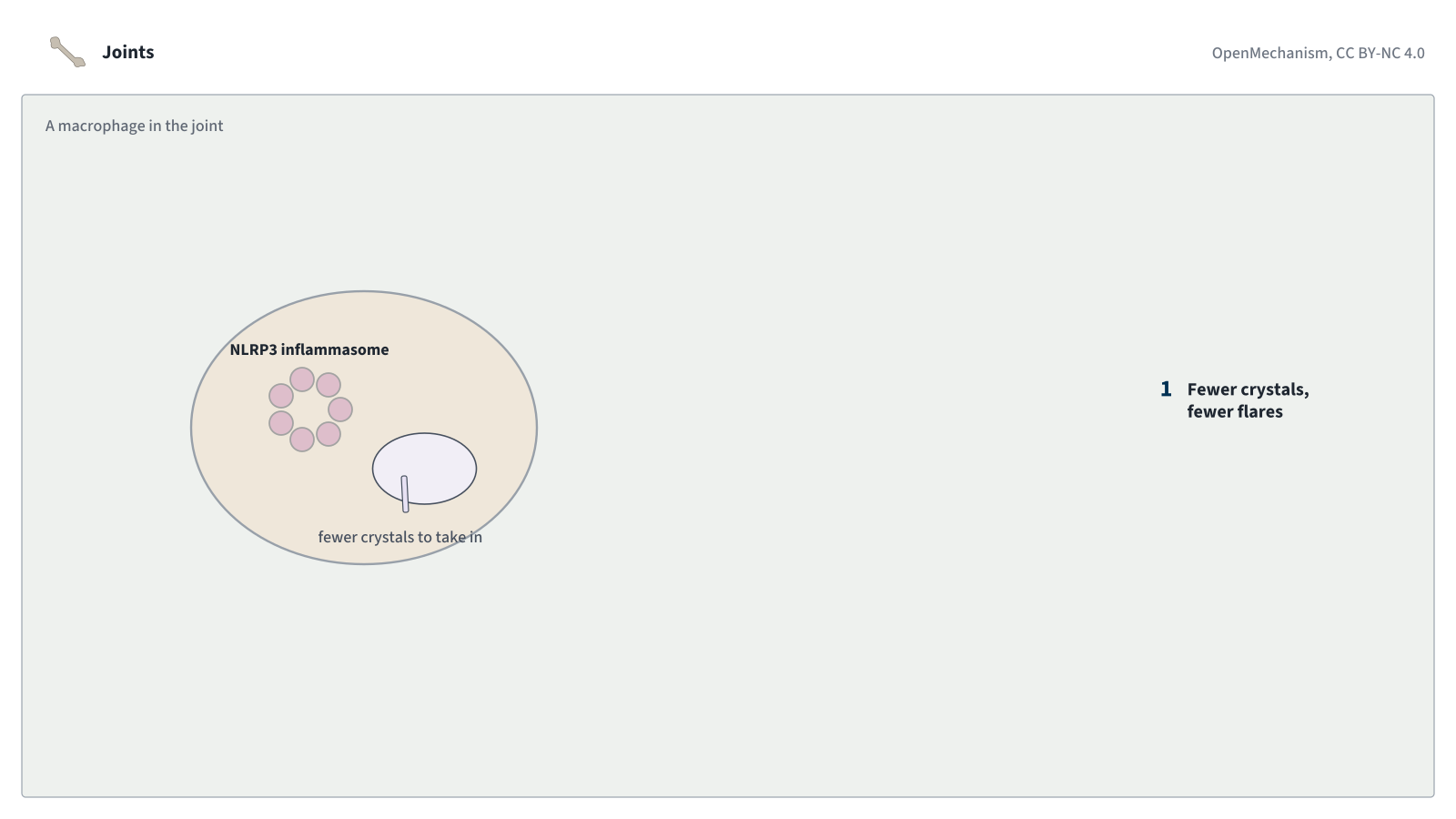
A macrophage in the joint, with allopurinol

Drawing: A macrophage in the joint, with allopurinol. 1: Fewer crystals, fewer flares.
Schematic, not to scale. License CC BY-NC 4.0.

For teachers: download this drawing.

  1. Fewer crystals, fewer flares. As allopurinol lowers urate, the crystals dissolve, and flares are prevented.3

    What the source says

    “Long-term urate lowering therapy (eg, allopurinol) leads to the dissolution of monosodium urate crystals, ultimately resulting in the prevention of gout flares and tophi and in improved quality of life.”

    Source 3

More on the medicine: allopurinol.

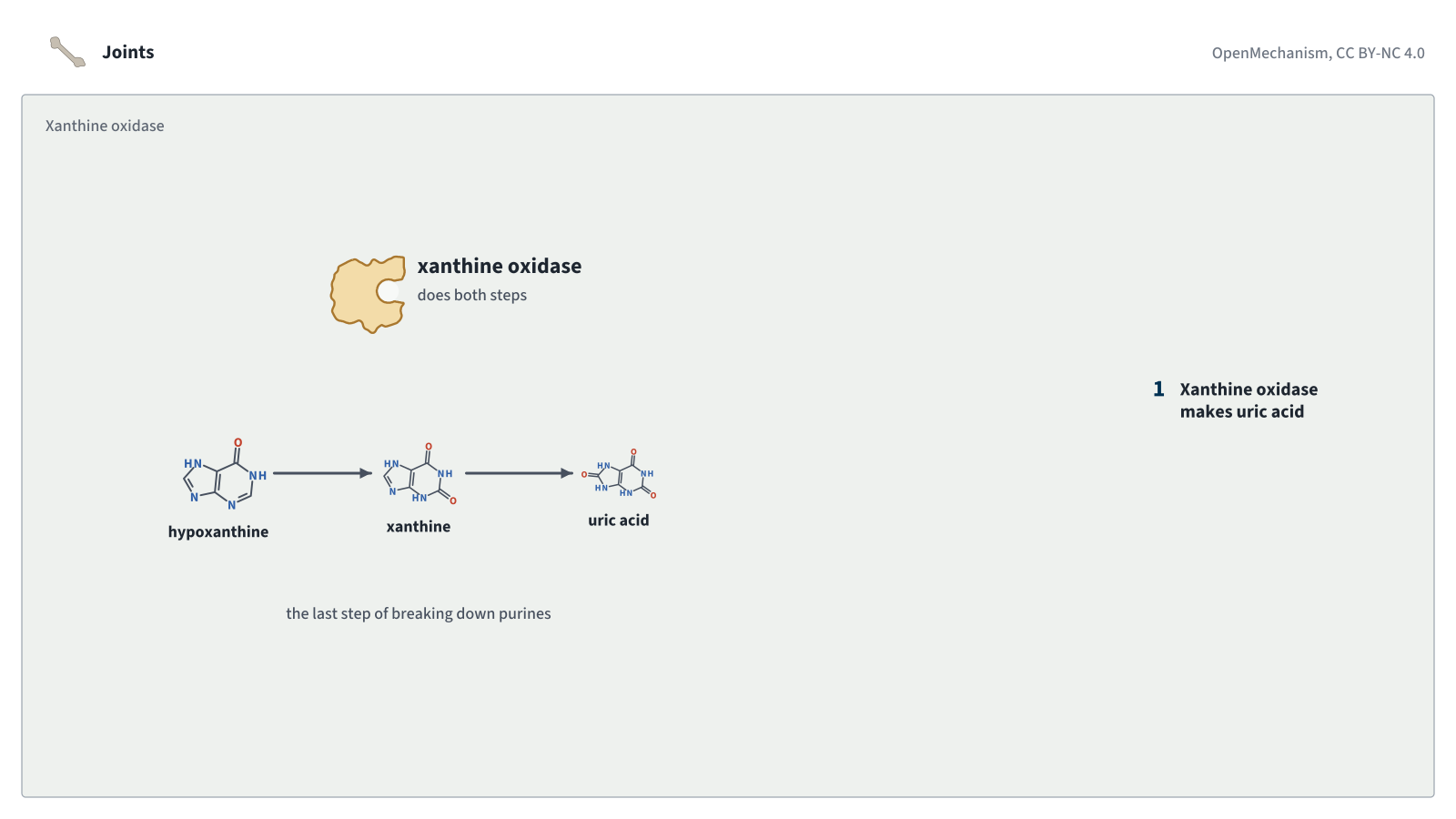
Xanthine oxidase, a calm joint

Drawing: Xanthine oxidase, a calm joint. 1: Xanthine oxidase makes uric acid.
Schematic, not to scale. Xanthine oxidase outline from a bovine structure with oxypurinol, allopurinol's active metabolite. License CC BY-NC 4.0.

For teachers: download this drawing.

  1. Xanthine oxidase makes uric acid. The enzyme xanthine oxidase turns hypoxanthine into xanthine and xanthine into uric acid, the last step of breaking down purines.2

    What the source says

    “It is an inhibitor of xanthine oxidase, the enzyme responsible for the conversion of hypoxanthine to xanthine and of xanthine to uric acid, the end product of purine metabolism in humans.”

    Source 2

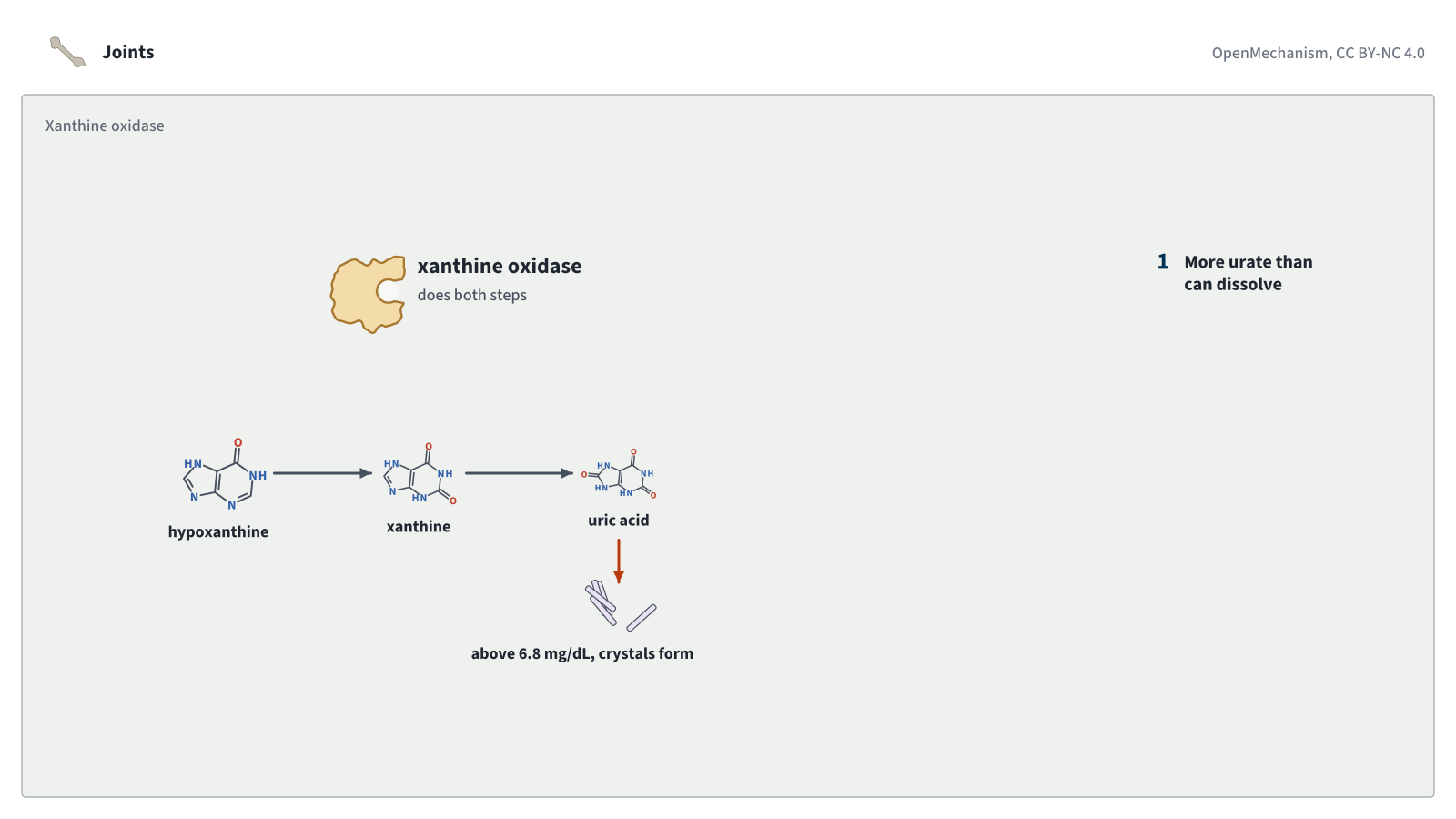
Xanthine oxidase, a gout flare

Drawing: Xanthine oxidase, a gout flare. 1: More urate than can dissolve.
Schematic, not to scale. Xanthine oxidase outline from a bovine structure with oxypurinol, allopurinol's active metabolite. License CC BY-NC 4.0.

For teachers: download this drawing.

  1. More urate than can dissolve. When urate rises above its limit of solubility, it can come out of solution as monosodium urate crystals.5

    What the source says

    “When urate levels exceed the limit of solubility (6.8 mg/dL [400 μmol/L]), MSU crystals may form or grow.”

    Source 5

More on the condition: gout.

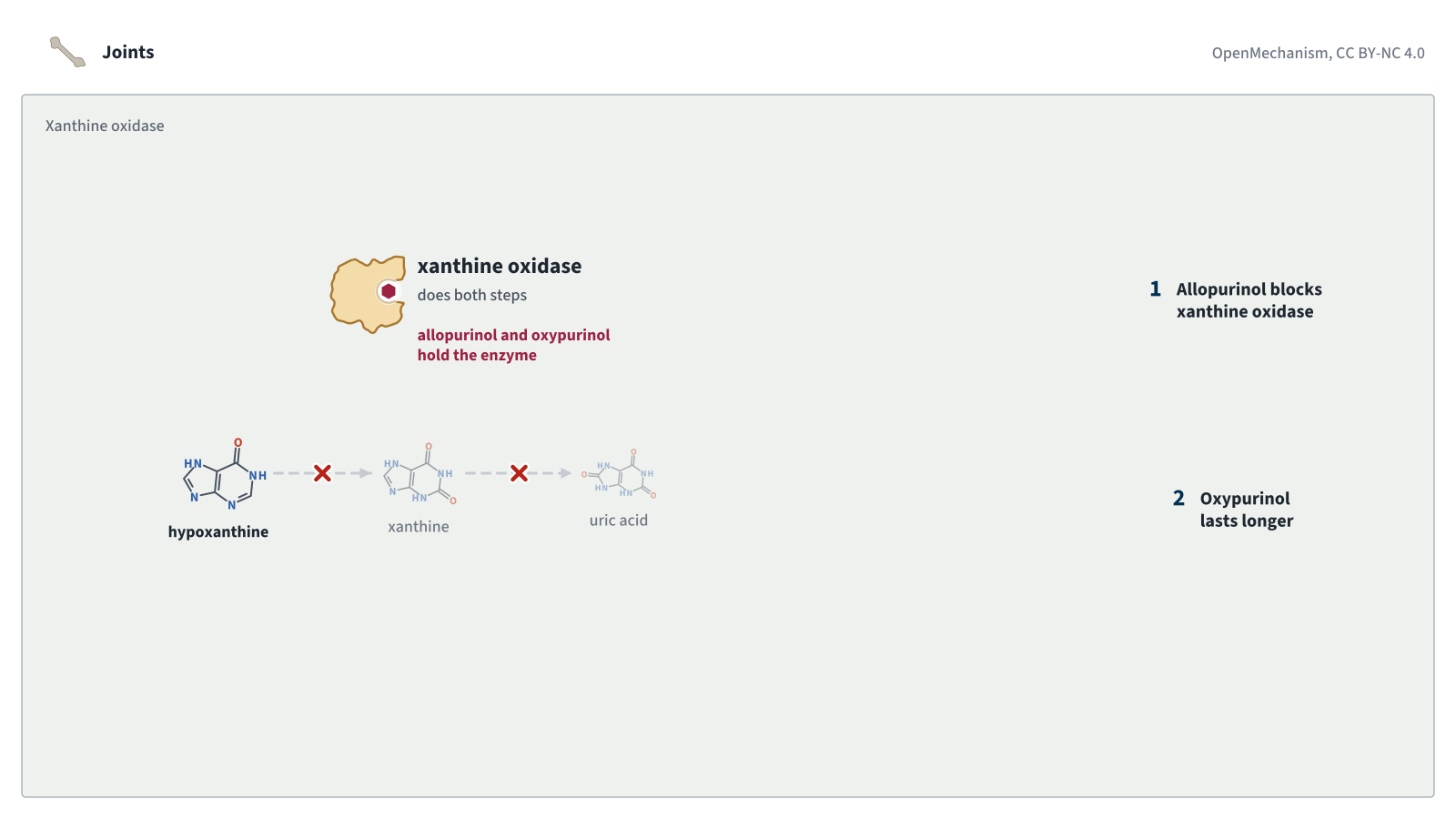
Xanthine oxidase, with allopurinol

Drawing: Xanthine oxidase, with allopurinol. 1: Allopurinol blocks xanthine oxidase. 2: Oxypurinol lasts longer.
Schematic, not to scale. Xanthine oxidase outline from a bovine structure with oxypurinol, allopurinol's active metabolite. License CC BY-NC 4.0.

For teachers: download this drawing.

  1. Allopurinol blocks xanthine oxidase. Allopurinol, built like the purine hypoxanthine, blocks xanthine oxidase, and so does oxypurinol, which the body makes from it.2

    What the source says

    “Allopurinol Tablets (allopurinol) is a structural analogue of the natural purine base, hypoxanthine.”

    Source 2

    “Allopurinol is metabolized to the corresponding xanthine analogue, oxypurinol (alloxanthine), which also is an inhibitor of xanthine oxidase.”

    Source 2
  2. Oxypurinol lasts longer. Allopurinol lasts 1 to 2 hours in the body and oxypurinol about 15 hours; the kidneys remove both.2

    What the source says

    “The half-life of allopurinol and oxipurinol are approximately 1 hour to 2 hours and 15 hours following oral dose of Allopurinol Tablets, respectively.”

    Source 2

    “Allopurinol Tablets and its primary active metabolite, oxipurinol, are eliminated by the kidneys.”

    Source 2

More on the medicine: allopurinol.

Key terms in these drawings

IL-1
Interleukin-1. A signaling molecule (cytokine) that drives inflammation.
NLRP3
NLRP3 gene (cryopyrin). The gene for cryopyrin, which forms inflammasomes: protein complexes inside cells that release IL-1β.

See also

Body system: muscles, bones & joints.

Condition: gout.

Medicine: allopurinol.

Sources

  1. 1
    Synovial jointsOpenStax Anatomy and Physiology 2e, section 9.4 (CC BY-NC-SA 4.0). Saved copy
  2. 2
    Allopurinol tablets: FDA label12.1 Mechanism of Action; 12.3 Pharmacokinetics. Saved copy
  3. 3
    GoutDalbeth N et al. Lancet 2021 (abstract). Saved copy
  4. 4
    Diagnosis, treatment, and prevention of goutHainer BL et al. Am Fam Physician 2014 (abstract). Saved copy
  5. 5
    GoutFitzGerald JD. Ann Intern Med 2025 (abstract). Saved copy
  6. 6
    Gout treatment: should we aim for rapid crystal dissolution?Pascual E et al. Ann Rheum Dis 2013 (abstract). Saved copy
  7. 7
    Allopurinol tablets: FDA label5.2 Gout Flares. Saved copy
  8. 8
    Gout-associated uric acid crystals activate the NALP3 inflammasomeMartinon F et al. Nature 2006 (abstract). Saved copy
  9. 9
    Bovine milk xanthine dehydrogenase with oxipurinol boundPDB 3BDJ; Okamoto, K. et al. Nucleosides Nucleotides Nucleic Acids 2008;27:888-893. The xanthine oxidase outline in the drawings is traced from this structure. Saved copy
Notes and limits
  • The label's advice on starting doses and on preventing flares at the start of treatment is left out: this page explains the mechanism, not what to do.
  • Some of the cell-level findings come from mice: macrophages without parts of the inflammasome did not activate IL-1 beta in response to crystals.8
  • The drawings are schematic and not to scale; each shows only what the statements under it say.

Spotted a mistake? Report an error (hello@openmechanism.com). Since launch, every published error we fix is listed on the corrections page.

Cite this page

Tran D. Urate crystals in a joint [Internet]. OpenMechanism; 2026 [updated 2026 Nov 13; cited 2026 Nov 13]. Available from: https://openmechanism.com/body/scales/joint