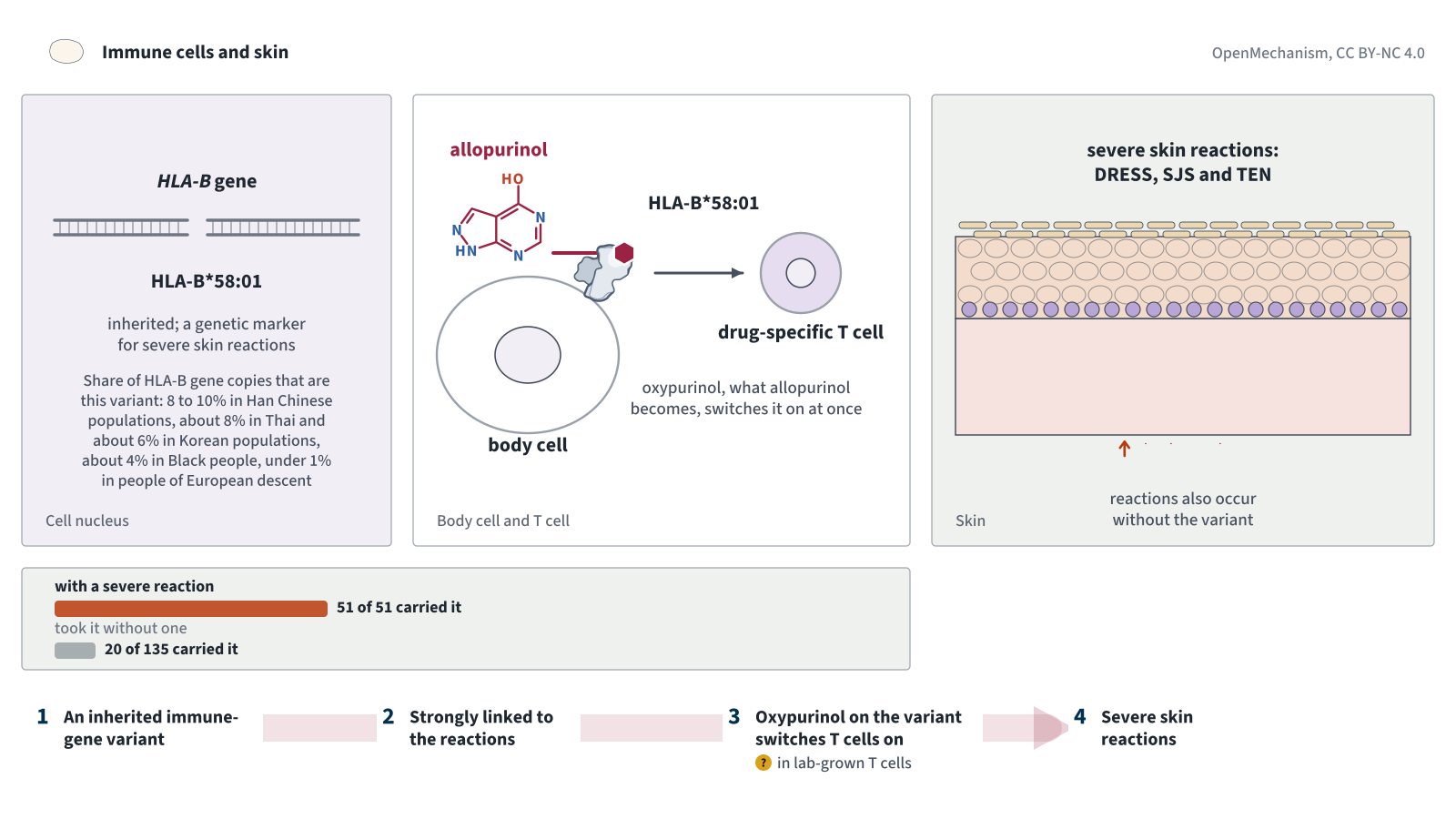
HLA-B*58:01, a variant of the immune gene HLA-B, is a genetic marker for severe skin reactions to allopurinol: DRESS, and SJS and TEN. In a Han Chinese case-control study it was carried by all 51 people who had such a reaction, against 20 of 135 who took allopurinol without one. In T cells grown in the laboratory, oxypurinol, what allopurinol becomes, bound to HLA-B*58:01 switched drug-specific T cells on directly. The variant is more common in some populations, and reactions can occur in people without it.
Schematic, not to scale. HLA-B*58:01 outline from the structure presenting a peptide. License CC BY-NC 4.0.
?Step 3: in lab-grown T cells
Yun and colleagues' 2014 laboratory study, in T cell lines from donors with and without HLA-B*58:01, says: We conclude that the drug-specific T cells are activated by OXP bound to HLA-B*58:01 through the p-i mechanism.
Clinical study: In Ko and colleagues' 2015 national cohort in Taiwan, 2,910 Han Chinese people were tested for HLA-B*58:01 before allopurinol: the 571 who carried it were advised to avoid it, and the 2,339 who did not were given it and followed for two months. The study counted severe skin reactions against the seven cases expected from Taiwan's earlier national rate, with no untested group, and not how they arise: SCARs did not develop in any of the participants receiving allopurinol who screened negative for HLA-B*58:01.Ko TM et al., BMJ 2015 (PMID 26399967) The allopurinol label adds that SJS and TEN can still occur in people who test negative.
An inherited immune-gene variant. *58:01 is a variant of HLA-B, one of the three human I genes, and a genetic marker for severe skin reactions to allopurinol. The variant makes up 8 to 10% of HLA-B gene copies in Han Chinese populations, about 8% in Thai and about 6% in Korean populations, about 4% in Black people and under 1% in people of European descent.1,2
What the source says
“Genetic variability across the three major histocompatibility complex (MHC) class I genes (human leukocyte antigen [HLA] A, B, and C) may affect susceptibility to many diseases such as cancer, auto-immune or infectious diseases.”
“The HLA-B*5801 allele is a genetic marker that has shown to be associated with risk of developing Allopurinol Tablets related hypersensitivity syndrome (DRESS) and SJS/TEN.”
“The frequency of the HLA- B*58:01 allele ranges from 8 to 10% in Han Chinese populations, about 8% in Thai populations, and about 6% in Korean populations based upon published literature and available databases.”
“The frequency of the HLA-B*58:01 allele is about 4% in Blacks, about 1 % to 2 % in indigenous peoples of the Americas and Hispanic populations, and < 1% in people from European descent and Japanese.”
Strongly linked to the reactions. In a case-control study in Han Chinese people, all 51 who had a severe skin reaction to allopurinol carried HLA-B*58:01, against 20 of 135 (15%) who took it without one.3
What the source says
“To identify genetic markers for allopurinol-SCAR, we carried out a case-control association study.”
Oxypurinol on the variant switches T cells on. Allopurinol becomes oxypurinol. In grown in the laboratory from donors, oxypurinol bound to HLA-B*58:01 switched drug-specific T cells on at once, without the usual processing inside cells.2,4
What the source says
“Allopurinol is metabolized to the corresponding xanthine analogue, oxypurinol (alloxanthine), which also is an inhibitor of xanthine oxidase.”
Severe skin reactions. The label calls these skin reactions serious and sometimes fatal. Carriers are at higher risk of allopurinol hypersensitivity syndrome (DRESS), though reactions, and among them, can occur in people without the variant.2
What the source says
“Serious and sometimes fatal dermatologic reactions, including toxic epidermal necrolysis (TEN), Stevens-Johnson syndrome (SJS), and drug reaction with eosinophilia and systemic symptoms (DRESS) have been reported in patients taking allopurinol”
“Patients who carry the HLA-B*58:01 allele are at a higher risk of allopurinol hypersensitivity syndrome (AHS), but hypersensitivity reactions have been reported in patients who do not carry this allele.”
“The HLA-B*5801 allele is a genetic marker that has shown to be associated with risk of developing Allopurinol Tablets related hypersensitivity syndrome (DRESS) and SJS/TEN.”
“Stevens-Johnson syndrome (SJS)/Toxic epidermal necrolysis (TEN) can still occur in patients who are found to be negative for HLA-B*5801 irrespective of ethnic origin.”
The label's advice on screening and stopping is left out: this page explains the mechanism, not what to do.
The immune mechanism behind these reactions is poorly understood; in the laboratory, T cells were switched on directly whether or not their donor carried the variant.4
text e7b8c33cf367…; drawings 02d99e6b1dc9…; notes 9feadef56b99…
AI source check
Claude Opus 5.5 (AI source check), 13 November 2026: 30 statements compared with their sources, 6 flagged for the reviewer. An automated check, not a medical review.
Next review due
14 May 2028
Cite this page
Tran D. Allopurinol and the HLA-B*58:01 variant [Internet]. OpenMechanism; 2026 [updated 2026 Nov 13; cited 2026 Nov 13]. Available from: https://openmechanism.com/explained/allopurinol-and-hla-b-5801