Medically reviewed by Daniel Tran, PharmD, on 13 November 2026.
Allopurinol and mercaptopurine
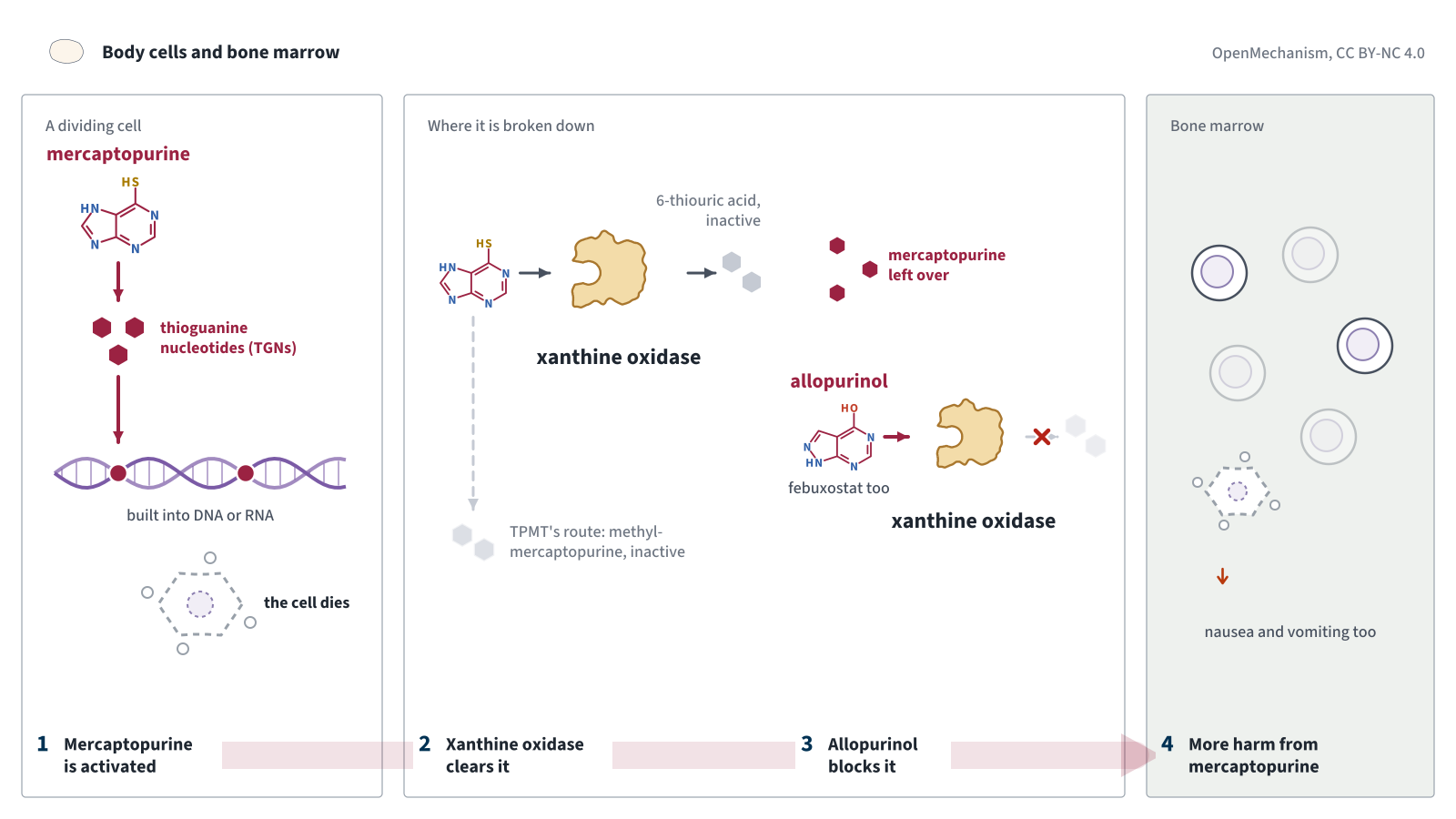
Inside cells mercaptopurine is turned into thioguanine nucleotides; built into DNA or RNA, they stop the cell cycle and kill the cell. The body inactivates mercaptopurine by two main routes: TPMT methylates it, and xanthine oxidase oxidizes it to 6-thiouric acid. Allopurinol blocks xanthine oxidase and can hold back the breakdown of mercaptopurine on its first pass, which can raise the risk of mercaptopurine's adverse reactions: bone marrow suppression, nausea and vomiting. Febuxostat, another xanthine oxidase blocker, could raise mercaptopurine levels enough to cause severe toxicity.
- Kind
- Interaction
- Medicines
- Allopurinol, Mercaptopurine
- Sources
- 5
For teachers: download this drawing.
Step by step
Mercaptopurine is activated. Inside cells mercaptopurine, a purine analog, is turned into metabolites including thioguanine nucleotides (TGNs); built into or , they stop the cell cycle and kill the cell.1
Xanthine oxidase clears it. The body inactivates mercaptopurine by two main routes: TPMT methylates it to methyl-mercaptopurine, and xanthine oxidase oxidizes it to 6-thiouric acid.1
What the source says
“Mercaptopurine is inactivated via two major pathways.”
Source 1“One is thiol methylation, which is catalyzed by the polymorphic enzyme thiopurine S-methyltransferase (TPMT), to form the inactive metabolite methyl-mercaptopurine.”
Source 1“The second inactivation pathway is oxidation, which is catalyzed by xanthine oxidase.”
Source 1“The product of oxidation is the inactive metabolite 6-thiouric acid.”
Source 1Allopurinol blocks it. Allopurinol, and oxypurinol that it becomes, block xanthine oxidase, the enzyme that makes uric acid, so allopurinol can hold back the breakdown of mercaptopurine on its first pass.1,2
What the source says
“It is an inhibitor of xanthine oxidase, the enzyme responsible for the conversion of hypoxanthine to xanthine and of xanthine to uric acid, the end product of purine metabolism in humans.”
Source 2“Allopurinol is metabolized to the corresponding xanthine analogue, oxypurinol (alloxanthine), which also is an inhibitor of xanthine oxidase.”
Source 2“Allopurinol can inhibit the first-pass oxidative metabolism of mercaptopurine by xanthine oxidase”
Source 1More harm from mercaptopurine. This can raise the risk of mercaptopurine's adverse reactions: bone marrow suppression, nausea and vomiting. Febuxostat, another xanthine oxidase blocker, could raise mercaptopurine levels enough to cause severe toxicity.1,3
What the source says
“which can lead to an increased risk of mercaptopurine adverse reactions (i.e., myelosuppression, nausea, and vomiting)”
Source 1“Concomitant administration of ULORIC with XO substrate drugs, azathioprine or mercaptopurine could increase plasma concentrations of these drugs resulting in severe toxicity.”
Source 3“ULORIC is an XO inhibitor.”
Source 3
See also
Medicine pages: allopurinol and mercaptopurine.
Related medicines: febuxostat.
Other interactions (muscles, bones & joints): colchicine with clarithromycin; probenecid and penicillin; tizanidine with ciprofloxacin or fluvoxamine; and all 40 interactions.
Conditions: gout and acute lymphoblastic leukemia.
The medicine in the body: allopurinol and the HLA-B*58:01 variant; and mercaptopurine and the TPMT and NUDT15 genes.
Sources
- 1Mercaptopurine tablets: FDA label7.1 Allopurinol; 12.1 Mechanism of Action; 12.3 Pharmacokinetics; 12.5 Pharmacogenomics. Saved copy
- 2Allopurinol tablets: FDA label12.1 Mechanism of Action. Saved copy
- 3Uloric (febuxostat): FDA label7 Drug Interactions. Saved copy
- 4Bovine milk xanthine dehydrogenase with oxipurinol boundPDB 3BDJ; Okamoto, K. et al. Nucleosides Nucleotides Nucleic Acids 2008;27:888-893. The xanthine oxidase outline in the drawing is traced from this structure. Saved copy
- 5Crystal structures of bovine milk xanthine dehydrogenase and xanthine oxidase: structure-based mechanism of conversionEnroth C et al. Proc Natl Acad Sci U S A 2000 (abstract). Also used for the drawing: the structure the xanthine oxidase outline is traced from is the enzyme's dehydrogenase form, and this paper says mammals make the enzyme, xanthine oxidoreductase, as xanthine dehydrogenase, which can be converted to the oxidase form, xanthine oxidase. Saved copy
Notes and limits
- The labels' dose changes are left out: this page explains the mechanism, not what to do.
- Published studies indicate that people whose TPMT or NUDT15 works less well build up active TGNs on usual doses and are at higher risk of severe bone marrow suppression.1
- Azathioprine, which has no page here yet, is affected too: with febuxostat, exposure to 6-mercaptopurine rose. The Uloric label says interaction studies with mercaptopurine itself have not been done.3
- The mercaptopurine label says it is not known which of the effects of mercaptopurine and its metabolites are directly or mainly responsible for cell death.1
Notes that apply to every page are on How to read a page.
Spotted a mistake? Report an error (hello@openmechanism.com). Since launch, every published error we fix is listed on the corrections page.
Medical review
Cite this page
Tran D. Allopurinol and mercaptopurine [Internet]. OpenMechanism; 2026 [updated 2026 Nov 13; cited 2026 Nov 13]. Available from: https://openmechanism.com/explained/allopurinol-and-mercaptopurine