Colchicine with clarithromycin
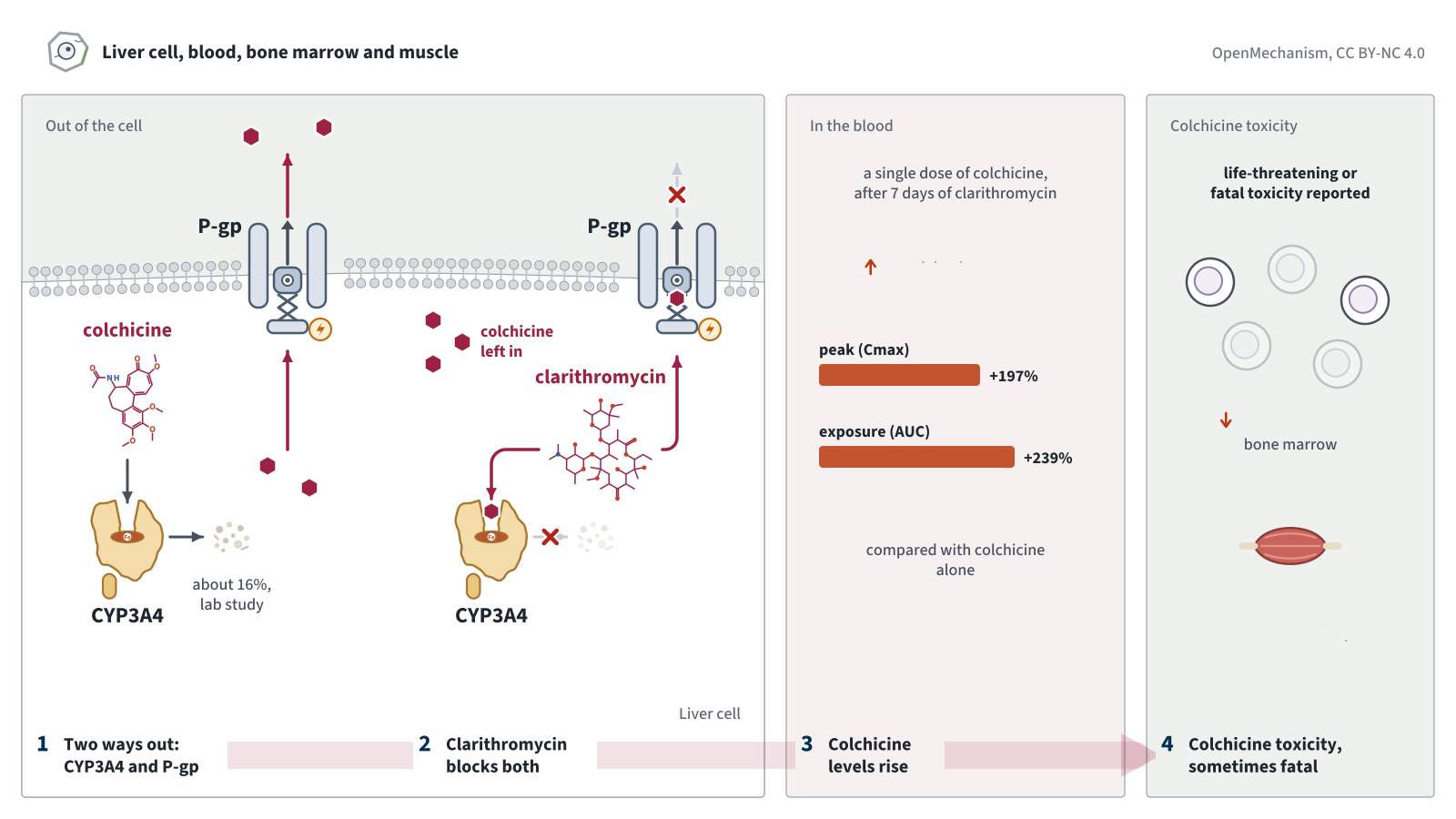
Colchicine is handled by the enzyme CYP3A4, which breaks some of it down, and by P-glycoprotein (P-gp), a pump that carries it out of cells. Clarithromycin blocks both. In a study, colchicine's peak level rose 197% and its exposure 239%, and life-threatening or fatal colchicine toxicity has been reported with the pair.
- Kind
- Interaction
- Medicines
- Colchicine
- Sources
- 4
For teachers: download this drawing.
Step by step
Two ways out: CYP3A4 and P-gp. Colchicine is handled by the enzyme and by P-glycoprotein (P-gp), a pump that carries it out of cells. In a laboratory study of human liver microsomes, CYP3A4 broke down about 16% of it; in healthy volunteers, 40 to 65% of a dose left unchanged in the urine, and P-gp's pumping is thought to play an important part.1,2
What the source says
“Colchicine is a substrate of the efflux transporter P-glycoprotein (P-gp), and the CYP3A4 metabolizing enzyme.”
Source 1“A published in vitro human liver microsome study showed that about 16% of colchicine is metabolized to 2-O-demethylcolchicine and 3-O-demethylcolchicine (2- and 3-DMC, respectively) by CYP3A4.”
Source 2“In a published study in healthy volunteers, 40 to 65% of the total absorbed dose of colchicine (1 mg administered orally) was recovered unchanged in urine.”
Source 2“Colchicine is a substrate of P-gp and P-gp efflux is postulated to play an important role in colchicine disposition.”
Source 2Clarithromycin blocks both. Clarithromycin is a strong CYP3A4 inhibitor and also blocks P-gp: the colchicine label calls it a dual inhibitor. The interaction may occur with both medicines at their usual doses.1,3
What the source says
“Fatal drug interactions have been reported when colchicine is administered with clarithromycin, a dual inhibitor of CYP3A4 and P-glycoprotein.”
Source 1“Clarithromycin and other macrolides are known to inhibit CYP3A and Pgp.”
Source 3“Clarithromycin is a strong CYP3A4 inhibitor and this interaction may occur while using both drugs at their recommended doses.”
Source 3Colchicine levels rise. Given with clarithromycin for 7 days, a single dose of colchicine reached a peak 197% higher, with an exposure () 239% higher, than colchicine alone.3
What the source says
“When a single dose of colchicine 0.6 mg was administered with clarithromycin 250 mg BID for 7 days, the colchicine C max increased 197% and the AUC 0-∞ increased 239% compared to administration of colchicine alone.”
Source 3Colchicine toxicity, sometimes fatal. Blocking both routes has been reported to cause life-threatening or fatal colchicine toxicity. Colchicine itself, even at usual doses, can harm the bone marrow, with fewer blood cells, and the muscles, up to . The clarithromycin label rules out the pair in people with kidney or liver impairment.1,3
What the source says
“Inhibition of both CYP3A4 and P-gp by dual inhibitors such as clarithromycin has been reported to produce life-threatening or fatal colchicine toxicity due to significant increases in systemic colchicine levels.”
Source 1“Myelosuppression, leukopenia, granulocytopenia, thrombocytopenia, pancytopenia, and aplastic anemia have been reported with colchicine used in therapeutic doses.”
Source 1“Neuromuscular toxicity and rhabdomyolysis have been reported from chronic treatment with colchicine in therapeutic doses, especially in combination with other drugs known to cause this effect.”
Source 1“Concomitant administration of clarithromycin and colchicine is contraindicated in patients with renal or hepatic impairment”
Source 3
See also
Medicine pages: colchicine.
Also part of this interaction: verapamil (“Toxicities have also been reported when colchicine is administered with inhibitors of CYP3A4 that may not be potent inhibitors of P-gp (e.g., grapefruit juice, erythromycin, verapamil), or inhibitors of P-gp that may not be potent inhibitors of CYP3A4 (e.g., cyclosporine).”1); and cyclosporine (“Toxicities have also been reported when colchicine is administered with inhibitors of CYP3A4 that may not be potent inhibitors of P-gp (e.g., grapefruit juice, erythromycin, verapamil), or inhibitors of P-gp that may not be potent inhibitors of CYP3A4 (e.g., cyclosporine).”1).
Other interactions (muscles, bones & joints): allopurinol and mercaptopurine; probenecid and penicillin; tizanidine with ciprofloxacin or fluvoxamine; and all 40 interactions.
Conditions: gout.
Sources
- 1Mitigare (colchicine) capsules: FDA label5 Warnings and Precautions; 7 Drug Interactions. Saved copy
- 2Mitigare (colchicine) capsules: FDA label12.3 Pharmacokinetics. Saved copy
- 3Clarithromycin tablets: FDA label5.4 Serious Adverse Reactions Due to Concomitant Use with Other Drugs; 7 Drug Interactions; 12.3 Pharmacokinetics. Saved copy
- 4Human CYP3A4 with ritonavirPDB 3NXU; Sevrioukova, I.F., Poulos, T.L. Proc.Natl.Acad.Sci.USA 2010;107:18422-18427. The CYP3A4 outline in the drawing is traced from this structure. Saved copy
Notes and limits
- CYP3A4 blockers that leave P-gp alone raised colchicine by up to 40% in studies; the label says blocking P-gp as well may be needed for a clinically meaningful interaction, though it cannot rule one out without it.2
Notes that apply to every page are on How to read a page.
Spotted a mistake? Report an error (hello@openmechanism.com). Since launch, every published error we fix is listed on the corrections page.
Cite this page
Tran D. Colchicine with clarithromycin [Internet]. OpenMechanism; 2026 [updated 2026 Nov 18; cited 2026 Nov 18]. Available from: https://openmechanism.com/explained/colchicine-and-clarithromycin