Allopurinol
Xanthine oxidase makes uric acid from hypoxanthine and xanthine. Allopurinol, and its active metabolite oxypurinol, block this enzyme, so less uric acid is produced. Its label lists it for adults with the signs and symptoms of gout; for adults and children with leukemia, lymphoma or solid tumors whose cancer treatment raises uric acid in the blood and urine; and for adults with calcium oxalate stones that keep coming back, who excrete more than 800 mg (men) or 750 mg (women) of uric acid a day despite lifestyle changes.
- Acts on
- Xanthine oxidase
- Where
- Purine breakdown in the body
- Medicine type
- Small molecule
- Used for
- Muscles, bones & joints
- Drug class
- Xanthine oxidase inhibitors, Gout medicines
How it works
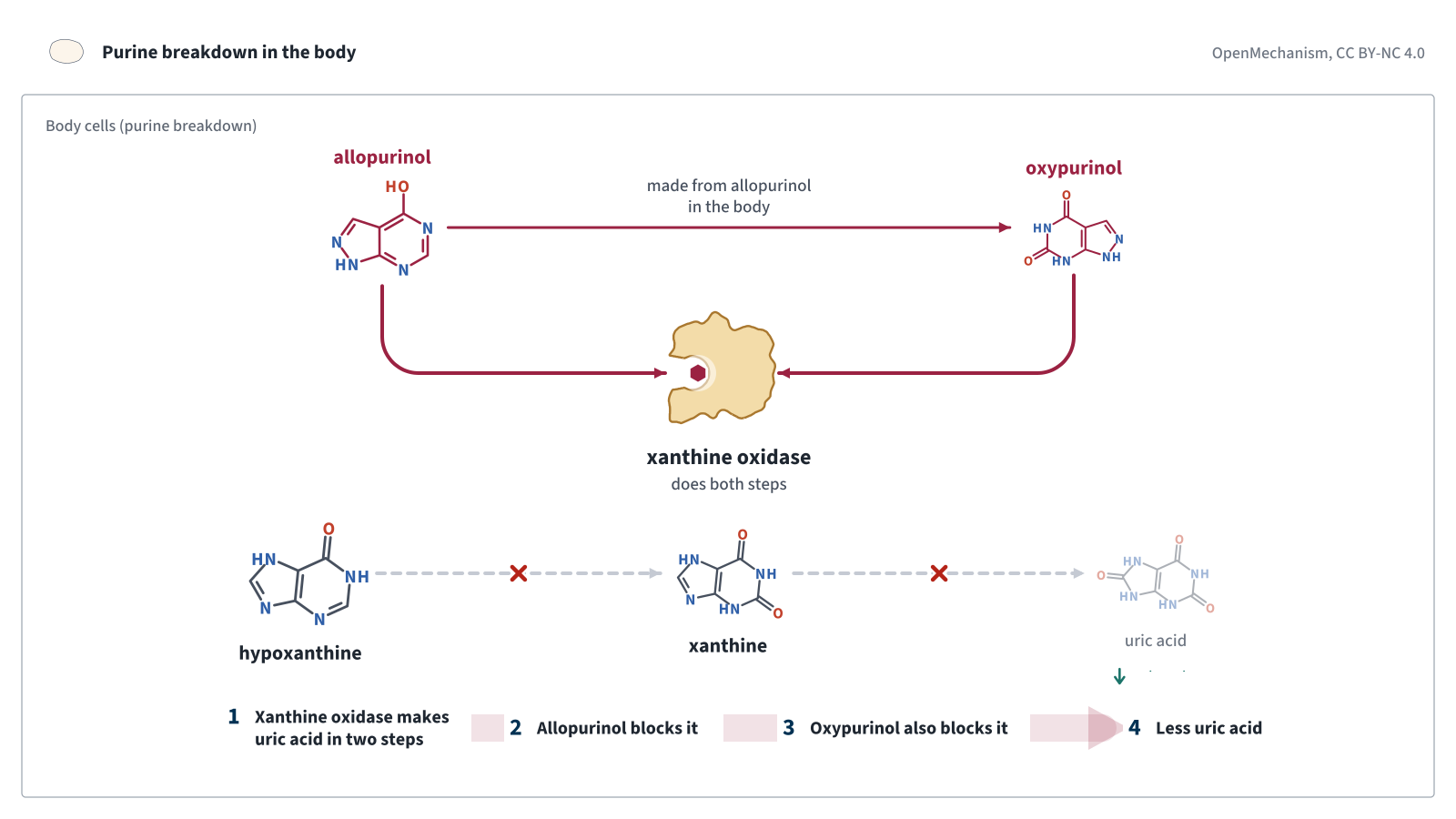
Xanthine oxidase makes uric acid in two steps. Xanthine oxidase normally converts hypoxanthine to xanthine and xanthine to uric acid, the end product of purine metabolism in humans.1
Allopurinol blocks it. Allopurinol inhibits these reactions immediately preceding uric-acid formation.1
Oxypurinol also blocks it. Its metabolite oxypurinol also inhibits xanthine oxidase, and the label says allopurinol's action is generally believed to come through oxypurinol.1
Less uric acid. Inhibiting xanthine oxidase lowers production of uric acid.1
For teachers: download this drawing or build a slide deck.
See also
Condition pages: gout and tumor lysis syndrome.
Other xanthine oxidase inhibitors: febuxostat.
Other gout medicines: colchicine and probenecid.
Explained: allopurinol and the HLA-B*58:01 variant; and allopurinol and mercaptopurine.
Related drawings: probenecid (lowers uric acid by having the kidneys excrete more of it).
Body system: muscles, bones & joints.
Inside the body: urate crystals in a joint.
Sources
- 1Allopurinol tablets: FDA label1 Indications and Usage; 12.1 Mechanism of Action; 12.2 Pharmacodynamics
- 2ChEMBL CHEMBL1467Target and action classification: Xanthine dehydrogenase inhibitor
Also used for the drawing
The drawing uses the label's name, xanthine oxidase; the structure below is the enzyme's dehydrogenase form. The 2000 paper below says mammals make the enzyme, xanthine oxidoreductase, as xanthine dehydrogenase, which can be converted to the oxidase form, xanthine oxidase. The xanthine oxidase outline is traced from the crystal structure below.
- 3Bovine milk xanthine dehydrogenase with oxipurinol boundPDB 3BDJ; Okamoto, K. et al. Nucleosides Nucleotides Nucleic Acids 2008; 27:888-893
- 4Crystal structures of bovine milk xanthine dehydrogenase and xanthine oxidase: structure-based mechanism of conversionEnroth C et al. Proc Natl Acad Sci U S A 2000 (abstract)
Spotted a mistake? Report an error (hello@openmechanism.com). Since launch, every published error we fix is listed on the corrections page.
Notes and limits
- A schematic teaching drawing: not to scale, not exact structures, binding poses or a complete pathway, and not a guide to dosing, treatment or how a person will respond.
- The steps are in the order that explains them; one step is said to cause the next only where the source says so.
- Allopurinol and oxypurinol are different molecules; the drawing does not compare how strongly each one inhibits the enzyme.
All recorded limits are on the evidence page, and notes that apply to every page are on How to read a page. Version 1.0.1, medically reviewed by Daniel Tran, PharmD, on 13 November 2026.
Cite this page
Tran D. Allopurinol [Internet]. OpenMechanism; 2026 [updated 2026 Nov 13; cited 2026 Nov 13]. Available from: https://openmechanism.com/medicines/allopurinol