Probenecid and penicillin
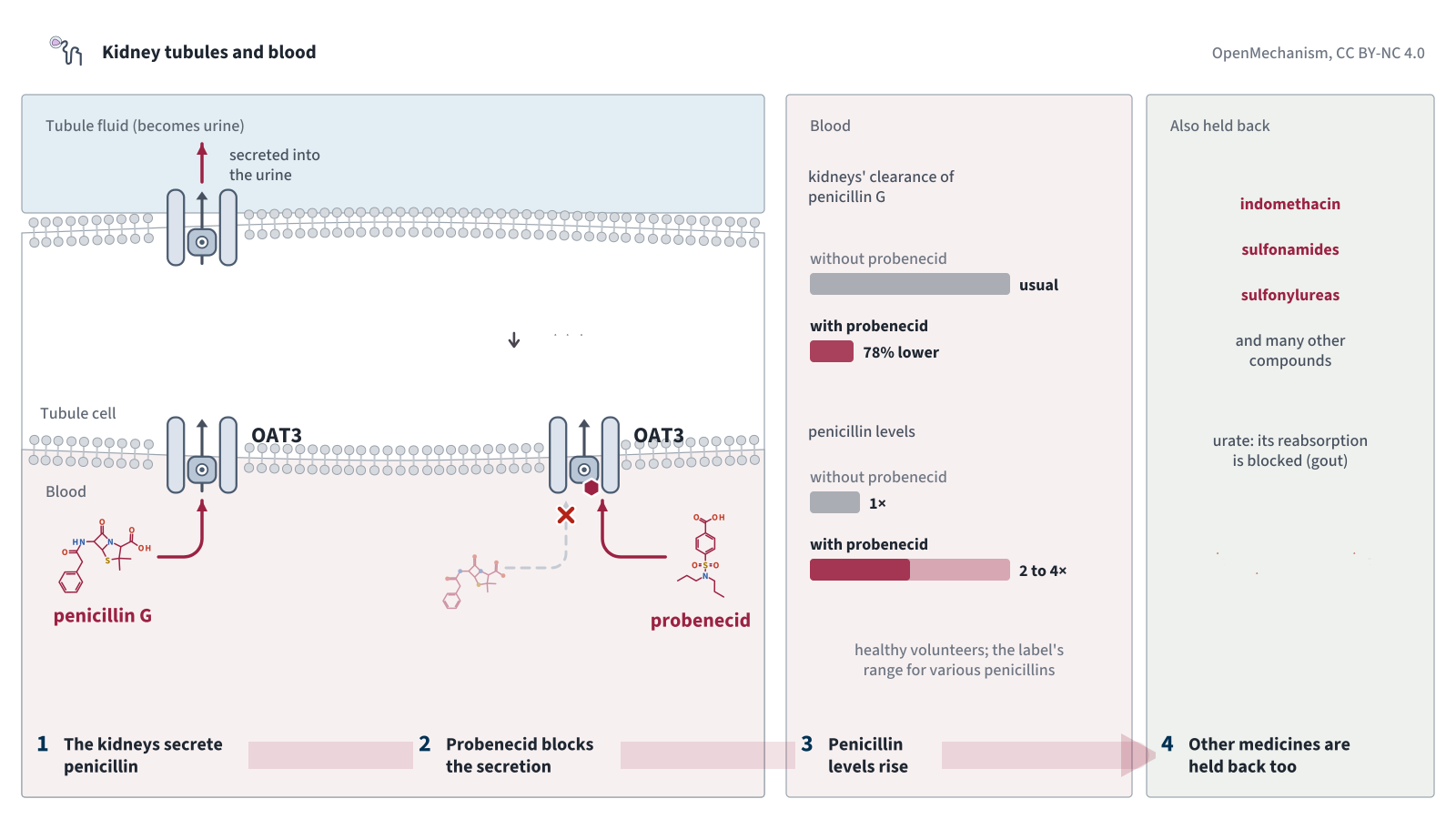
The kidneys clear penicillin quickly, mostly by actively secreting it into the urine. Probenecid blocks that secretion, so penicillin stays in the blood longer and its levels rise two- to four-fold; this is one of probenecid's uses. In healthy people, probenecid cut the kidneys' clearance of penicillin G by 78%.
- Kind
- Interaction
- Medicines
- Probenecid, Penicillin G
- Sources
- 5
For teachers: download this drawing.
Step by step
The kidneys secrete penicillin. Penicillins leave the body quickly in the urine, mostly unchanged, by filtration and by active secretion from the kidney tubules; for penicillin G, secretion is the larger route.1
What the source says
“Penicillins are rapidly excreted in the urine by glomerular filtration and active tubular secretion, primarily as unchanged drug.”
Source 1“The renal clearance, which is extremely rapid, is the result of glomerular filtration and active tubular transport, with the latter route predominating.”
Source 1Probenecid blocks the secretion. Probenecid is a renal tubular blocking agent: it blocks the tubular secretion of penicillin. In human kidney tissue it blocked the uptake of benzylpenicillin (penicillin G), which researchers use to test the transporter OAT3.1,2,3,4
What the source says
“Probenecid is a uricosuric and renal tubular blocking agent.”
Source 2“Probenecid blocks the renal tubular secretion of penicillin.”
Source 1“adefovir and benzylpenicillin were selected as organic anion transporter (OAT) 1- and OAT3-selective probe substrates, respectively.”
Source 3“In human kidney slices, probenecid potently inhibited the uptake of both adefovir and benzylpenicillin”
Source 3“benzylpenicillin (penicillin G)”
Source 4Penicillin levels rise. So penicillin leaves more slowly and its levels rise, two- to four-fold for various penicillins, by any route it is given; probenecid is used for this on purpose. In healthy people, the highest dose of probenecid tested (1,500 mg) cut the kidneys' clearance of penicillin G by 78%.1,2,3
What the source says
“Therefore, the concurrent administration of probenecid prolongs the elimination of penicillin G and, consequently, increases serum concentrations.”
Source 1“Probenecid inhibits the tubular secretion of penicillin and usually increases penicillin plasma levels by any route the antibiotic is given.”
Source 2“A 2-fold to 4-fold elevation has been demonstrated for various penicillins.”
Source 2“As an adjuvant to therapy with penicillin or with ampicillin, methicillin, oxacillin, cloxacillin, or nafcillin, for elevation and prolongation of plasma levels by whatever route the antibiotic is given.”
Source 2“renal clearance of benzylpenicillin was reduced by 78% in the subjects treated with the maximum dose of probenecid (1500mg)”
Source 3Other medicines are held back too. Probenecid has also been reported to block the kidneys' handling of many other compounds, among them indomethacin, sulfonamides and sulfonylureas, and it blocks the reabsorption of urate, which is how it treats gout. Higher levels of a second medicine may bring more of its side effects; with penicillin and related antibiotics, psychic disturbances have been reported.2,5
What the source says
“Probenecid has also been reported to inhibit the renal transport of many other compounds including aminohippuric acid (PAH), aminosalicylic acid (PAS), indomethacin, sodium iodomethamate and related iodinated organic acids, 17-ketosteroids, pantothenic acid, phenolsulfonphthalein (PSP), sulfonamides, and sulfonylureas.”
Source 2“It inhibits the tubular reabsorption of urate, thus increasing the urinary excretion of uric acid and decreasing serum urate levels.”
Source 2“Probenecid tablets are indicated for the treatment of the hyperuricemia associated with gout and gouty arthritis.”
Source 2“high plasma concentrations of the other drug may increase the incidence of adverse reactions associated with that drug.”
Source 5“In the case of penicillin or other beta-lactams, psychic disturbances have been reported.”
Source 5
See also
Medicine pages: probenecid and penicillin G.
Other interactions (muscles, bones & joints): allopurinol and mercaptopurine; colchicine with clarithromycin; tizanidine with ciprofloxacin or fluvoxamine; and all 40 interactions.
Conditions: gout.
Sources
- 1Pfizerpen (penicillin G potassium): FDA labelClinical Pharmacology. Saved copy
- 2Probenecid tablets: FDA labelIndications and Usage; Description; Clinical Pharmacology. Saved copy
- 3Inhibitory effects of p-aminohippurate and probenecid on the renal clearance of adefovir and benzylpenicillin as probe drugs for organic anion transporter (OAT) 1 and OAT3 in humansMaeda K et al. Eur J Pharm Sci 2014 (abstract). Saved copy
- 4Clinical pharmacokinetics of antibacterial drugs in neonatesPaap CM et al. Clin Pharmacokinet 1990 (abstract). Saved copy
- 5Probenecid tablets (Rising): FDA labelDrug Interactions. Saved copy
Notes and limits
- The 78% comes from healthy volunteers given the highest of three probenecid doses (500, 750 or 1,500 mg).3
Notes that apply to every page are on How to read a page.
Spotted a mistake? Report an error (hello@openmechanism.com). Since launch, every published error we fix is listed on the corrections page.
Cite this page
Tran D. Probenecid and penicillin [Internet]. OpenMechanism; 2026 [updated 2026 Oct 20; cited 2026 Oct 20]. Available from: https://openmechanism.com/explained/probenecid-and-penicillin